Women practice yoga at a lotus pond in Tiande Lake on the International Yoga Day on June 21, 2017 in Taizhou, Jiangsu Province of China. (Photo by VCG/VCG via Getty Images)
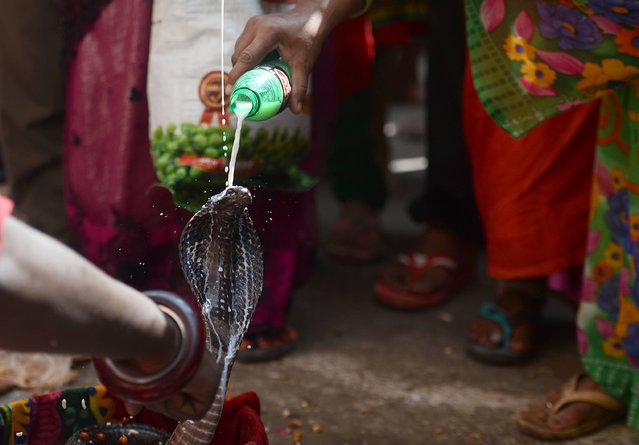
An Indian Hindu devotee pours milk on a snake as an offering during the annual Nag Panchami festival, dedicated to the worship of snakes outside the Nagvasuki temple, in Allahabad, on July 28, 2017. Officially the snake charmers' profession is banned in India, but many in the country offered prayers and milk blessings to cobras and other deadly serpents on July 28 in an annual tribute. The 800,000 charmers and their young apprentices come to the fore for the Nag Panchami festival which dates back several centuries. (Photo by Sanjay Kanojia/AFP Photo)
Artist Le Pustra and organiser Else Edelstahl pose for a picture at Simon Dach Strasse, a street filled with many bars, in Berlin, Germany, August 28, 2016. Else Edelstahl organises the party series “Boheme Sauvage”, in which people dress up in 1920s style, celebrating Berlin nightlife of a past era. (Photo by Hannibal Hanschke/Reuters)
An overcrowded dinghy with migrants from different African countries is followed by members of the German NGO Jugend Rettet as they approach the Iuventa vessel during a rescue operation, off the Libyan coast in the Mediterranean Sea September 21, 2016. (Photo by Zohra Bensemra/Reuters)
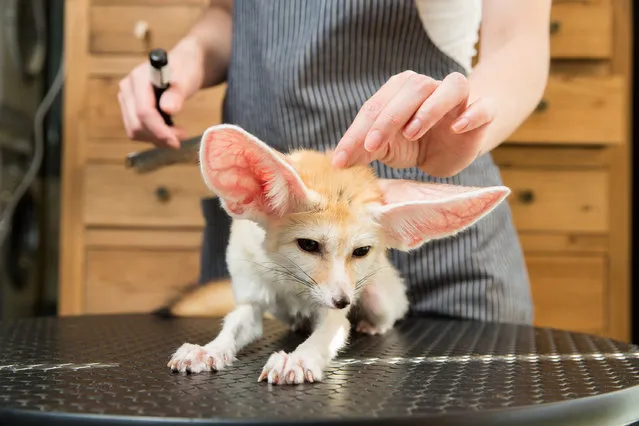
A dramatic rise in owning exotic pets in China is fuelling global demand for threatened species. The growing trade in alligators, snakes, monkeys, crocodiles and spiders is directly linked to species loss in some of the world’s most threatened ecosystems. Here: A fennec fox (Vulpes zerda) is groomed in a pet store in central Beijing. Native to the Sahara in North Africa, the species became a popular pet after being depicted as a character in Disney’s 2016 animated movie Zootopia. Individuals can cost between $2,000–$3,000. (Photo by Sean Gallagher/The Guardian)
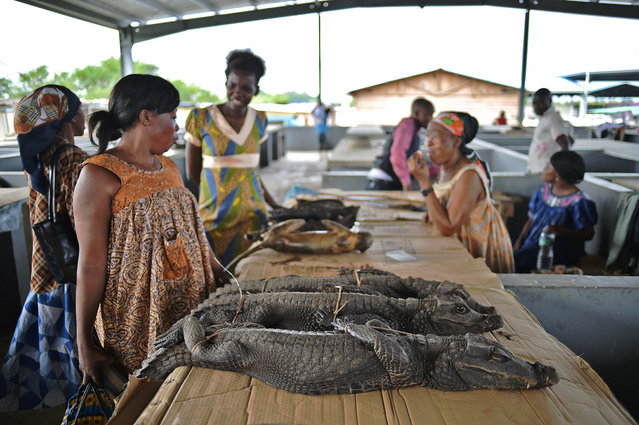
Shoppers walk past crocodiles for sale at a market in Bata on February 3, 2015. Markets in Equatorial Guinea sell a variety of animals including pangolins, monkeys and crocodiles as food. (Photo by Carl de Souza/AFP Photo)
Students of the Krasnoyarsk choreographic college Anastasia Shevtsova (R) and Yulia Lyakhovykh do leg-splits as they study for an exam and a performance by the graduates at the State Theatre of Opera and Ballet, at the college's campus in the Siberian city of Krasnoyarsk, Russia, May 4, 2017. (Photo by Ilya Naymushin/Reuters)