Loading...
Done
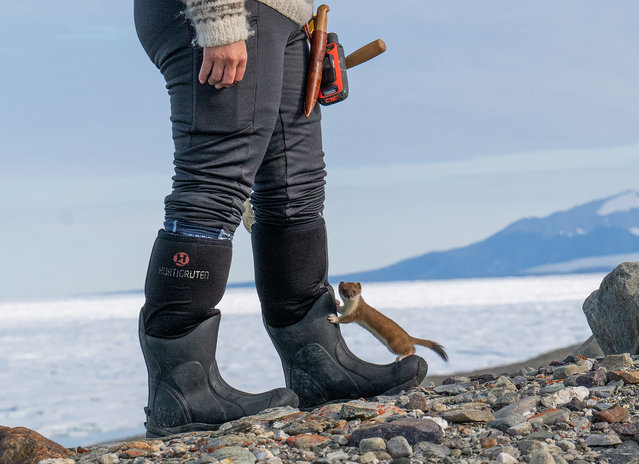
Scientists trekking for days to the undisputed furthest north land point on the planet, in October 2024 were greeted by an unexpected welcoming party: a stoat, whom they named Randall. The team were heading to Kaffeklubben Island, also known as Inuit Qeqertaat, off the northern tip of Greenland, about 440 miles from the North Pole, when Randall emerged from a cairn of rocks, showing no fear as he went to investigate them. (Photo by Jeff Kerby/Magnus News)

Scientists trekking for days to the undisputed furthest north land point on the planet, in October 2024 were greeted by an unexpected welcoming party: a stoat, whom they named Randall. The team were heading to Kaffeklubben Island, also known as Inuit Qeqertaat, off the northern tip of Greenland, about 440 miles from the North Pole, when Randall emerged from a cairn of rocks, showing no fear as he went to investigate them. (Photo by Jeff Kerby/Magnus News)
Details
27 Oct 2024 04:30:00
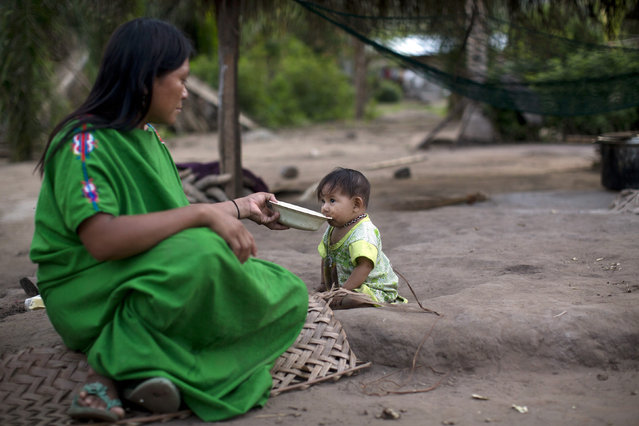
In this November 19, 2015 photo, Ester Melendez feeds banana porridge to her nine-month-old daughter Dina, in Pichiquia, an Ashaninka indigenous community in Peru's Junin region. Incursions and assaults by loggers, miners, colonists and leftist guerrillas have reduced the lands of the Ashaninka people in the Peruvian Amazon, leaving many of the 97,000 members of the group malnourished, despite efforts by the government and independent organizations to help. (Photo by Rodrigo Abd/AP Photo)

In this November 19, 2015 photo, Ester Melendez feeds banana porridge to her nine-month-old daughter Dina, in Pichiquia, an Ashaninka indigenous community in Peru's Junin region. Incursions and assaults by loggers, miners, colonists and leftist guerrillas have reduced the lands of the Ashaninka people in the Peruvian Amazon, leaving many of the 97,000 members of the group malnourished, despite efforts by the government and independent organizations to help. (Photo by Rodrigo Abd/AP Photo)
Details
10 Dec 2015 08:00:00
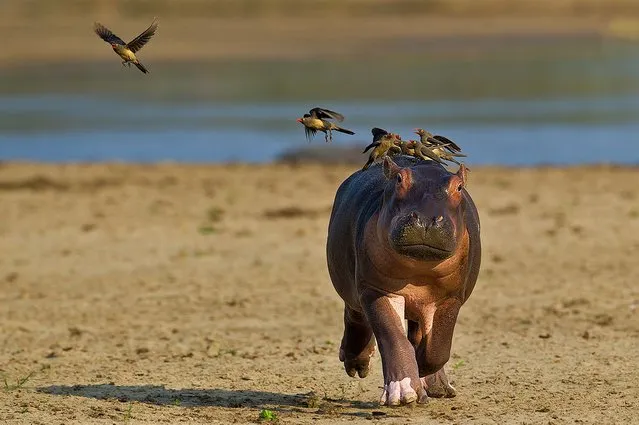
This is the hilarious moment a terrified baby hippo ran screaming for its mum when a flock of bird landed on its back in South Luangwa National Park in Zambia. The hippo was seen screaming, running and twisting from side to side in a desperate bid to shake off the red and yellow ox-pecker birds. (Photo by Marc Mol/Caters News/SIPA Press)

This is the hilarious moment a terrified baby hippo ran screaming for its mum when a flock of bird landed on its back in South Luangwa National Park in Zambia. The hippo was seen screaming, running and twisting from side to side in a desperate bid to shake off the red and yellow ox-pecker birds. Ox-peckers and hippos usually have a mutually beneficial relationship where the birds help free hippos of ticks and other parasites by feeding on them. (Photo by Marc Mol/Caters News/SIPA Press)
Details
16 Jan 2015 13:07:00
A general view shows solar panels to produce renewable energy at the photovoltaic park in Les Mees, in the department of Alpes-de-Haute-Provence, southern France March 31, 2015. The solar farm of the Colle des Mees, the biggest in France, consists of 112,780 solar modules covering an area of 200 hectares of land and representing 100 MW of power. (Photo by Jean-Paul Pelissier/Reuters)

A general view shows solar panels to produce renewable energy at the photovoltaic park in Les Mees, in the department of Alpes-de-Haute-Provence, southern France March 31, 2015. The solar farm of the Colle des Mees, the biggest in France, consists of 112,780 solar modules covering an area of 200 hectares of land and representing 100 MW of power. (Photo by Jean-Paul Pelissier/Reuters)
Details
01 Apr 2015 12:18:00
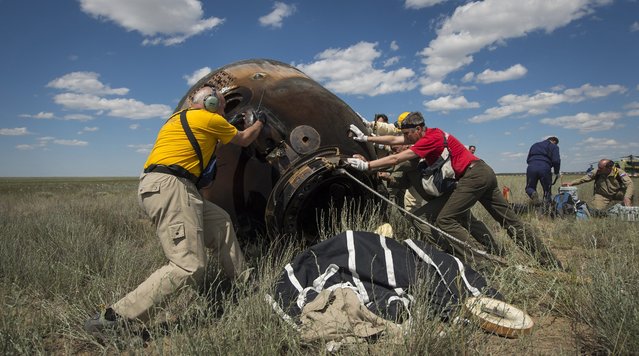
A handout phptopgraph made avaiable by NASA showing Russian support personnel roll the Soyuz TMA-19M spacecraft after it landed with with with Expedition 47 crew members Tim Kopra of NASA, Tim Peake of the European Space Agency, and Yuri Malenchenko of Roscosmos near the town of Zhezkazgan, Kazakhstan 18 June 2016. Kopra, Peake, and Malenchenko are returning after six months in space where they served as members of the Expedition 46 and 47 crews onboard the International Space Station. (Photo by Bill Ingalls/EPA/NASA)

A handout phptopgraph made avaiable by NASA showing Russian support personnel roll the Soyuz TMA-19M spacecraft after it landed with with with Expedition 47 crew members Tim Kopra of NASA, Tim Peake of the European Space Agency, and Yuri Malenchenko of Roscosmos near the town of Zhezkazgan, Kazakhstan 18 June 2016. Kopra, Peake, and Malenchenko are returning after six months in space where they served as members of the Expedition 46 and 47 crews onboard the International Space Station. (Photo by Bill Ingalls/EPA/NASA)
Details
19 Jun 2016 10:20:00
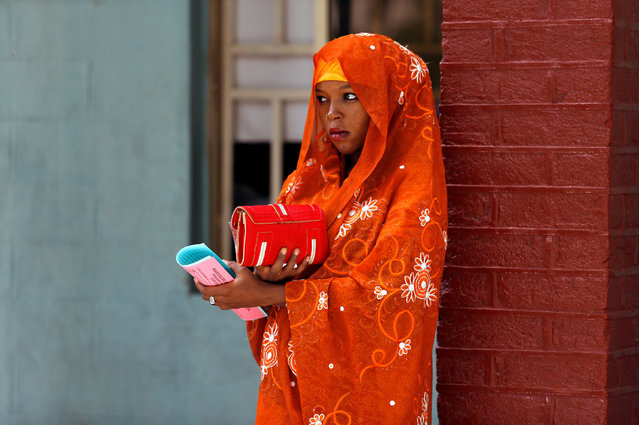
A woman waits at a polio immunisation health centre, in Maiduguri, Borno State, Nigeria, August 29, 2016. Nigeria's military has liberated large swathes of land from Boko Haram but a ride with an army convoy, all guns firing for fear of ambush, shows how far the northeast is from normality after a brutal Islamist insurgency that has displaced millions. The moment military convoys leave the relative safety of Bama, Borno state's second town, soldiers in the lead vehicle open fire with a heavy cannon into the scrub along the road to pre-empt attacks by remaining fighters from the Islamist group. (Photo by Afolabi Sotunde/Reuters)

A woman waits at a polio immunisation health centre, in Maiduguri, Borno State, Nigeria, August 29, 2016. Nigeria's military has liberated large swathes of land from Boko Haram but a ride with an army convoy, all guns firing for fear of ambush, shows how far the northeast is from normality after a brutal Islamist insurgency that has displaced millions. (Photo by Afolabi Sotunde/Reuters)
Details
08 Sep 2016 09:45:00
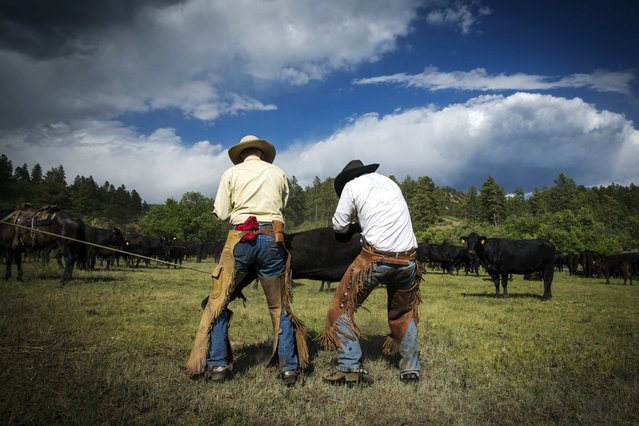
Cowboys Wyatt Williams (R) and David Thompson work to restrain a calf in order to give it medicine near Ignacio, Colorado June 12, 2014. The land where the cattle graze is leased from the Forest Service by third-generation rancher Steve Pargin. Several times a year, he and a crew led by his head cowboy, David Thompson, spend a week or more herding cattle from mountain range to mountain range to prevent them from causing damage to fragile ecosystems by staying in a single area too long. (Photo by Lucas Jackson/Reuters)

Cowboys Wyatt Williams (R) and David Thompson work to restrain a calf in order to give it medicine near Ignacio, Colorado June 12, 2014. The land where the cattle graze is leased from the Forest Service by third-generation rancher Steve Pargin. Several times a year, he and a crew led by his head cowboy, David Thompson, spend a week or more herding cattle from mountain range to mountain range to prevent them from causing damage to fragile ecosystems by staying in a single area too long. (Photo by Lucas Jackson/Reuters)
Details
15 Jul 2014 11:04:00
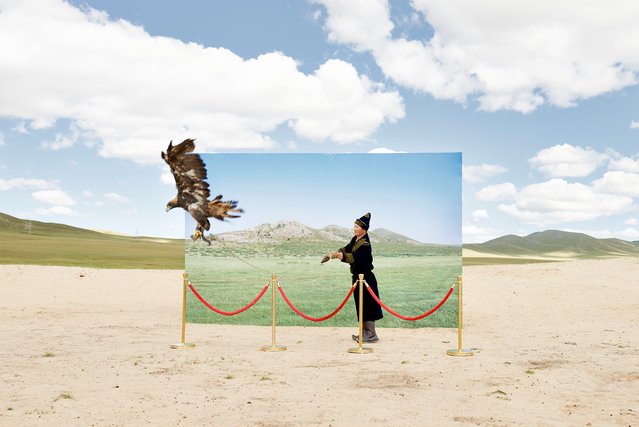
Up to 35% of Mongolians still live a nomadic life, depending on their land to survive. But environmental changes, particularly desertification, means this way of life is under threat. Korean photographer Daesung Lee’s Futuristic Archaeology images show billboard-size backdrops of lush steppe contrasting with actual scenery as former nomads enact scenes of hunting, herding and Mongolian wrestling. (Photo by Daesung Lee)

Up to 35% of Mongolians still live a nomadic life, depending on their land to survive. But environmental changes, particularly desertification, means this way of life is under threat. Korean photographer Daesung Lee’s Futuristic Archaeology images show billboard-size backdrops of lush steppe contrasting with actual scenery as former nomads enact scenes of hunting, herding and Mongolian wrestling. (Photo by Daesung Lee)
Details
24 Nov 2016 08:01:00