Loading...
Done
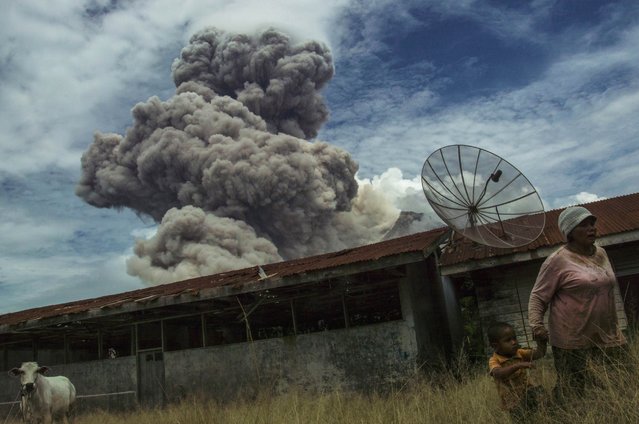
In this photograph taken on April 1, 2015, an Indonesian resident and child walk away from an abandoned school building as Mount Sinabung erupts in Karo district on the Indonesian island of Sumatra. According to authorities about 3,500 people were displaced after the February 2014 eruption of Mount Sinabung volcano and many are still living in evacuation centers as the volcano remains active. (Photo by Sutanta Aditya/AFP Photo)

In this photograph taken on April 1, 2015, an Indonesian resident and child walk away from an abandoned school building as Mount Sinabung erupts in Karo district on the Indonesian island of Sumatra. According to authorities about 3,500 people were displaced after the February 2014 eruption of Mount Sinabung volcano and many are still living in evacuation centers as the volcano remains active. (Photo by Sutanta Aditya/AFP Photo)
Details
04 Apr 2015 10:32:00
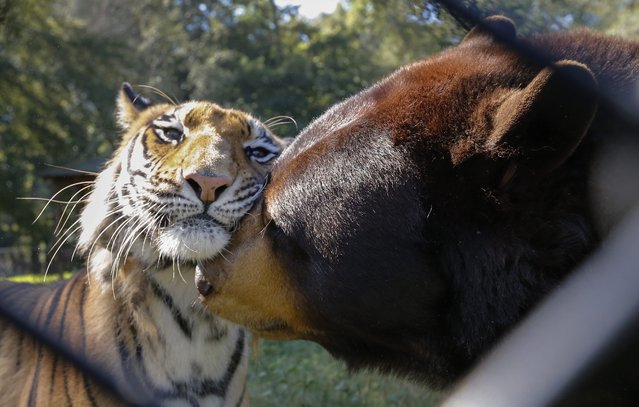
Baloo (R), a North American Black Bear, rubs snouts with his companion Shere Hkhan, a Bengal tiger, inside their shared enclosure at Noah's Ark animal sanctuary in Locust Grove, Georgia, USA, 28 August 2014. According to the facility, the pair and a lion named Leo, were confiscated at a young age from a drug dealer's basement in Atlanta, Georgia. Noah's Ark cares for about 100 different species of animals on a 250 acre farm since 1990. (Photo by Erik S. Lesser/EPA)

Baloo (R), a North American Black Bear, rubs snouts with his companion Shere Hkhan, a Bengal tiger, inside their shared enclosure at Noah's Ark animal sanctuary in Locust Grove, Georgia, USA, 28 August 2014. According to the facility, the pair and a lion named Leo, were confiscated at a young age from a drug dealer's basement in Atlanta, Georgia. Noah's Ark cares for about 100 different species of animals on a 250 acre farm since 1990. (Photo by Erik S. Lesser/EPA)
Details
30 Aug 2014 11:28:00
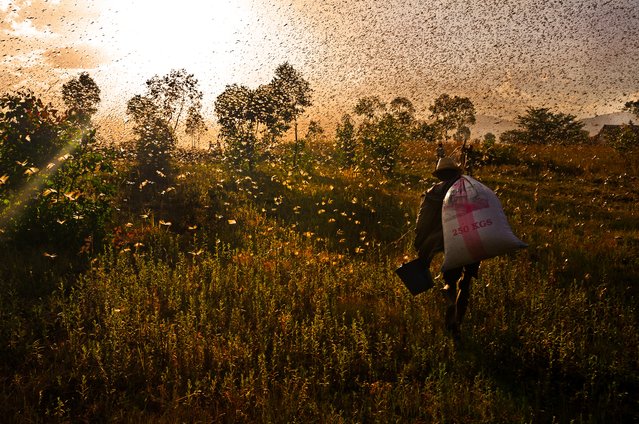
“Locusts & Men”. Oppression, interaction, collaboration. In the life cycle of nature nothing is lost, but the coexistence of different species is sometimes difficult. In Madagascar periodically returns the archaic antagonism between man and the migratory locust, in a circle of life where the two species are looking for space and food for their survival. Photo location: Madagascar, 2013. (Photo and caption by Michele Martinelli/National Geographic Photo Contest)

“Locusts & Men”. Oppression, interaction, collaboration. In the life cycle of nature nothing is lost, but the coexistence of different species is sometimes difficult. In Madagascar periodically returns the archaic antagonism between man and the migratory locust, in a circle of life where the two species are looking for space and food for their survival. At the end of the day a man walks home carrying on his shoulders the heavy bag which contains the locusts captured during the day. The insects provide nutritious meals for the man and his family. Photo location: Madagascar, 2013. (Photo and caption by Michele Martinelli/National Geographic Photo Contest)

ATTENTION! All pictures are presented in high resolution. To see Hi-Res images – just TWICE click on any picture. In other words, click small picture – opens the BIG picture. Click BIG picture – opens VERY BIG picture.
Details
03 Dec 2013 10:59:00
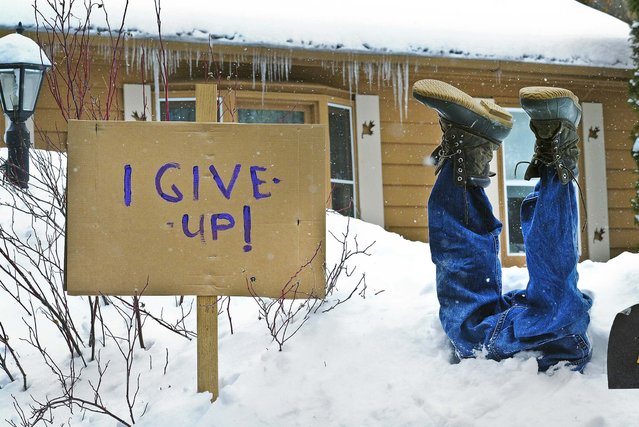
A mannequin with boots is stuffed upside down in the snow in front of a  home in Nisswa, Minnesota, on March 18, 2013. (Photo by Steve Kohls/The Brainerd Daily Dispatch)

A mannequin with boots is stuffed upside down in the snow in front of a home in Nisswa, Minnesota, on March 18, 2013. (Photo by Steve Kohls/The Brainerd Daily Dispatch)

P.S. All pictures are presented in high resolution. To see Hi-Res images – just TWICE click on any picture. In other words, click small picture – opens the BIG picture. Click BIG picture – opens VERY BIG picture (if available; this principle works anywhere on the site AvaxNews).
Details
23 Mar 2013 14:08:00
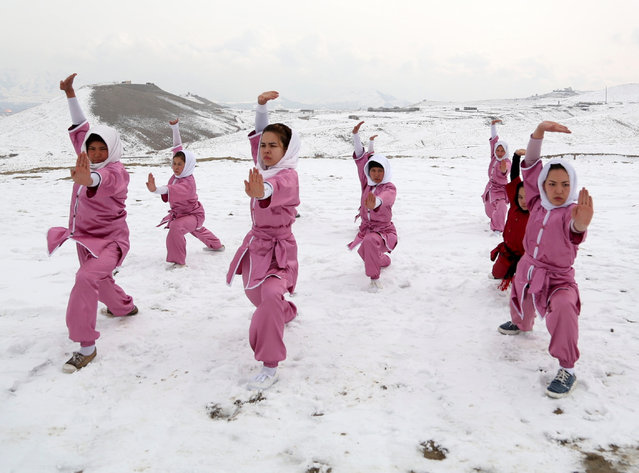
Afghan girl athletes perform Wushu on the top of a hill in Kabul, capital of Afghanistan, January 18, 2017. In the conservative Afghan society where people especially in the countryside deeply believe in the old traditions and don't allow their girls and female members of the family to go out of home, exercising sport in open is extremely risky, but a group of girls are broken the taboo and exercising Wushu on a hilltop where the temperature is minus 2 Celsius degrees. (Photo by Rahmat Alizadah/Xinhua/Barcroft Images)

Afghan girl athletes perform Wushu on the top of a hill in Kabul, capital of Afghanistan, January 18, 2017. In the conservative Afghan society where people especially in the countryside deeply believe in the old traditions and don't allow their girls and female members of the family to go out of home, exercising sport in open is extremely risky, but a group of girls are broken the taboo and exercising Wushu on a hilltop where the temperature is minus 2 Celsius degrees. (Photo by Rahmat Alizadah/Xinhua/Barcroft Images)
Details
21 Jan 2017 11:26:00
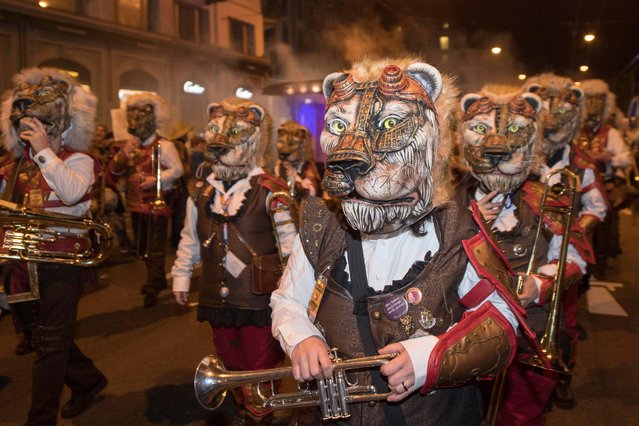
Masked Guggen music bands parade through the streets on the occasion of the beginning of the Fasnacht Carnival of Lucerne, Switzerland, early 23 February 2017. (Photo by Urs Flueeler/EPA)

Masked Guggen music bands parade through the streets on the occasion of the beginning of the Fasnacht Carnival of Lucerne, Switzerland, early 23 February 2017. (Photo by Urs Flueeler/EPA)
Details
25 Feb 2017 00:01:00
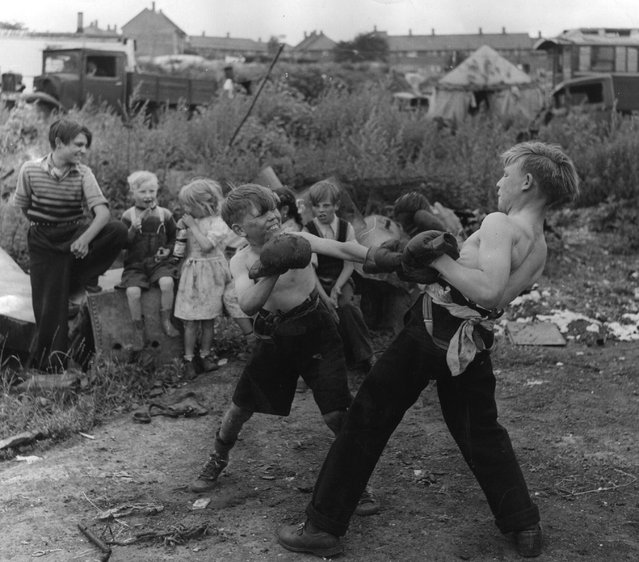
The unromantic gypsies. Children boxing in a gypsy camp in Kent, England on July 1, 1951. Like all boys these gypsy lads like to try their hand at boxing. Encouraged by their friends they fight it out on Corke's Meadow. Few Romanies now live a life of wandering romance. Most are like the three hundred squatters of Corke's Meadow, Kent, which is part of a “gypsy problem” that involves about 100,000 today. Of those about 25,000 can be rightly called gypsies, the rest are Mumpers and Posh-rats and Hobos. Corke's Meadow has both kinds. “Picture Post” cameraman Bert Hardy photographs the Corke's Meadow gypsies in their encampment. (Photo by Hulton-Deutsch Collection/Corbis via Getty Images)

The unromantic gypsies. Children boxing in a gypsy camp in Kent, England on July 1, 1951. Like all boys these gypsy lads like to try their hand at boxing. Encouraged by their friends they fight it out on Corke's Meadow. Few Romanies now live a life of wandering romance. Most are like the three hundred squatters of Corke's Meadow, Kent, which is part of a “gypsy problem” that involves about 100,000 today. Of those about 25,000 can be rightly called gypsies, the rest are Mumpers and Posh-rats and Hobos. Corke's Meadow has both kinds. “Picture Post” cameraman Bert Hardy photographs the Corke's Meadow gypsies in their encampment. (Photo by Hulton-Deutsch Collection/Corbis via Getty Images)
Details
12 Mar 2017 00:01:00
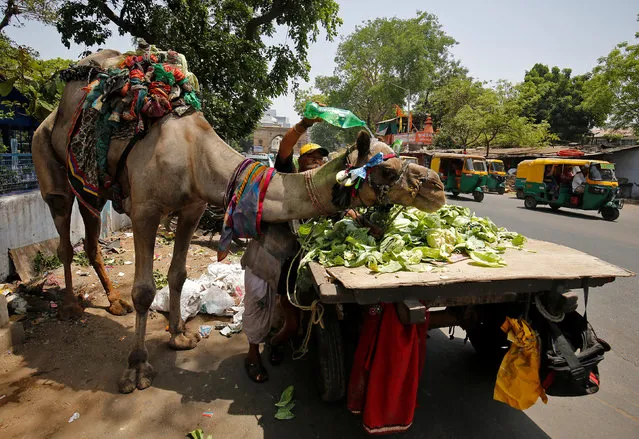
A man pours water on his camel on a hot summer day in Ahmedabad, India, May 18, 2017. (Photo by Amit Dave/Reuters)

A man pours water on his camel on a hot summer day in Ahmedabad, India, May 18, 2017. (Photo by Amit Dave/Reuters)
Details
22 May 2017 07:21:00