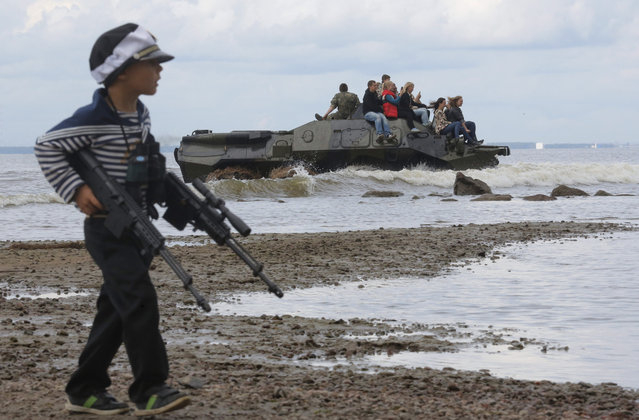
A boy walks with toy guns as people ride an APC during a military show at the Finnish Gulf coast in St.Petersburg, Russia, Saturday, September 5, 2015. (Photo by Dmitry Lovetsky/AP Photo)
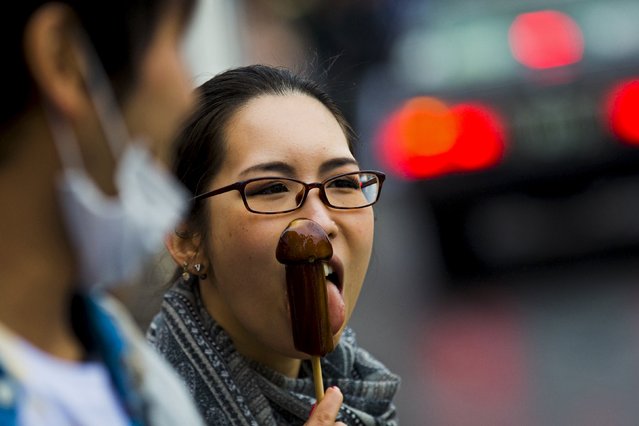
A woman eats candy in the shape of a phallus during the Kanamara Matsuri, or Iron Phallus Festival through a street near the Kanamara shrine in Kawasaki outside of Tokyo April 5, 2015. The festival celebrates fertility and is used to raise awareness and money for the prevention of sexually transmitted diseases. (Photo by Thomas Peter/Reuters)
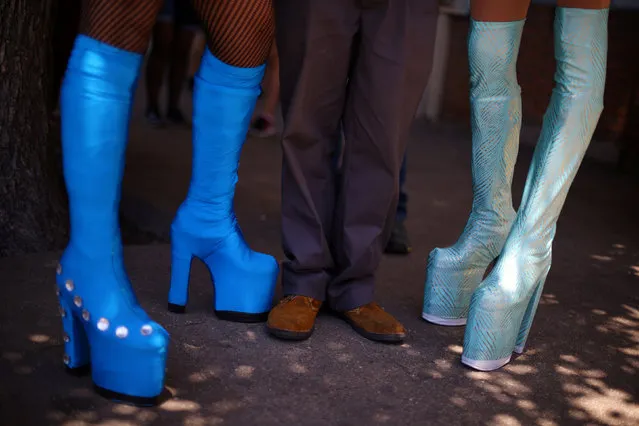
Activists attend a parade to demand rights of gender equality to LGBT community members in Santiago, Chile, November 25, 2017. (Photo by Ivan Alvarado/Reuters)
Aeroflot employees with a puppy at the canine service of Aeroflot at Sheremetyevo International Airport in Moscow Region, Russia on October 2, 2020, that has started to train service dogs to detect COVID-19 in people. (Photo by Vladimir Gerdo/TASS)
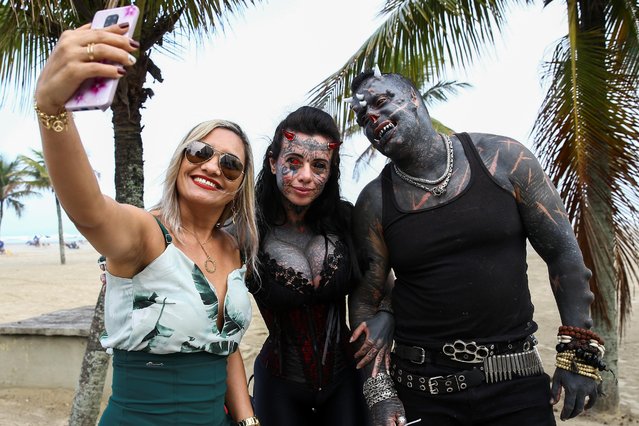
Brazilian tattoo artist Michel Praddo, also known as Diabao or Human Satan, and his wife Carol Praddo, known as Mulher Demonia or Demon Woman, take a picture with a fan at the beach shore in Praia Grande, Brazil on August 18, 2021. (Photo by Carla Carniel/Reuters)
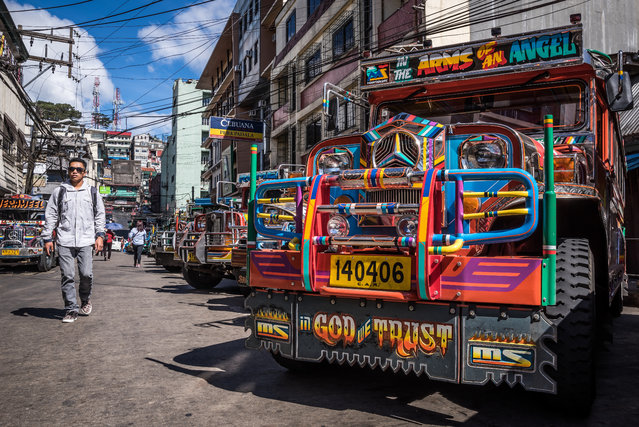
These Filipino icons of ingenuity were originally re-crafted from abandoned US army jeeps after the second world war, and helped to establish a new system of urban transportation. Jeepneys are being phased to help ease city congestion, but the move will also cause unemployment for experienced drivers – and higher fares for commuters. (Photo by Claudio Sieber/Barcroft Media)
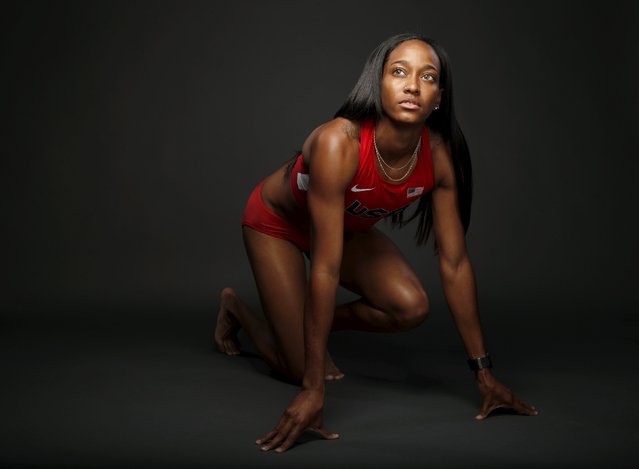
Runner English Gardner poses for a portrait at the U.S. Olympic Committee Media Summit in Beverly Hills, Los Angeles, California March 8, 2016. “My musical inspiration when I'm training is usually a lot of upbeat music”, said Gardner. (Photo by Lucy Nicholson/Reuters)
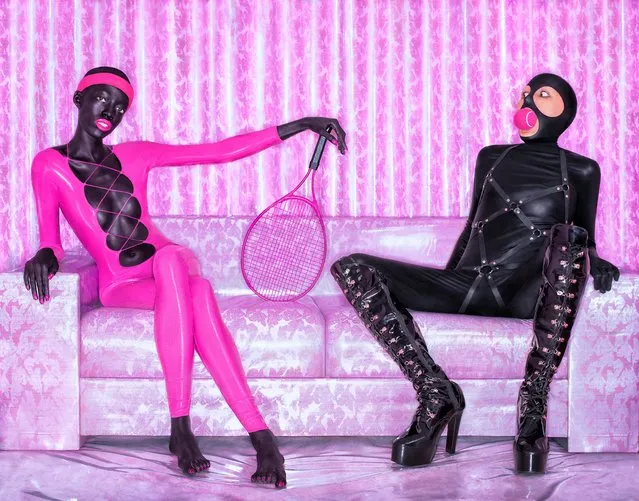
Photographer Pol Kurucz’s vivid collection of photos explores issues faced by black Brazilian women, from political misrepresentation to unrealistic beauty standards. Kolor Collective is a Rio de Janeiro-based creative group that challenges the struggle faced by black women in Brazil through theatrical and provocative art. It was founded in 2015 by Franco-Hungarian photographer Pol Kurucz, who often touches on his own experiences of discrimination to call out sensitive social problems. (Photo by Kolor Art Collective/The Guardian)