Loading...
Done
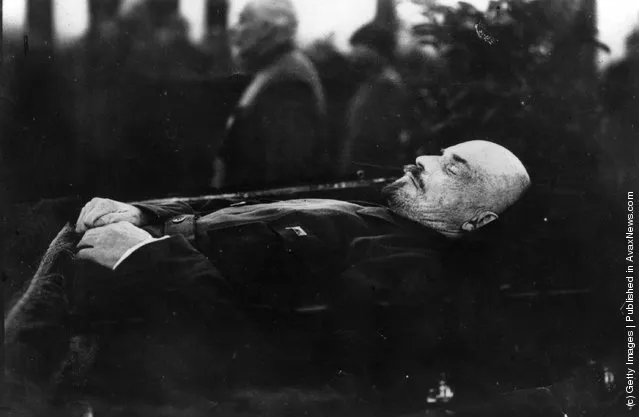
1924:  Vladimir Ilyich Lenin lying in state in the Kremlin

Photo: Vladimir Ilyich Lenin (1870 – 1924) lying in state in the Kremlin. (Photo by Hulton Archive/Getty Images). 1924

Important! For the same article in Russian language click here.

Something quite intriguing is happening within Russian-speaking internet during the last few – should you type a fully academic inquiry (at least, according to Russian academic requirements) in national search engines for "Lenin's mausoleum" – the first thing you get (even in top 10 searches) is website pages talking about black magic and occult. Website authors view this construction differently, but unconditionally agree on one thing: the mausoleum of the "leader of the world proletariat” – the essence of a magical artifact, a sort of “energy vampire”. It was built with a certain purpose: to drain the energy out of miserable Soviet citizens on one hand; and to poison the anthroposphere of one-sixth part of the earth with its vibes (the exact territory that was occupied by the former Soviet Union), depriving the Russian people of will to resist on the other hand. Complete nonsense? No doubt. Nevertheless, an intriguing one. Well, probably because some oddities do exist in mausoleum's history. These oddities are the thing we are going to discuss this time. First, let me refresh you memory on the subject.
Details
16 Oct 2011 11:27:00
A Chinese man wears a mask to protect against pollution as he waits at a red light while commuting to work in heavy smog on December 8, 2015 in Beijing, China. The Beijing government issued a 'red alert' for the first time since new standards were introduced earlier this year as the city and many parts of northern China were shrouded in heavy pollution. (Photo by Kevin Frayer/Getty Images)

A Chinese man wears a mask to protect against pollution as he waits at a red light while commuting to work in heavy smog on December 8, 2015 in Beijing, China. The Beijing government issued a 'red alert' for the first time since new standards were introduced earlier this year as the city and many parts of northern China were shrouded in heavy pollution. Levels of PM 2.5, considered the most hazardous, crossed 400 units in Beijing, lower than last week, but still nearly 20 times the acceptable standard set by the World Health Organization. The governments of more than 190 countries are meeting in Paris to set targets on reducing carbon emissions in an attempt to forge a new global agreement on climate change. (Photo by Kevin Frayer/Getty Images)
Details
11 Dec 2015 08:01:00
Villagers from Jiexi Jiantan village perform a ritual of “Zha Laoye”, or “Cracking local spirits”, in Chaoshan, Guangdong Province, China, 10 February 2019. Jiexi Jiantan Village celebrates the annual custom of “Zha Laoye” where Laoye are local spirits. Every third day of the lunar New Year, statues of local spirits known as the “Thousand-mile Eye” Laoye and “Ear Following the Wind” Laoye are brought out to the village committee to receive incensed tea offered by believers. By the sixth day of the year, the “Zha Laoye” activities begin with each man holding one of the statues on a chair above his head while run around a bonfire. Two other men light firecrackers strung up on a long bamboo poles and chase the spirit around the bonfire, signifying a bountiful new year. (Photo by EPA/EFE/ZNSEN)

Villagers from Jiexi Jiantan village perform a ritual of “Zha Laoye”, or “Cracking local spirits”, in Chaoshan, Guangdong Province, China, 10 February 2019. Jiexi Jiantan Village celebrates the annual custom of “Zha Laoye” where Laoye are local spirits. Every third day of the lunar New Year, statues of local spirits known as the “Thousand-mile Eye” Laoye and “Ear Following the Wind” Laoye are brought out to the village committee to receive incensed tea offered by believers. (Photo by EPA/EFE/ZNSEN)
Details
23 Feb 2019 00:07:00
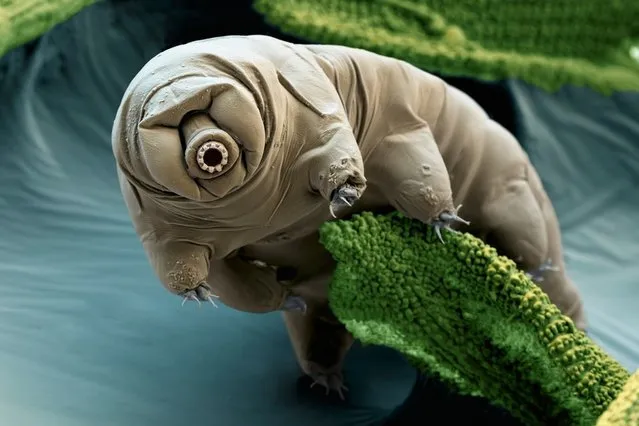
Tardigrades (commonly known as waterbears or moss piglets). (Photo by SPL/East News)

“Tardigrades (commonly known as waterbears or moss piglets) are small, water-dwelling, segmented animals with eight legs. Tardigrades were first discovered in 1773 by Johann August Ephraim Goeze, who called them kleiner Wasserbär, meaning “little water bear” in German. The name Tardigrada means “slow walker” and was given by Lazzaro Spallanzani in 1777. The name water bear comes from the way they walk, reminiscent of a bear's gait. The biggest adults may reach a body length of 1.5 millimetres (0.059 in), the smallest below 0.1 mm. Freshly hatched tardigrades may be smaller than 0.05 mm”. – Wikipedia. Photo: Tardigrades. (Photo by SPL/East News)
Details
26 Sep 2012 09:55:00
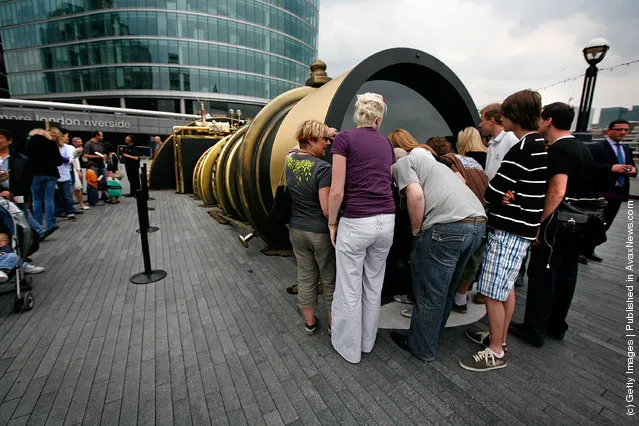
Telectroscope

“The telectroscope (also referred to as “electroscope”) was the first non-working prototype (i.e. conceptual model) of a television or videophone system. The term was used in the 19th century to describe science-based systems of distant seeing. The name and its concept came into being not long after the telephone was patented in 1876, and its original concept evolved from that of remote facsimile reproductions onto paper, into the live viewing of remote images”. – Wikipedia

Photo: Visitors to London wave to people they can see in New York as they peer through the Telectroscope situated by Tower Bridge on May 23, 2008 in London, England. The device named the Telectroscope provides a live visual link up between London and New York, to another Telectroscope by Brooklyn Bridge. (Photo by Cate Gillon/Getty Images)
Details
16 Sep 2011 12:19:00
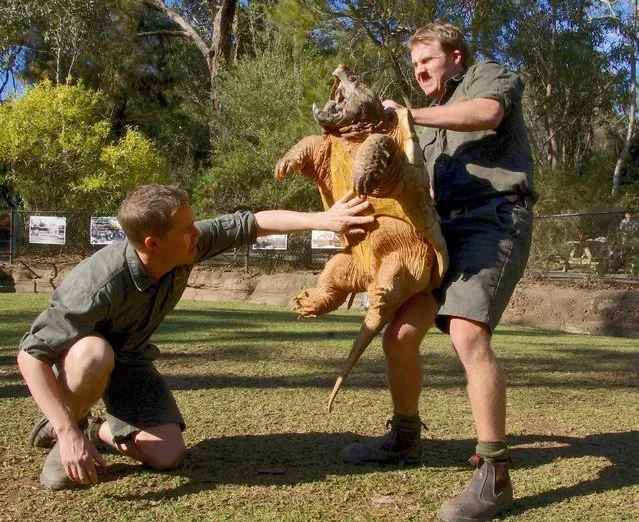
Two keepers at the Australian Reptile Park in New South Wales struggle with Leonardo, an alligator snapping turtle weighing 45 kilos at the park in Gosford, NSW 2 July 2015. The 50cm long Leonardo – who was smuggled illegally into Australia and found in a Sydney sewer in November 200 – was removed from his tank for an annual health check. And as a gesture to onlooking press photographers demonstrated his strength by snapping a piece of bamboo in half. (Photo by EPA/HO)

Two keepers at the Australian Reptile Park in New South Wales struggle with Leonardo, an alligator snapping turtle weighing 45 kilos at the park in Gosford, NSW 2 July 2015. The 50cm long Leonardo – who was smuggled illegally into Australia and found in a Sydney sewer in November 2000 – was removed from his tank for an annual health check. And as a gesture to onlooking press photographers demonstrated his strength by snapping a piece of bamboo in half. (Photo by EPA/HO)
Details
03 Jul 2015 12:53:00
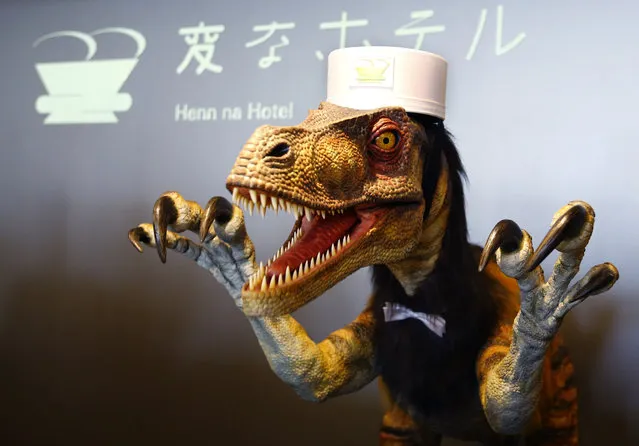
A receptionist dinosaur robot performs at the new robot hotel, aptly called Henn na Hotel or Weird Hotel, in Sasebo, southwestern Japan, Wednesday, July 15, 2015. From the receptionist that does the check-in and check-out to the porter that’s a stand-on-wheels taking luggage up to the room, the hotel, that is run as part of Huis Ten Bosch amusement park, is “manned” almost totally by robots to save labor costs. (Photo by Shizuo Kambayashi/AP Photo)

A receptionist dinosaur robot performs at the new robot hotel, aptly called Henn na Hotel or Weird Hotel, in Sasebo, southwestern Japan, Wednesday, July 15, 2015. From the receptionist that does the check-in and check-out to the porter that’s a stand-on-wheels taking luggage up to the room, the hotel, that is run as part of Huis Ten Bosch amusement park, is “manned” almost totally by robots to save labor costs. (Photo by Shizuo Kambayashi/AP Photo)
Details
16 Jul 2015 11:18:00
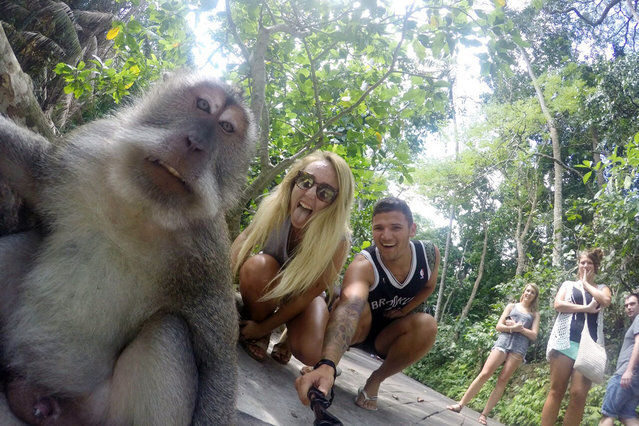
British tourists snap a cheeky selfie with a monkey at the Ubud Monkey Forest in Bali, Indonesia, August 4, 2015. George Benton, 22, from Paignton, Devon was visiting the Sacred Monkey Forest Sanctuary in Ubud, Bali whilst traveling with his girlfriend Chloe when the couple snapped a surprise shot with Balinese long-tailed monkey using a “selfie stick”. (Photo by George Benton/Splash News)

British tourists snap a cheeky selfie with a monkey at the Ubud Monkey Forest in Bali, Indonesia, August 4, 2015. George Benton, 22, from Paignton, Devon was visiting the Sacred Monkey Forest Sanctuary in Ubud, Bali whilst traveling with his girlfriend Chloe when the couple snapped a surprise shot with Balinese long-tailed monkey using a “selfie stick”. “We couldn't believe our luck when we looked back at the photos, he looked straight into the camera!” said George, who went on to reward the cheeky chap with a banana for giving the couple such a memorable photo. (Photo by George Benton/Splash News)
Details
05 Aug 2015 14:41:00