Loading...
Done
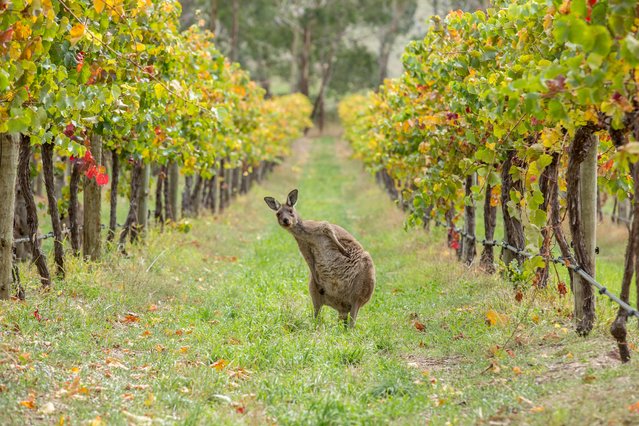
“Are you here for the Winery Tour?” This is a Western Grey Kangaroo caught lounging in the wineries of the Adelaide Hills in South Australia. This past Autumn has been a spectacular time for wildlife viewing and I got lucky to spot this guy while mountain biking in the hills. Such a funny stance it just begs the question... Have you been drinking? ...and or... Are you here for the Winery Tour? Photo location: Adelaide Hills, South Australia, Australia. (Photo and caption by Greg Snell/National Geographic Photo Contest)

“Are you here for the Winery Tour?” This is a Western Grey Kangaroo caught lounging in the wineries of the Adelaide Hills in South Australia. This past Autumn has been a spectacular time for wildlife viewing and I got lucky to spot this guy while mountain biking in the hills. Such a funny stance it just begs the question... Have you been drinking? ...and or... Are you here for the Winery Tour? Such a spontaneous moment I figured it would be perfect for an entry. I hope you like it! Cheers. Photo location: Adelaide Hills, South Australia, Australia. (Photo and caption by Greg Snell/National Geographic Photo Contest)
Details
19 Jun 2014 09:28:00
Juanita Robinson (L) from Ohio and Trenaya Blackburn pose as Quan White from Michigan takes their picture as they vacation on South Beach on May 16, 2016 in Miami Beach, Florida. The Florida government announced it broke a tourism record in the first quarter of this year, attracting 29.8 million tourists, an increase of 4.8 percent over the same time frame in 2015. (Photo by Joe Raedle/AFP Photo)

Juanita Robinson (L) from Ohio and Trenaya Blackburn pose as Quan White from Michigan takes their picture as they vacation on South Beach on May 16, 2016 in Miami Beach, Florida. The Florida government announced it broke a tourism record in the first quarter of this year, attracting 29.8 million tourists, an increase of 4.8 percent over the same time frame in 2015. (Photo by Joe Raedle/AFP Photo)
Details
05 Jun 2016 12:45:00
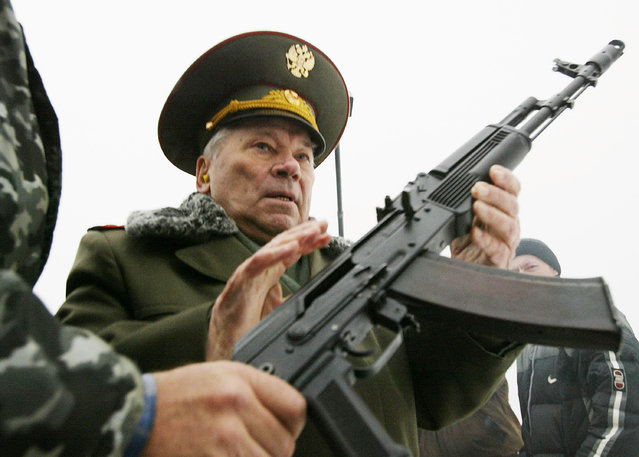
Mikhail Kalashnikov, the father of the world's most popular assault rifle, is handed  an AK-74 November 23, 2002 in Izhevsk,1000 East km. from Moscow. November 23 marked the 55th anniversary of the release of the first Kalashnikov gun. According to the Moscow-based Center for Analysis of Strategic and Technologies some 70 million to 100 million Kalashnikovs have been built worldwide since 1947, compared about 7 million to Kalashnikov's Western rival the M-16 assault rifles. (Photo by Oleg Nikishin/Getty Images)

Mikhail Kalashnikov, the father of the world's most popular assault rifle, is handed an AK-74 November 23, 2002 in Izhevsk,1000 East km. from Moscow. November 23 marked the 55th anniversary of the release of the first Kalashnikov gun. According to the Moscow-based Center for Analysis of Strategic and Technologies some 70 million to 100 million Kalashnikovs have been built worldwide since 1947, compared about 7 million to Kalashnikov's Western rival the M-16 assault rifles. (Photo by Oleg Nikishin/Getty Images)
Details
24 Dec 2013 09:12:00
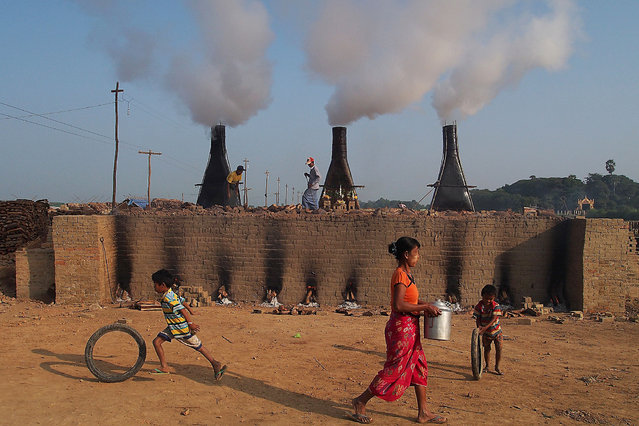
Children play in front of a brick factory on the outskirts of the northern Myanmar city of Mandalay on December 14, 2015. (Photo by Phyo Hein Kyaw/AFP Photo)

Children play in front of a brick factory on the outskirts of the northern Myanmar city of Mandalay on December 14, 2015. (Photo by Phyo Hein Kyaw/AFP Photo)
Details
06 May 2016 13:11:00
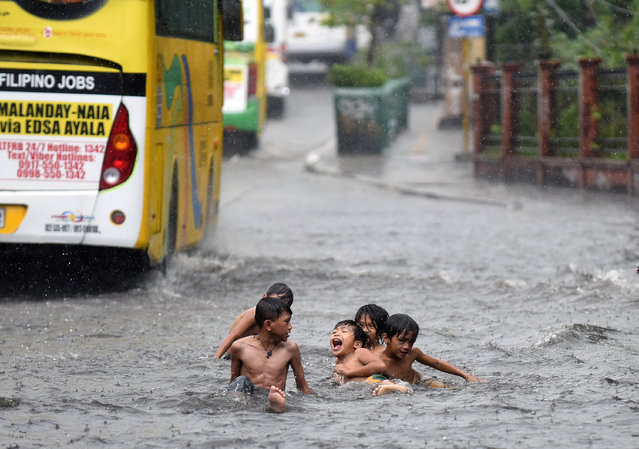
Children play on a flooded highway during a summer downpour in Edsa, Quezon city, metro Manila, Philippines on April 25, 2018. (Photo by Dondi Tawatao/Reuters)

Children play on a flooded highway during a summer downpour in Edsa, Quezon city, metro Manila, Philippines on April 25, 2018. (Photo by Dondi Tawatao/Reuters)
Details
25 Jun 2018 00:03:00
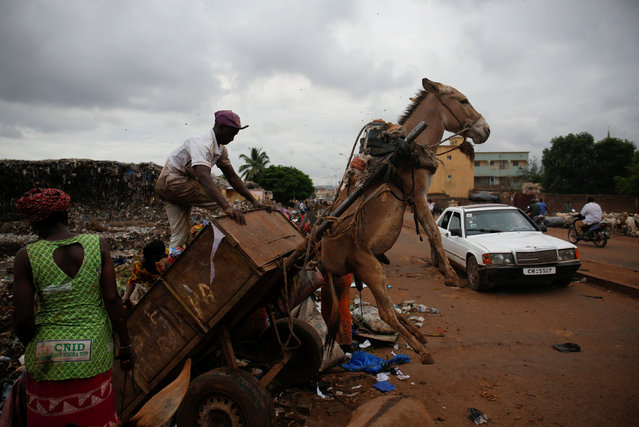
A waste picker unloads garbage at a waste transfer station in Bamako, Mali, August 19, 2018. In the Malian capital of Bamako, donkey carts driven by young men like 19-year-old Arouna Diabate play a vital role battling the fast-growing city's waste problem. Every morning before dawn, Diabate hitches his donkey to a cart and sets off on his rounds, going door-to-door to collect household garbage which he delivers to a local waste transfer station for a monthly salary of around $35. “I won't be picking up trash with a donkey cart for the rest of my life, but for now people appreciate us because we help clean up the homes of Bamako”, Diabate said. (Photo by Luc Gnago/Reuters)

A waste picker unloads garbage at a waste transfer station in Bamako, Mali, August 19, 2018. In the Malian capital of Bamako, donkey carts driven by young men like 19-year-old Arouna Diabate play a vital role battling the fast-growing city's waste problem. Every morning before dawn, Diabate hitches his donkey to a cart and sets off on his rounds, going door-to-door to collect household garbage which he delivers to a local waste transfer station for a monthly salary of around $35. “I won't be picking up trash with a donkey cart for the rest of my life, but for now people appreciate us because we help clean up the homes of Bamako”, Diabate said. (Photo by Luc Gnago/Reuters)
Details
18 Sep 2018 00:01:00
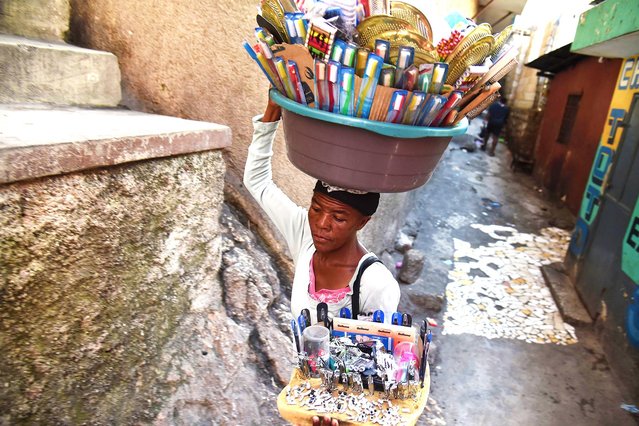
A vendor carries her products in a bucket on her head as she walks through the neighborhood of Jalousie, in the commune of Petion Ville, Port-au-Prince, on December 17, 2018. On the hills of Port-au-Prince, a chaotic jumble of structures stretches ever farther into the distance: Haiti's capital is suffering under the weight of high inflation, endemic corruption and a perilous drop in the value of its currency. Jalousie is a poor neighborhood of the capital which lacks sanitation and potable water. (Photo by Hector Retamal/AFP Photo)

A vendor carries her products in a bucket on her head as she walks through the neighborhood of Jalousie, in the commune of Petion Ville, Port-au-Prince, on December 17, 2018. On the hills of Port-au-Prince, a chaotic jumble of structures stretches ever farther into the distance: Haiti's capital is suffering under the weight of high inflation, endemic corruption and a perilous drop in the value of its currency. Jalousie is a poor neighborhood of the capital which lacks sanitation and potable water. (Photo by Hector Retamal/AFP Photo)
Details
30 Jan 2019 00:01:00
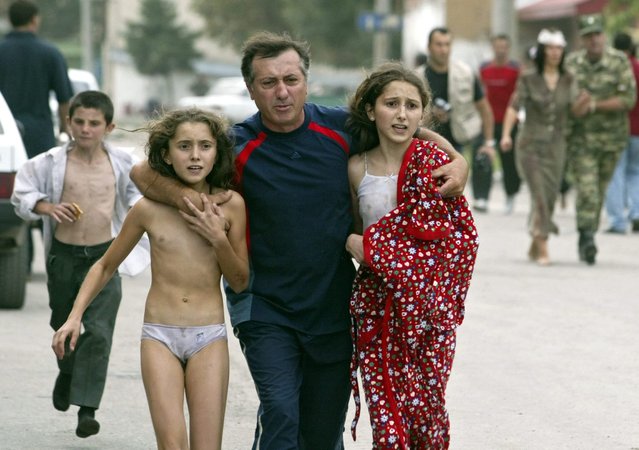
A man assists two young hostages who managed to escape from the school building after special forces entered the school in Beslan, North Ossetia, Friday 03 September 2004. Streams of hostages fled the besieged school in Beslan in southern Russia Friday amid intensive shooting and a series of powerful explosions that signalled a bloody end to the three-day stand-off with terrorists. (Photo by Yuri Kochetkov/EPA)

On September 1, 2004, Chechen militants stormed an elementary school in the town of Beslan in the Russian republic of North Ossetia. They took 1,100 teachers, children, and their relatives hostage, demanding the withdrawal of federal forces from Chechnya as a condition for their release. On September 3, 2004, Russian security forces stormed the building, resulting in a battle in which more than 330 hostages died, including 186 children. Here: A man assists two young hostages who managed to escape from the school building after special forces entered the school in Beslan, North Ossetia, Friday 03 September 2004. (Photo by Yuri Kochetkov/EPA)
Details
25 Sep 2017 06:41:00