Loading...
Done
A woman looks at head of bluefin tuna on display in front of a store at Tsukiji fish market in Tokyo, Monday, February 19, 2018.  The large bluefin are particularly valuable in Japan, where they are considered a premium sushi and sashimi fish. A single fish sold for more than $1.75 million at an auction in Japan in 2013. (Photo by Koji Sasahara/AP Photo)

A woman looks at head of bluefin tuna on display in front of a store at Tsukiji fish market in Tokyo, Monday, February 19, 2018. The large bluefin are particularly valuable in Japan, where they are considered a premium sushi and sashimi fish. A single fish sold for more than $1.75 million at an auction in Japan in 2013. (Photo by Koji Sasahara/AP Photo)
Details
06 Mar 2018 00:05:00
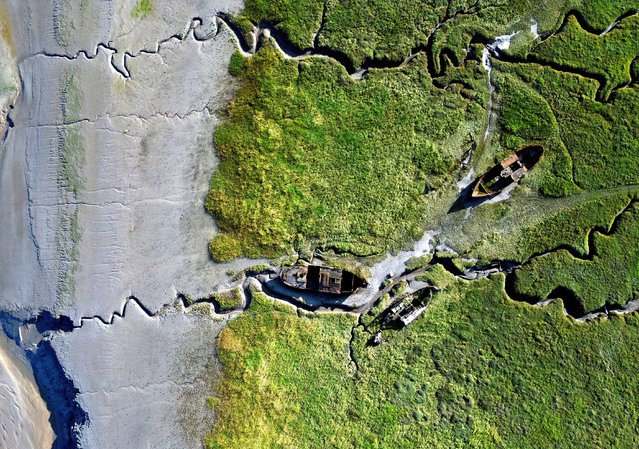
Decaying fishing trawlers known collectively as The Fleetwood Wrecks, are seen at low tide on the banks of the River Wyre in Fleetwood, Britain on September 26, 2023. (Photo by Lee Smith/Reuters)

Decaying fishing trawlers known collectively as The Fleetwood Wrecks, are seen at low tide on the banks of the River Wyre in Fleetwood, Britain on September 26, 2023. (Photo by Lee Smith/Reuters)
Details
03 Nov 2023 03:23:00
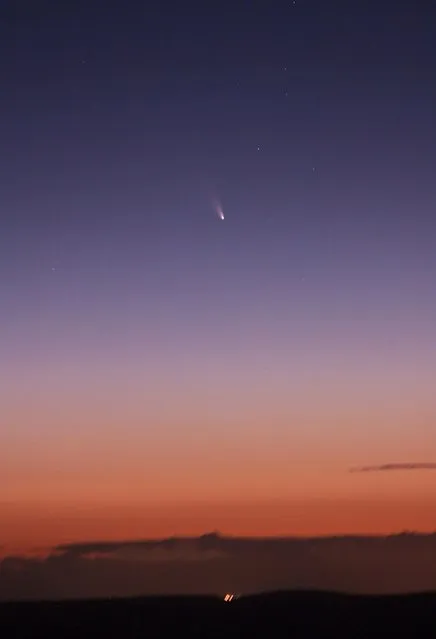
This image provided by NASA shoaws the comet PANSTARRS as seen from Mount Dale, Western Australia on March 5, 2013. According to NASA on March 10, it will make its closest approach to the sun about 28 million miles (45 million kilometers) away. As it continues its nightly trek across the sky, the comet may get lost in the sun's glare but should return and be visible to the naked eye by March 12. (Photo by AP Photo/NASA)

It’s time to start watching for Comet PANSTARRS, one of two comets to get excited about in 2013. Photo: This image provided by NASA shoaws the comet PANSTARRS as seen from Mount Dale, Western Australia on March 5, 2013. According to NASA on March 10, it will make its closest approach to the sun about 28 million miles (45 million kilometers) away. As it continues its nightly trek across the sky, the comet may get lost in the sun's glare but should return and be visible to the naked eye by March 12. (Photo by AP Photo/NASA)
Details
13 Mar 2013 08:03:00
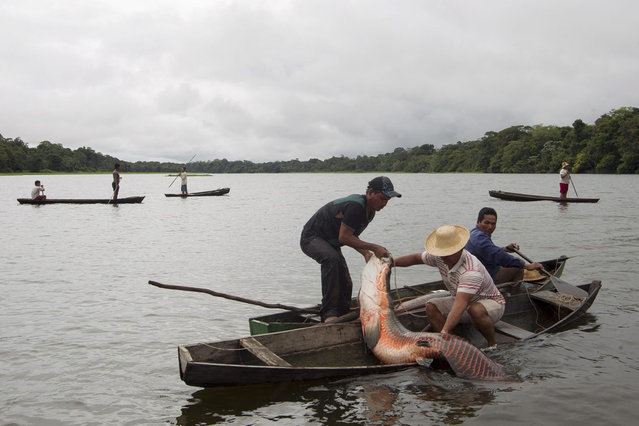
Villagers from the Porto Novo community load into their canoes arapaima or pirarucu, the largest freshwater fish species in South America and one of the largest in the world, while fishing in Poco Fundo lake along a branch of the Solimoes river, one of the main tributaries of the Amazon, in the Mamiraua nature reserve near Fonte Boa about 600 km (373 miles) west of Manaus, November 26, 2013. (Photo by Bruno Kelly/Reuters)

Villagers from the Porto Novo community load into their canoes arapaima or pirarucu, the largest freshwater fish species in South America and one of the largest in the world, while fishing in Poco Fundo lake along a branch of the Solimoes river, one of the main tributaries of the Amazon, in the Mamiraua nature reserve near Fonte Boa about 600 km (373 miles) west of Manaus, November 26, 2013. Catching the arapaima, a fish that is sought after for its meat and is considered by biologists to be a living fossil, is only allowed once a year by Brazil's environmental protection agency. The minimum size allowed for a fisherman to keep an arapaima is 1.5 meters (4.9 feet). (Photo by Bruno Kelly/Reuters)
Details
17 Dec 2013 08:03:00
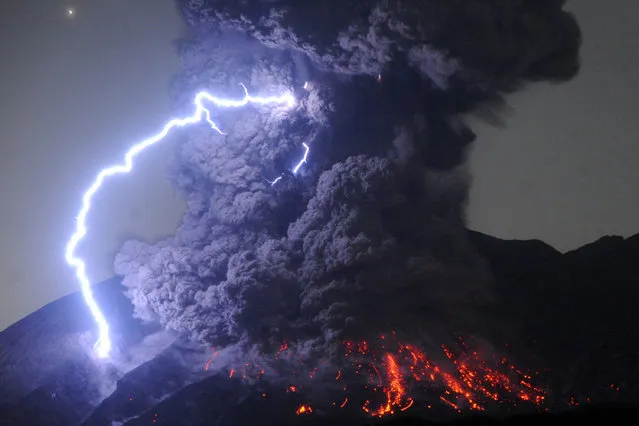
A dirty thunderstorm occurs over Mount Sakurajima as the volcano erupts violently at 12:03 am on July 26, 2016 in Tarumizu, Kagoshima, Japan. The eruption occurred at the mountain's Showa crater. This is the first time that the active volcano in southern Kyushu has spewed out a smokestack that high since an eruption on August 18, 2013, according to the Kagoshima Meteorological Office. (Photo by The Asahi Shimbun via Getty Images)

A dirty thunderstorm occurs over Mount Sakurajima as the volcano erupts violently at 12:03 am on July 26, 2016 in Tarumizu, Kagoshima, Japan. The eruption occurred at the mountain's Showa crater. This is the first time that the active volcano in southern Kyushu has spewed out a smokestack that high since an eruption on August 18, 2013, according to the Kagoshima Meteorological Office. (Photo by The Asahi Shimbun via Getty Images)
Details
24 Dec 2016 09:40:00
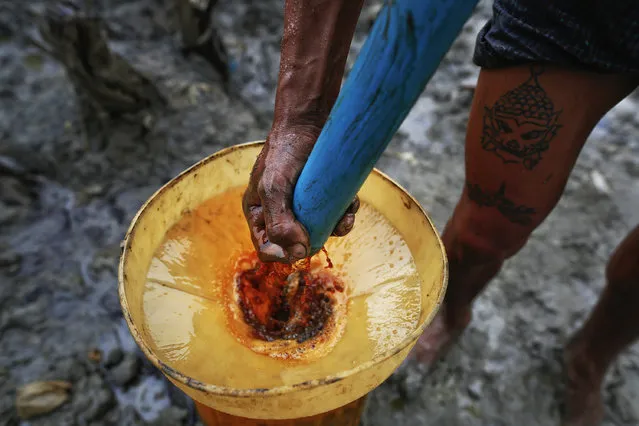
Ko Min, 26, manually extracts oil from one of three 300 feet deep wells he works on in the Minhla township of the Magwe district October 27, 2013. Everyday, Ko Min makes around $30 extracting crude oil from three small wells after he bought rights to use them for close to $1000 from a farmer who owns the land. (Photo by Damir Sagolj/Reuters)

Ko Min, 26, manually extracts oil from one of three 300 feet deep wells he works on in the Minhla township of the Magwe district October 27, 2013. Everyday, Ko Min makes around $30 extracting crude oil from three small wells after he bought rights to use them for close to $1000 from a farmer who owns the land. In Myanmar, an impoverished country rich with natural resources, people from poor communities find ways to supplement their income by exploiting such resources, such as the Minhla township, traditionally rich with oil, often using primitive and dangerous methods. (Photo by Damir Sagolj/Reuters)
Details
21 Apr 2014 10:06:00
In this photo taken Tuesday, Nov. 26, 2013 and made available Thursday, November 28, a Sumatran tiger leaps on Australia Zoo handler Dave Styles, left, as an unidentified man comes to Styles' aid in an enclosure at the zoo at Sunshine Coast, Australia. Styles who suffered puncture wounds to his head and shoulder was rescued by fellow workers at the zoo. He is recovering following surgery after being airlifted to a hospital. (Photo by Johanna Schehl/AP Photo)

In this photo taken Tuesday, November 26, 2013 and made available Thursday, November 28, a Sumatran tiger leaps on Australia Zoo handler Dave Styles, left, as an unidentified man comes to Styles' aid in an enclosure at the zoo at Sunshine Coast, Australia. Styles who suffered puncture wounds to his head and shoulder was rescued by fellow workers at the zoo. He is recovering following surgery after being airlifted to a hospital. (Photo by Johanna Schehl/AP Photo)
Details
29 Nov 2013 08:58:00
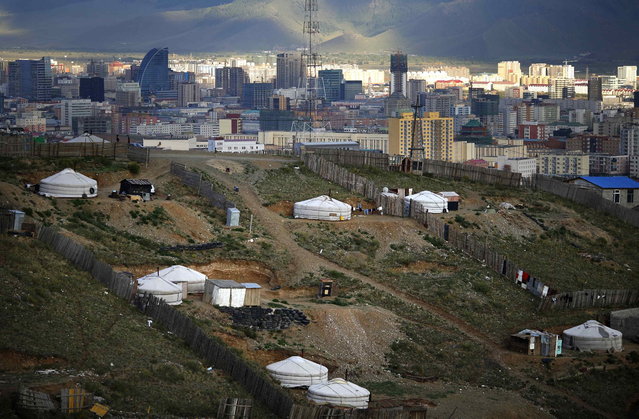
Gers, traditional Mongolian tents, are seen on a hill in an area known as a ger district in Ulan Bator June 26, 2013. (Photo by Carlos Barria/Reuters)

Gers, traditional Mongolian tents, are seen on a hill in an area known as a ger district in Ulan Bator June 26, 2013. Approximately 60 percent of the population of Ulan Bator live in settlements known as ger districts and in many cases residents have limited access to basic services such as water and sanitation. According to a 2010 National Population Center census, every year between thirty and forty thousand people migrate from the countryside to the capital Ulan Bator. Ger districts in the city have been expanding rapidly in recent years. Mongolia is the world's least densely populated country, with 2.8 million people spread across an area around three times the size of France. (Photo by Carlos Barria/Reuters)
Details
11 Aug 2013 11:45:00