Loading...
Done


“The Crimean War (October 1853 – February 1856) was a conflict fought between the Russian Empire and an alliance of the French Empire, the British Empire, the Ottoman Empire, and the Kingdom of Sardinia. The war was part of a long-running contest between the major European powers for influence over territories of the declining Ottoman Empire. Most of the conflict took place on the Crimean Peninsula, but there were smaller campaigns in western Anatolia, Caucasus, the Baltic Sea, the Pacific Ocean and the White Sea”. – Wikipedia

Photo: A vivandiere, a female soldier selling provisions and spirits, with the Allied forces during the Crimean War. (Photo by Hulton Archive/Getty Images)
Details
18 Jul 2011 11:57:00
Regenwurmlager, Poland. The Regenwurmlager is an extensive underground fortification area constructed by Germany in 1920s-1940s, now in western Poland, near the city of Międzyrzecz. (Photo by Anna Arinova/Caters News)

Stunning silhouettes under European cities reveal the size and splendor of the continent’s urban foundations. Photographer and content-manager Anna Arinova, 28, from Moscow, captured the awe-inspiring labyrinths in Russia and Germany. Here: Regenwurmlager, Poland. The Regenwurmlager is an extensive underground fortification area constructed by Germany in 1920s-1940s, now in western Poland, near the city of Międzyrzecz. (Photo by Anna Arinova/Caters News)
Details
29 Dec 2016 07:53:00
Nature on My Doorstep, finalist. I Want That Pomerade Grain by Biagio Alberto Scalia, taken in national park of Circeo, Latina, Italy. (Photo by Biagio Alberto Scalia/REDISCOVER Nature/EEA)

A praying mantis, a huddle of butterflies, Galician horses and an alpine sunset are the winners of this year’s European Environment Agency’s “Rediscover Nature” photo competition. Here: Nature on My Doorstep, finalist. I Want That Pomerade Grain by Biagio Alberto Scalia, taken in national park of Circeo, Latina, Italy. (Photo by Biagio Alberto Scalia/REDISCOVER Nature/EEA)
Details
20 Nov 2020 00:03:00
Ttrulli Alberobello, Italy‎

The stone huts and streets of this Italian city look like a scene from a fairytale. The buildings you see before you are called trulli. The rise in popularity of such houses was in 19th century when they were constructed as storehouses and temporary field shelters or as permanent shelters by agricultural laborers and small proprietors. Wouldn’t it be amazing to own such a house? To become engulfed by the fairytale as you sip a cup of coffee, looking out of a small window onto a crowded street.
Details
20 Nov 2014 12:36:00
A woman is rescued from a car after a flash flood in Nizhny Novgorod, Russia on June 19, 2018. (Photo by Lucy Nicholson/Reuters)

This absolute hero came to the rescue when flash floods in a World Cup city left two women stranded in their submerged cars. Here: A woman is rescued from a car after a flash flood in Nizhny Novgorod, Russia on June 19, 2018. (Photo by Lucy Nicholson/Reuters)
Details
21 Jun 2018 00:01:00
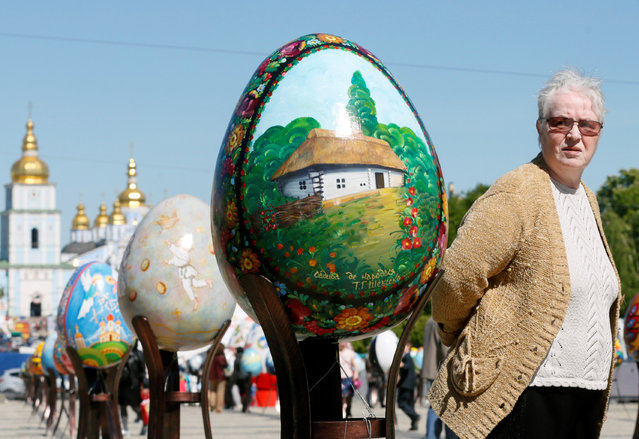
A woman looks at traditional Ukrainian Easter eggs “Pysanka”, installed as part of the upcoming celebrations of Easter, in central Kiev, Ukraine, April 29, 2016. A pysanka is a Ukrainian Easter egg, decorated with traditional Ukrainian folk designs using a wax-resist (batik) method. The word pysanka comes from the verb pysaty, “to write”, as the designs are not painted on, but written with beeswax. Many other eastern European ethnic groups decorate eggs using wax resist for Easter. These include the Belarusians, Bulgarians, Croats, Czechs, Hungarians, Lithuanians, Poles, Romanians, Serbs, Slovaks, Slovenes and Sorbs. (Photo by Valentyn Ogirenko/Reuters)

A woman looks at traditional Ukrainian Easter eggs “Pysanka”, installed as part of the upcoming celebrations of Easter, in central Kiev, Ukraine, April 29, 2016. A pysanka is a Ukrainian Easter egg, decorated with traditional Ukrainian folk designs using a wax-resist (batik) method. The word pysanka comes from the verb pysaty, “to write”, as the designs are not painted on, but written with beeswax. Many other eastern European ethnic groups decorate eggs using wax resist for Easter. These include the Belarusians, Bulgarians, Croats, Czechs, Hungarians, Lithuanians, Poles, Romanians, Serbs, Slovaks, Slovenes and Sorbs. (Photo by Valentyn Ogirenko/Reuters)
Details
30 Apr 2016 09:00:00
A masked man in military fatigues brings a blindfolded Irma Krat, arrested and held by pro-Russian protestors before her meeting with journalists near of occupied police station in Slaviansk, Ukraine, 21 April 2014. Pro-Russian activists are demanding broader autonomy from Kiev and closer ties to Russia. (Photo by Roman Pilipey/EPA)

A masked man in military fatigues brings a blindfolded Irma Krat, arrested and held by pro-Russian protestors before her meeting with journalists near of occupied police station in Slaviansk, Ukraine, 21 April 2014. Pro-Russian activists are demanding broader autonomy from Kiev and closer ties to Russia. Pro-Russian activists continued occupying government, police and other administrative buildings in eastern Ukrainian cities, in defiance of an ultimatum by the Ukrainian government to lay down their weapons. Russia, the United States, the European Union and Ukraine on 17 April had agreed on steps to de-escalate the crisis in Ukraine during talks in Geneva, Switzerland. (Photo by Roman Pilipey/EPA)
Details
26 Apr 2014 12:00:00


“Solar Impulse is a European long-range solar powered plane project being undertaken by Bertrand Piccard and André Borschberg. The project eventually hopes to succeed in the first circling of the earth with a piloted fixed-wing aircraft using only solar power. The first aircraft, bearing the Swiss aircraft registration code of HB-SIA, is a single-seater, capable of taking off under its own power, and intended to remain airborne up to 36 hours. This aircraft first flew an entire diurnal solar cycle, including nearly 9 hours of night flying, in a 26-hour flight on 7–8 July 2010”. – Wikipedia


Photo: Workers prepare the Solar Impulse airplane HB-SIA for a first runway test on November 19, 2009 in Dubendorf, Switzerland. Solar Impulse chairman Bertrand Piccard, psychatrist and aeronaut, who made the first non-stop round-the-world balloon flight, and CEO and former fighter pilot Andrй Borschberg plan a round-the-world flight, driven only by solar energy, for 2012. (Photo by Johannes Simon/Getty Images)
Details
16 May 2011 08:13:00