Loading...
Done
Emilia Pechinkova, a 24-years-old Bulgarian Pomak (Bulgarian speaking Muslims) bride poses for a photograph following the “gelina” or face painting ceremony carried out by female guests and relatives in preparation for her three-day wedding ceremony in the village of Draginovo, 100 kms southeast of Sofia on April 22, 2016. Bulgaria's Muslim population is one of the highest in the European Union. (Photo by Nikolay Doychinov/AFP Photo)

Emilia Pechinkova, a 24-years-old Bulgarian Pomak (Bulgarian speaking Muslims) bride poses for a photograph following the “gelina” or face painting ceremony carried out by female guests and relatives in preparation for her three-day wedding ceremony in the village of Draginovo, 100 kms southeast of Sofia on April 22, 2016. Bulgaria's Muslim population is one of the highest in the European Union. During the Communist regime religious rituals were not tolerated, and Muslims were forced to abandon wearing their traditional wedding outfits. Recently, more young Pomak women want to include traditional wedding customs that were forbidden during the regime, regardless of their secular lifestyles and the high cost of such a wedding. (Photo by Nikolay Doychinov/AFP Photo)
Details
25 Apr 2016 09:55:00


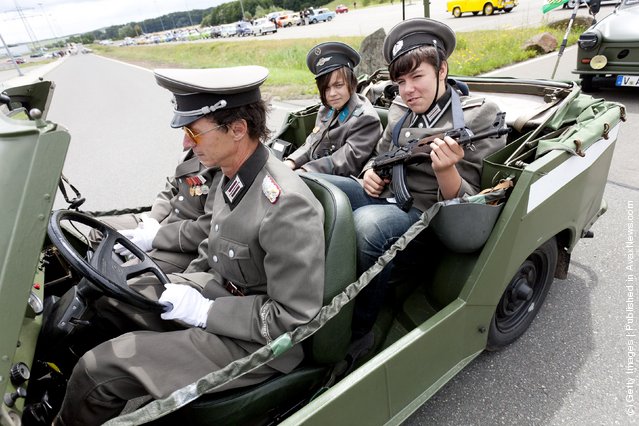
“The Trabant is a car that was produced by former East German auto maker VEB Sachsenring Automobilwerke Zwickau in Zwickau, Sachsen. It was the most common vehicle in East Germany, and was also exported to countries both inside and outside the communist bloc. The main selling points was that it had room for four adults and luggage in a compact, light and durable shell and that it was fast (when introduced) and durable. With its mediocre performance, smoky two-stroke engine, and production shortages, the Trabant is often cited as an example of the disadvantages of centralized planning; on the other hand, it is regarded with derisive affection as a symbol of the failed former East Germany and of the fall of communism (in former West Germany, as many East Germans streamed into West Berlin and West Germany in their Trabants after the opening of the Berlin Wall in 1989). It was in production without any significant changes for nearly 30 years with 3,096,099 Trabants produced in total”. – Wikipedia

Photo: Enthusiasts weared in uniforms of the former eastern german army trive in a military Trabant car as fans and owners of East German-era Trabant cars gather at the 2011 International Trabantfahrer Treffen (International Trabant Drivers Meeting) on June 26, 2011 in Zwickau, Germany. The Trabant, also known as the Trabi, was among the main cars produced in communist East Germany and built by VEB Sachsenring Automobilwerke in Zwickau for 30 years until 1989. Today the car has cult status for many followers and one company, IndiKar, is even seeking to revive the brand in a modern, electric version. (Photo by Carsten Koall/Getty Images)

Details
27 Jun 2011 12:21:00
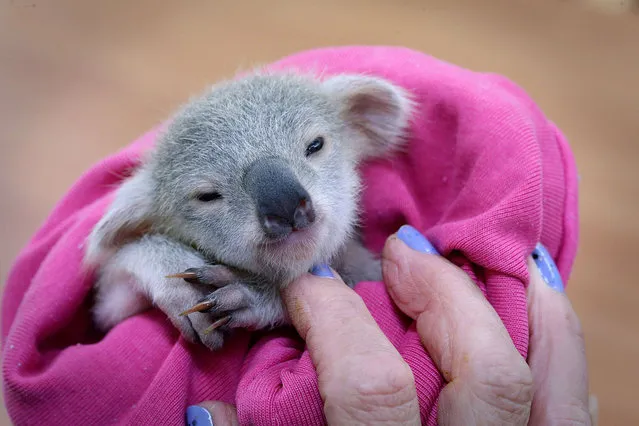
An adorable baby koala is seen enjoying a snooze after a traumatic start to life. The baby koala, nicknamed “Blondie Bumstead”, is being cared for by a volunteer from the Ipswich Koala protection society in Queensland after her mother was killed by a dog. (Photo by Jamie Hanson/Newspix/REX Features)

An adorable baby koala is seen enjoying a snooze after a traumatic start to life. The baby koala, nicknamed “Blondie Bumstead”, is being cared for by a volunteer from the Ipswich Koala protection society in Queensland after her mother was killed by a dog. Blondie, who was named for her light fur, was given just a 50-50 chance of pulling through after the attack. But after a course of antibiotics and some tender loving car from volunteer Marilyn Spletter she has now been given a clean bill of health. According to Marilyn she has hand-reared around 40 baby koalas but says that Blondie, who will be released back into the wild after 15 months, is one of her favourites. She said: “She's got a little character all of her own and she knows what she wants and what she doesn't. When she's stressed I kiss her on the nose or I rub my nose on hers and it relaxes her”. (Photo by Jamie Hanson/Newspix/REX Features)
Details
07 Aug 2014 10:26:00
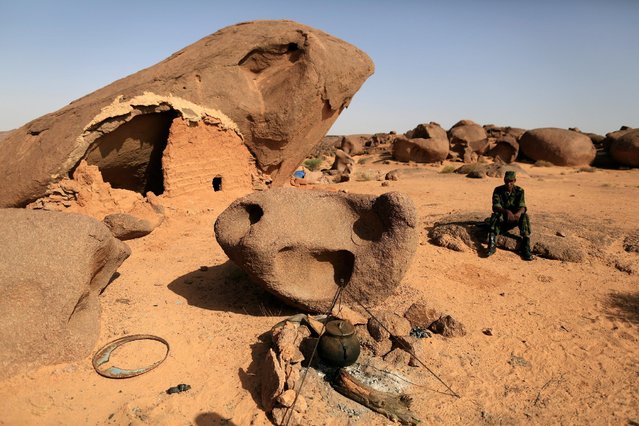
A Polisario fighter sits on a rock at a forward base on the outskirts of Tifariti, Western Sahara, September 9, 2016. At a rocky outpost in Western Sahara, a new generation of soldiers who have never known war are mobilising as tensions resurface in one of Africa's oldest disputes after a quarter century of uneasy peace. Young Sahrawi troops man new desert posts for the Polisario Front, which for more than 40 years has sought independence for the vast desert region - first in a guerrilla war against Morocco and then politically since a ceasefire deal in 1991. Now a standoff with Morocco, which controls the majority of Western Sahara, is renewing pressure for a diplomatic solution to ensure foot soldiers don't return to fighting as the last generation of commanders once did. The standoff since August has brought Moroccan and Polisario forces within 200 metres of each other in a narrow strip of land near the Mauritanian border. Rich in phosphate, Western Sahara has been contested since 1975 when Spanish colonial powers left. Morocco claimed the territory and fought the 16-year war with Polisario. (Photo by Zohra Bensemra/Reuters)

A Polisario fighter sits on a rock at a forward base on the outskirts of Tifariti, Western Sahara, September 9, 2016. At a rocky outpost in Western Sahara, a new generation of soldiers who have never known war are mobilising as tensions resurface in one of Africa's oldest disputes after a quarter century of uneasy peace. (Photo by Zohra Bensemra/Reuters)
Details
04 Nov 2016 12:09:00
What the World Eats By Peter Menzel And Faith D'Aluisio Part 2

A stunning photographic collection featuring portraits of people from 30 countries and the food they eat in one day. In this fascinating study of people and their diets, 80 profiles are organized by the total number of calories each person puts away in a day. Featuring a Japanese sumo wrestler, a Massai herdswoman, world-renowned Spanish chef Ferran Adria, an American competitive eater, and more, these compulsively readable personal stories also include demographic particulars, including age, activity level, height, and weight. Essays from Harvard primatologist Richard Wrangham, journalist Michael Pollan, and others discuss the implications of our modern diets for our health and for the planet. This compelling blend of photography and investigative reportage expands our understanding of the complex relationships among individuals, culture, and food.
Details
02 May 2014 09:20:00
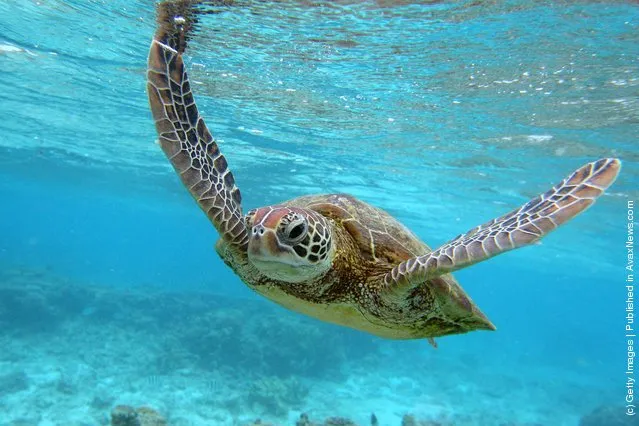
A Hawksbill sea turtle is seen swimming in Lady Elliot Island, Australia

“The Great Barrier Reef is one of the most important sea turtle habitats in the world, with Lady Elliot Island being a key part of that habitat. Every year between November and March the green and loggerhead turtles lumber up the same beach on which they were born more than 50 years ago. These turtles nest on Lady Elliot Island up to nine times in a season, laying between 80 and 120 eggs per clutch. About eight weeks later, young hatchlings leave their nests and head towards the ocean (January to April)”. – Wikipedia

Photo: A Hawksbill sea turtle is seen swimming on January 15, 2012 in Lady Elliot Island, Australia. (Photo by Mark Kolbe/Getty Images)
Details
02 Feb 2012 11:28:00
In this November 6, 2014 photo, Shelah Barr of Happy Hounds Massage gives a massage to Dewie, 2, at the home of Laurie Ubben in San Francisco. (Photo by Jeff Chiu/AP Photo)

“Spa treatments don't stop with people. You won't see any aromatherapy candles around, but animals get massages, too, and it's become a regular service that many pet owners value as more than just glorified petting. Practitioners say massage can be a preventive measure for younger animals and rehabilitative for older ones by boosting flexibility, circulation and immunity”. – Terry Tang via The Associated Press. Here: in this November 6, 2014 photo, Shelah Barr of Happy Hounds Massage gives a massage to Dewie, 2, at the home of Laurie Ubben in San Francisco. (Photo by Jeff Chiu/AP Photo)
Details
05 Dec 2014 13:31:00
A small section of the expanding remains of the Veil Nebula, a massive star that exploded about 8,000 years ago. The entire nebula is 110 light-years across, covering six full moons on the sky as seen from Earth, and resides about 2,100 light-years away in the constellation Cygnus, the Swan. (Photo by Reuters/NASA/ESA/Hubble)

A small section of the expanding remains of the Veil Nebula, a massive star that exploded about 8,000 years ago. The entire nebula is 110 light-years across, covering six full moons on the sky as seen from Earth, and resides about 2,100 light-years away in the constellation Cygnus, the Swan. (Photo by Reuters/NASA/ESA/Hubble)
Details
29 Feb 2016 11:30:00