Loading...
Done
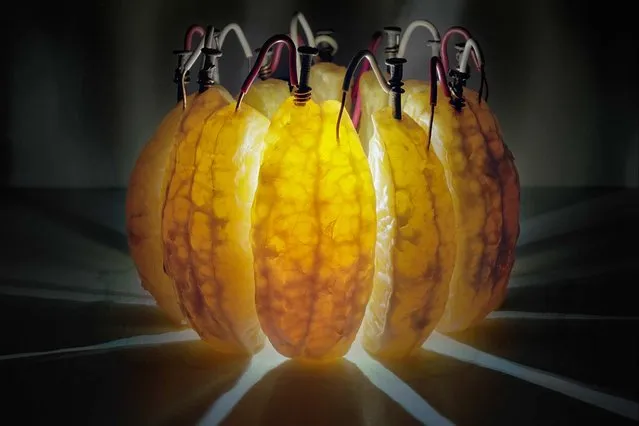
Wedges of an orange generate enough current and electrical juice – 3.5 volts – to power an LED. The fruit’s citric acid helps electrons flow from galvanized nails to copper wire in this 14-hour exposure. This image was published in September’s Visions of Earth, a trio of photos that appear in each issue of National Geographic. (Photo by Caleb Charland/National Geographic)

Wedges of an orange generate enough current and electrical juice – 3.5 volts – to power an LED. The fruit’s citric acid helps electrons flow from galvanized nails to copper wire in this 14-hour exposure. This image was published in September’s Visions of Earth, a trio of photos that appear in each issue of National Geographic. (Photo by Caleb Charland/National Geographic)
Details
06 Jan 2014 12:09:00
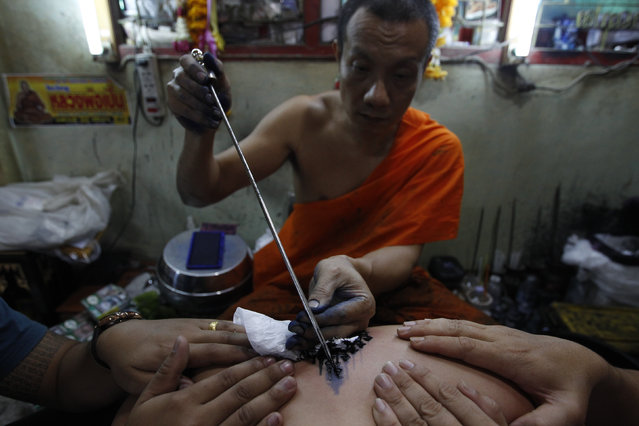
A Buddhist monk uses a traditional needle to tattoo the body of a man at Wat Bang Phra in Nakhon Pathom province on the outskirts of Bangkok, Thailand,  March 18, 2016. (Photo by Chaiwat Subprasom/Reuters)

A Buddhist monk uses a traditional needle to tattoo the body of a man at Wat Bang Phra in Nakhon Pathom province on the outskirts of Bangkok, Thailand, March 18, 2016. Believers from across Thailand travel to the monastery to have their bodies adorned with tattoos and to pay their respects to the temple's master tattooist. They believe the tattoos have mystical powers, ward off bad luck and protect them from harm. (Photo by Chaiwat Subprasom/Reuters)
Details
19 Mar 2016 12:44:00


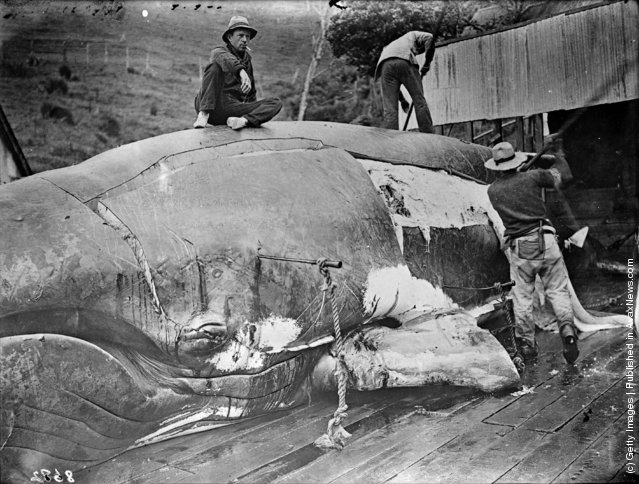
Men slicing blubber off a large, dead whale. (Photo by Topical Press Agency/Getty Images). Circa 1912
Details
08 Jun 2011 09:12:00


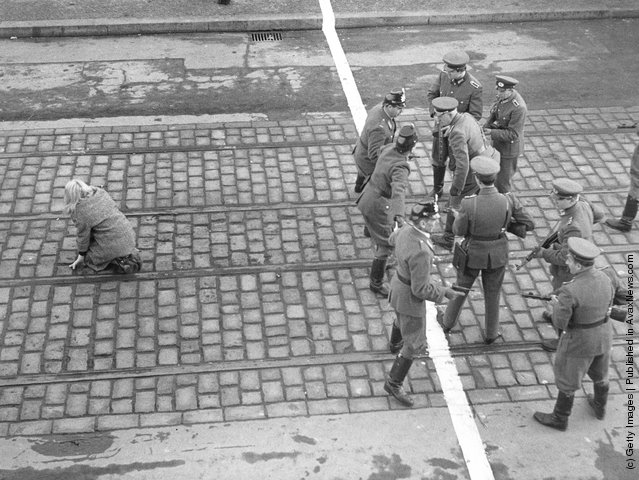
“The Berlin Wall (German: Berliner Mauer) was a barrier constructed by the German Democratic Republic (GDR, East Germany) starting on 13 August 1961, that completely cut off West Berlin from surrounding East Germany and from East Berlin. The barrier included guard towers placed along large concrete walls, which circumscribed a wide area (later known as the “death strip”) that contained anti-vehicle trenches, “fakir beds” and other defenses. The Soviet-dominated Eastern Bloc officially claimed that the wall was erected to protect its population from fascist elements conspiring to prevent the “will of the people” in building a socialist state in East Germany. However, in practice, the Wall served to prevent the massive emigration and defection that marked Germany and the communist Eastern Bloc during the post-World War II period”. – Wikipedia

Photo: West Berlin policemen and East German Volkspolizei face each other across the border in Berlin, circa 1955. (Photo by Three Lions/Hulton Archive/Getty Images)
Details
22 May 2011 10:49:00
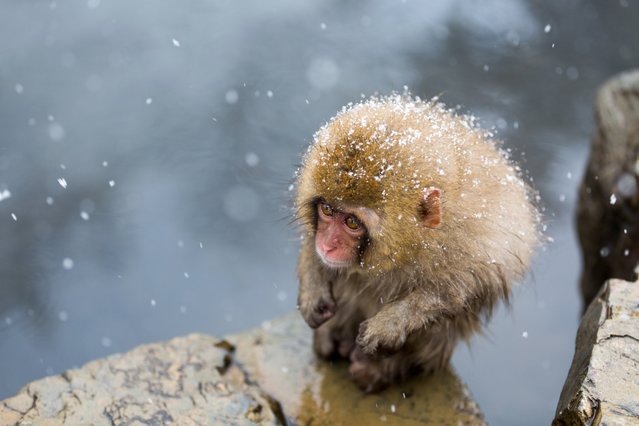
“A Little Monkey on the Cliff”. “A cold front hit the Nagano prefecture. I saw a little monkey enduring the cold in Jigokudani Monkey Park. This little monkey is really cute”. (Photo by Hidetoshi Ogata/Smithsonian Photo Contest)

“A Little Monkey on the Cliff”. “A cold front hit the Nagano prefecture. I saw a little monkey enduring the cold in Jigokudani Monkey Park. This little monkey is really cute”. (Photo by Hidetoshi Ogata/Smithsonian Photo Contest)
Details
10 Mar 2016 12:01:00
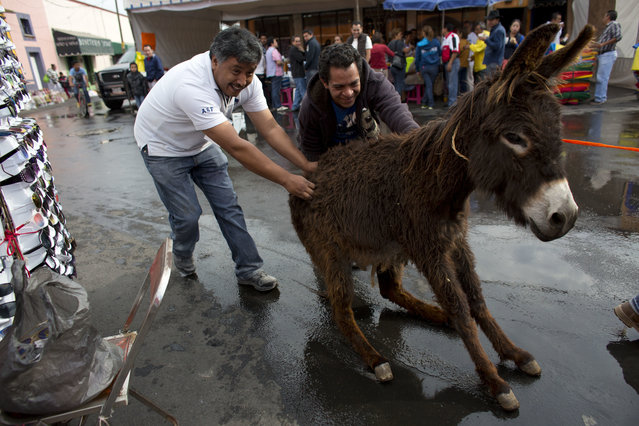
In this May 1, 2016 photo, a reluctant donkey is alternately pushed and pulled and enticed with carrots toward town hall in order to be dressed for the costume competition at the annual donkey festival in Otumba, Mexico state, Mexico. Otumba was an important donkey market during Spanish colonial times, standing at the crossroads of major roads leading to Mexico City, where the beasts pulled heavy loads and carried travelers. Today, however, farmers use tractors and pickup trucks, and the donkey population is in decline. (Photo by Rebecca Blackwell/AP Photo)

In this May 1, 2016 photo, a reluctant donkey is alternately pushed and pulled and enticed with carrots toward town hall in order to be dressed for the costume competition at the annual donkey festival in Otumba, Mexico state, Mexico. Otumba was an important donkey market during Spanish colonial times, standing at the crossroads of major roads leading to Mexico City, where the beasts pulled heavy loads and carried travelers. Today, however, farmers use tractors and pickup trucks, and the donkey population is in decline. (Photo by Rebecca Blackwell/AP Photo)
Details
04 May 2016 11:55:00
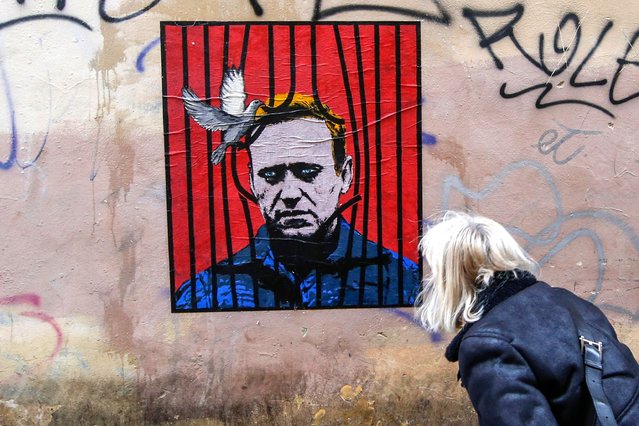
A view of a large poster depicting Russian opposition leader Alexei Navalny behind bars with a dove freeing him from detention, by an unidentified street artist known as Harry Greb, in downtown Rome, Italy, 25 January 2021. Navalny was detained after his arrival to Moscow from Germany on 17 January 2021. A Moscow judge on 18 January ruled that he will remain in custody for 30 days following his airport arrest. Navalny urged Russians to take to the streets to protest against President Putin's rule. (Photo by Fabio Frustaci/EPA/EFE)

A view of a large poster depicting Russian opposition leader Alexei Navalny behind bars with a dove freeing him from detention, by an unidentified street artist known as Harry Greb, in downtown Rome, Italy, 25 January 2021. Navalny was detained after his arrival to Moscow from Germany on 17 January 2021. A Moscow judge on 18 January ruled that he will remain in custody for 30 days following his airport arrest. Navalny urged Russians to take to the streets to protest against President Putin's rule. (Photo by Fabio Frustaci/EPA/EFE)
Details
11 Feb 2021 09:45:00
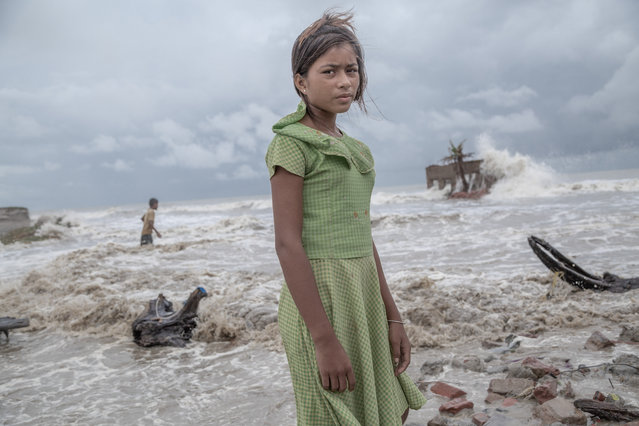
A girl, standing before her tea shop, which is completely ruined by sea water in Frazerganj, Sundarbans, India on August 18, 2020. After Cyclone Aila struck the Sundarbans in 2009, it became clear that frequent cyclonic events will turn the residents of Sundarbans into climate refugees. Within May 5, 2019 – May 25, 2021, Sundarbans faced cyclones- Fani, Bulbul, Amphan & Yaas – each devastating enough to justify the fear of mass displacement. (Photo by Supratim Bhattacharjee/Mangrove Photography Awards)

A girl, standing before her tea shop, which is completely ruined by sea water in Frazerganj, Sundarbans, India on August 18, 2020. After Cyclone Aila struck the Sundarbans in 2009, it became clear that frequent cyclonic events will turn the residents of Sundarbans into climate refugees. Within May 5, 2019 – May 25, 2021, Sundarbans faced cyclones- Fani, Bulbul, Amphan & Yaas – each devastating enough to justify the fear of mass displacement. (Photo by Supratim Bhattacharjee/Mangrove Photography Awards)
Details
26 Sep 2024 03:06:00