Loading...
Done
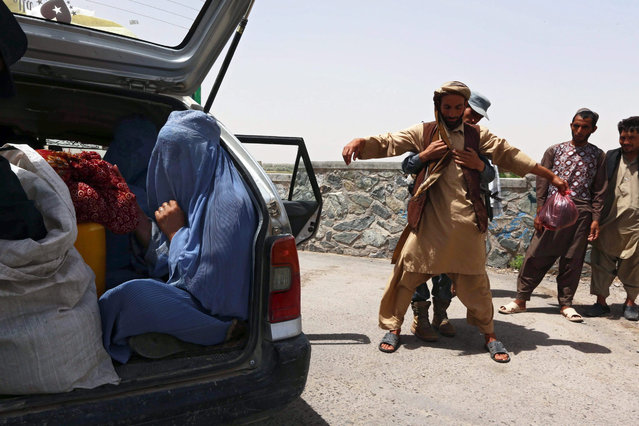
An Afghan policeman frisks a man while a burqa-cald woman sits in the trunk of a car on a roadside in Herat, Afghanistan, 05 July 2015. At least 18 police, two civilians and 30 rebels were killed in central Afghanistan during three days of fierce fighting, police said on 04 July. The clashes ended 04 July after security forces retook control of nine police checkpoints that had fallen to the rebels. (Photo by Jalil Rezayee/EPA)

An Afghan policeman frisks a man while a burqa-cald woman sits in the trunk of a car on a roadside in Herat, Afghanistan, 05 July 2015. At least 18 police, two civilians and 30 rebels were killed in central Afghanistan during three days of fierce fighting, police said on 04 July. The clashes ended 04 July after security forces retook control of nine police checkpoints that had fallen to the rebels. (Photo by Jalil Rezayee/EPA)
Details
06 Jul 2015 10:44:00
The Chilean ship “Skorpios II” is seen after it ran aground in “Maillen” island, near Puerto Montt, south of Santiago, in this handout picture from the Chilean Navy, February 5, 2015. According to the Chilean Navy, the ship's 89 passengers and 31 crew members were all evacuated and no oil spills or casualties were reported. (Photo by Reuters/Chilean Navy)

The Chilean ship “Skorpios II” is seen after it ran aground in “Maillen” island, near Puerto Montt, south of Santiago, in this handout picture from the Chilean Navy, February 5, 2015. According to the Chilean Navy, the ship's 89 passengers and 31 crew members were all evacuated and no oil spills or casualties were reported. (Photo by Reuters/Chilean Navy)
Details
07 Feb 2015 14:22:00
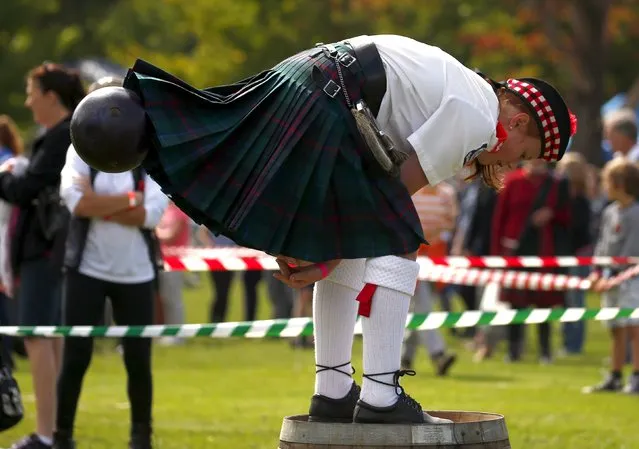
A competitor wearing a kilt and standing on a barrel throws a bowling ball between her legs during the 'Brigaball' contest at the annual Bundanoon Highland Gathering, showcasing traditional Scottish events, held in the town of Bundanoon, located southwest of Sydney, April 9, 2016. (Photo by David Gray/Reuters)

A competitor wearing a kilt and standing on a barrel throws a bowling ball between her legs during the “Brigaball” contest at the annual Bundanoon Highland Gathering, showcasing traditional Scottish events, held in the town of Bundanoon, located southwest of Sydney, April 9, 2016. (Photo by David Gray/Reuters)
Details
11 Apr 2016 11:20:00
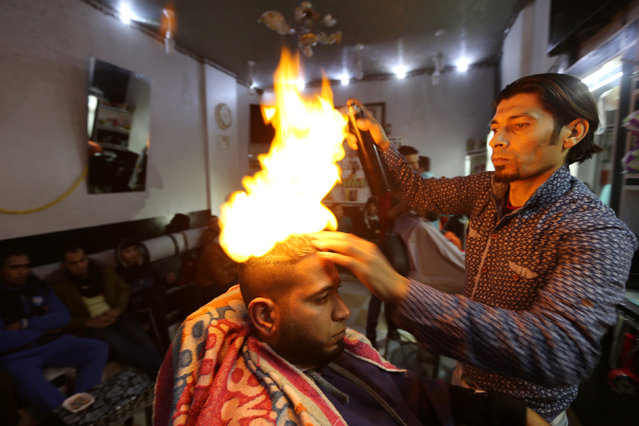
Palestinian barber Ramadan Odwan styles and straightens the hair of a customer with fire at his salon in Rafah, in the southern Gaza Strip February 2, 2017. In Ramadan Odwan's barbershop in Gaza, hair isn't just blow-dried, it's blowtorch-dried. “People have gone crazy about it, many people are curious to go through the experience and they are not afraid”, he told Reuters. “People here love adventures”. Odwan, 37, is not the first stylist in the world to use flame to straighten hair, but his craft is unique in the Gaza Strip. In his salon in the southern Gaza town of Rafah, Odwan applied what he described as a protective liquid coating to a customer's hair – he declined to disclose its contents – before aiming for the head and pressing the button on a small blowtorch. “I control how long I apply fire, I keep it on and off for 10 seconds or 15 seconds. It is completely safe and I have not encountered any accident since I started it two months ago”, Odwan added. Odwan charges 20 shekels ($5.20) for a haircut and fire-straightening. A barber for the past 18 years, he said part of the reason he uses the technique is to show that Palestinian barbers are as “professional as those out there around the world”. (Photo by Ibraheem Abu Mustafa/Reuters)

Palestinian barber Ramadan Odwan styles and straightens the hair of a customer with fire at his salon in Rafah, in the southern Gaza Strip February 2, 2017. In Ramadan Odwan's barbershop in Gaza, hair isn't just blow-dried, it's blowtorch-dried. “People have gone crazy about it, many people are curious to go through the experience and they are not afraid”, he told Reuters. “People here love adventures”. (Photo by Ibraheem Abu Mustafa/Reuters)
Details
11 Feb 2017 00:05:00


“Kumbh Mela is a mass Hindu pilgrimage in which Hindus gather at the Ganges river. The normal Kumbh Mela is celebrated every 3 years, the Ardh (half) Kumbh Mela is celebrated every six years at Haridwar and Prayag, the Purna (complete) Kumbh takes place every twelve years, at four places (Prayag (Allahabad), Haridwar, Ujjain, and Nashik). The Maha (great) Kumbh Mela which comes after 12 “Purna Kumbh Melas”, or 144 years, is held at Allahabad.

The last Ardh Kumbh Mela was held over a period of 45 days beginning in January 2007, more than 70 million Hindu pilgrims took part in the Ardh Kumbh Mela at Prayag, and on January 15, the most auspicious day of the festival of Makar Sankranti, more than 5 million participated. The previous Maha Kumbh Mela, held in 2001, was attended by around 60 million people, making it at the time the largest gathering anywhere in the world in recorded history”. – Wikipedia

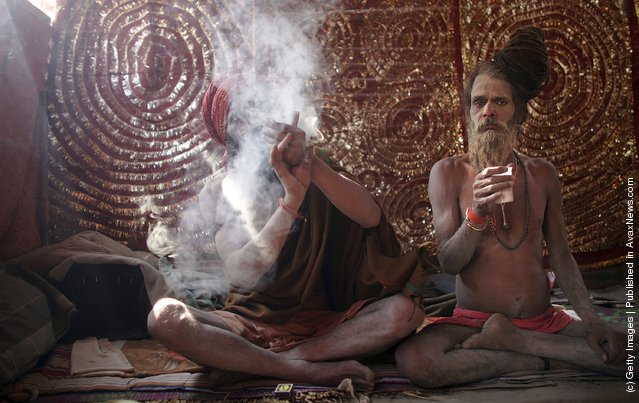
Photo: Sadhus (holy men) smoke at their camp near the ritual site at Sangam, the confluence of the Ganges, Yamuna and mythical Saraswati rivers during the Ardh Kumbh Mela festival (Half Pitcher festival) January 18, 2007 in Allahabad, India. Millions of Hindu pilgrims have flocked to the largest religious gathering in the world which lasts for 45 days in northern India. The festival commemorates the mythical conflict between gods and demons over a pitcher filled with the “nectar of immortality”. Devotees believe that taking a holy dip in the Ganges at this time washes away their sins and paves the path to salvation. (Photo by Mario Tama/Getty Images)

Details
30 Jun 2011 10:27:00
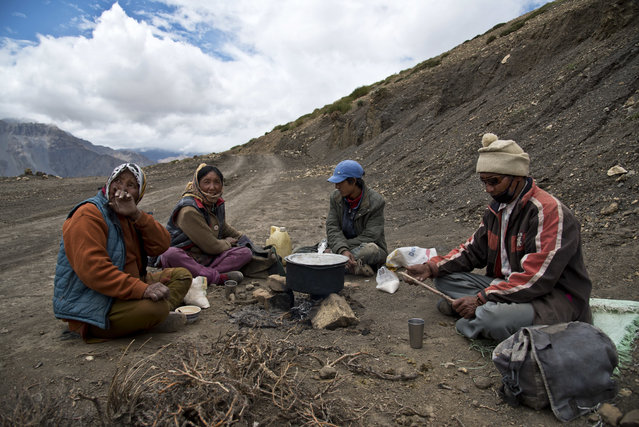
In this August 17, 2016, photo, from left to right, Chhering Chodom, 60, Tashi Yangzom, 50, Lobsang Chhering, 27, and Dorje Tandup, 58, drink milk tea on the side of the road. For centuries, the sleepy valley nestled in the Indian Himalayas remained a hidden Buddhist enclave forbidden to outsiders. Enduring the harsh year-round conditions of the high mountain desert, the people of Spiti Valley lived by a simple communal code – share the Earth's bounty, be hospitable to neighbors, and eschew greed and temptation at all turns. That's all starting to change, for better or worse. Since India began allowing its own citizens as well as outsiders to visit the valley in the early 1990s, tourism and trade have boomed. And the marks of modernization, such as solar panels, asphalt roads and concrete buildings, have begun to appear around some of the villages that dot the remote landscape at altitudes above 4,000 meters (13,000 feet). (Photo by Thomas Cytrynowicz/AP Photo)

In this August 17, 2016, photo, from left to right, Chhering Chodom, 60, Tashi Yangzom, 50, Lobsang Chhering, 27, and Dorje Tandup, 58, drink milk tea on the side of the road. For centuries, the sleepy valley nestled in the Indian Himalayas remained a hidden Buddhist enclave forbidden to outsiders. Enduring the harsh year-round conditions of the high mountain desert, the people of Spiti Valley lived by a simple communal code – share the Earth's bounty, be hospitable to neighbors, and eschew greed and temptation at all turns. That's all starting to change, for better or worse. (Photo by Thomas Cytrynowicz/AP Photo)
Details
15 Sep 2016 09:22:00
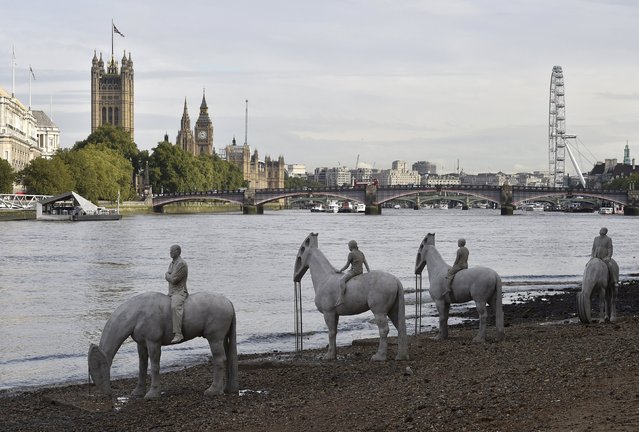
Sculptures entitled “The Rising Tide” by British sculptor Jason deCaires Taylor are seen beside the River Thames in front of the Houses of Parliament and the London Eye ferris wheel in London, September 3, 2015. The representations of four horses and riders are fully visible at low tide but become immersed underwater twice a day as the Thames rises to reach full tide. The installation will be on display throughout September as part of the annual Totally Thames festival. (Photo by Toby Melville/Reuters)

Sculptures entitled “The Rising Tide” by British sculptor Jason deCaires Taylor are seen beside the River Thames in front of the Houses of Parliament and the London Eye ferris wheel in London, September 3, 2015. The representations of four horses and riders are fully visible at low tide but become immersed underwater twice a day as the Thames rises to reach full tide. The installation will be on display throughout September as part of the annual Totally Thames festival. (Photo by Toby Melville/Reuters)
Details
04 Sep 2015 13:58:00
The International Space Station (ISS) moving in front of the sun in November 2020 by astrophotographer Andrew McCarthy. These incredible photos capture the clearest images ever taken of the International Space Station (ISS) moving in front of both the moon and the sun. The photos, taken within days of one another, were captured in the space of less than a second, as the space station could be clearly seen zooming across against the bright backdrops of both moon and sun. Photographer Andrew McCarthy, from California, USA, said the photo of the ISS in front of the sun, in broad daylight, was “one of my trickiest shots ever”. (Photo by Andrew McCarthy/South West News Service)

The International Space Station (ISS) moving in front of the sun in November 2020 by astrophotographer Andrew McCarthy. These incredible photos capture the clearest images ever taken of the International Space Station (ISS) moving in front of both the moon and the sun. The photos, taken within days of one another, were captured in the space of less than a second, as the space station could be clearly seen zooming across against the bright backdrops of both moon and sun. Photographer Andrew McCarthy, from California, USA, said the photo of the ISS in front of the sun, in broad daylight, was “one of my trickiest shots ever”. (Photo by Andrew McCarthy/South West News Service)
Details
28 Nov 2020 00:05:00