Loading...
Done
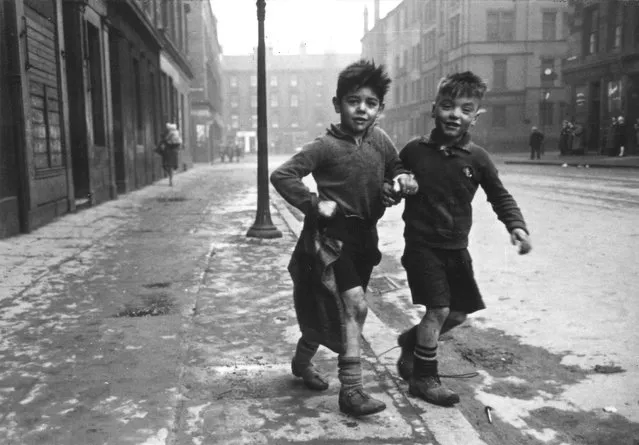
Two boys in the Gorbals area of Glasgow, UK on January 31, 1948. The Gorbals tenements were built quickly and cheaply in the 1840s, providing housing for Glasgow's burgeoning population of industrial workers. Conditions were appalling; overcrowding was standard and sewage and water facilities inadequate. The tenements housed about 40,000 people with up to eight family members sharing a single room, 30 residents sharing a toilet and 40 sharing a tap. By the time this photograph was taken 850 tenements had been demolished since 1920. Redevelopment of the area began in the late 1950s and the tenements were replaced with a modern tower block complex in the sixties. (Photo by Bert Hardy/Getty Images)

Two boys in the Gorbals area of Glasgow, UK on January 31, 1948. The Gorbals tenements were built quickly and cheaply in the 1840s, providing housing for Glasgow's burgeoning population of industrial workers. Conditions were appalling; overcrowding was standard and sewage and water facilities inadequate. The tenements housed about 40,000 people with up to eight family members sharing a single room, 30 residents sharing a toilet and 40 sharing a tap. By the time this photograph was taken 850 tenements had been demolished since 1920. Redevelopment of the area began in the late 1950s and the tenements were replaced with a modern tower block complex in the sixties. (Photo by Bert Hardy/Getty Images)
Details
09 Mar 2017 00:03:00
A woman smokes marijuana during the annual 4/20 marijuana rally on Parliament Hill in Ottawa, Ontario, Canada, April 20, 2017. (Photo by Chris Wattie/Reuters)

A woman smokes marijuana during the annual 4/20 marijuana rally on Parliament Hill in Ottawa, Ontario, Canada, April 20, 2017. (Photo by Chris Wattie/Reuters)
Details
22 Apr 2017 09:38:00
In this Tuesday, May 3, 2016 photo, Madeley Vasquez, 16, breast feeds her one-year-old son Joangel as she waits in line outside a supermarket to buy food in Caracas, Venezuela. Vasquez once ran down the block to avoid getting caught up in a knife fight that broke out when a woman was accused of cutting the line. (Photo by Ariana Cubillos/AP Photo)

In this Tuesday, May 3, 2016 photo, Madeley Vasquez, 16, breast feeds her one-year-old son Joangel as she waits in line outside a supermarket to buy food in Caracas, Venezuela. Vasquez once ran down the block to avoid getting caught up in a knife fight that broke out when a woman was accused of cutting the line. (Photo by Ariana Cubillos/AP Photo)
Details
20 Sep 2016 08:47:00
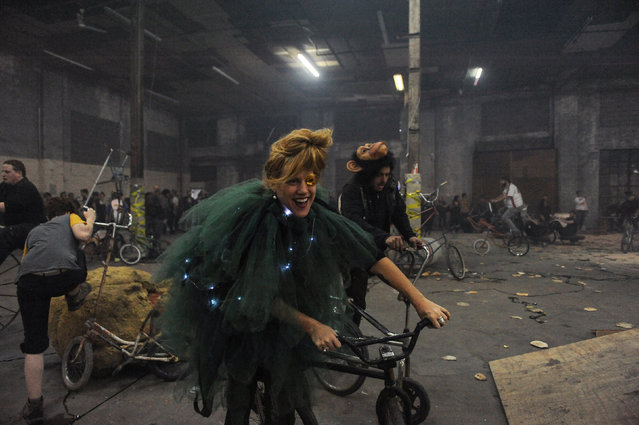
People ride bicycles in Halloween costumes during “Bike Kill 13” in the Brooklyn borough of New York City, October 29, 2016. “Bike Kill” is an annual gathering of builders and riders of home-made bicycles that culminates in a tall bike jousting competition. (Photo by Stephanie Keith/Reuters)

People ride bicycles in Halloween costumes during “Bike Kill 13” in the Brooklyn borough of New York City, October 29, 2016. “Bike Kill” is an annual gathering of builders and riders of home-made bicycles that culminates in a tall bike jousting competition. (Photo by Stephanie Keith/Reuters)
Details
01 Nov 2016 12:01:00
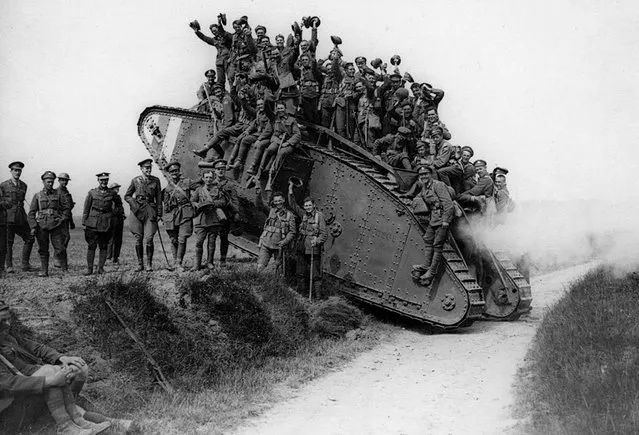
These black-and-white photos are taken from the new book “Armoured Warfare in the First World War 1916 – 1918” by Anthony Tucker-Jones and published by Pen & Sword Military. “Interestingly the British, French and Germans took completely different approaches with varying results”. The British military produced “Little Willie” in Autumn 1915 weighing 18 tonnes, which had a crew of two plus four gunners. “Inspired by a tracked artillery tractor “Little Willie” was referred to as a water tank – hence the name tank – to ensure secrecy”, said Anthony. “This led to the strange looking Mark I with its peculiar rhomboid shape, designed to cross trenches with guns in sponsons on either side. The Germans saw the tank as unchivalrous and were slow to grasp its utility. They favoured the Stormtrooper (specialist soldiers used to infiltrate enemy trenches) and artillery, not the tank”, said Anthony. “However, they didn’t hesitate to make use of captured British tanks. Although the tank helped secure victory and German soldiers dubbed it “Germany’s Downfall” the country was ultimately brought to its knees by the Allies blockade”. Here: British troops hitch a ride on a Mark IV after the massed tank fleet spearheading attack at Cambrai on November 20, 1917. (Photo by Anthony Tucker-Jones/Mediadrumworld.com)

These black-and-white photos are taken from the new book “Armoured Warfare in the First World War 1916 – 1918” by Anthony Tucker-Jones and published by Pen & Sword Military. Here: British troops hitch a ride on a Mark IV after the massed tank fleet spearheading attack at Cambrai on November 20, 1917. (Photo by Anthony Tucker-Jones/Mediadrumworld.com)
Details
23 Feb 2017 00:02:00
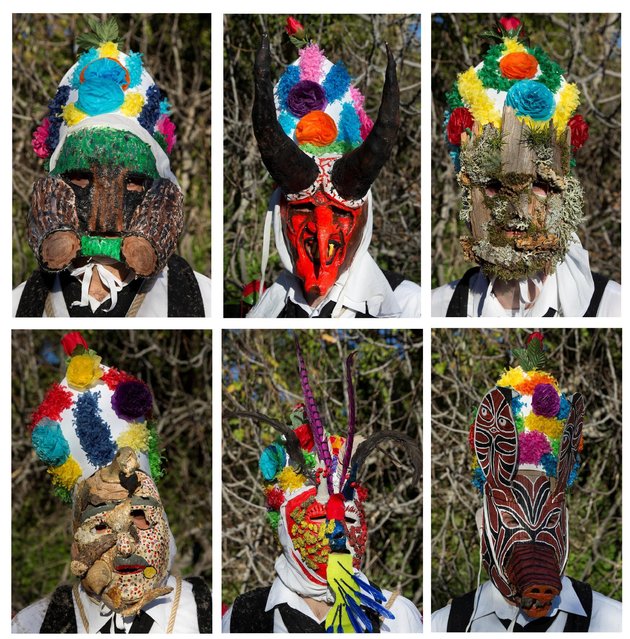
This combination picture shows some revellers wearing masks while dressed as “Botargas” during carnival celebrations in Almiruete, Spain, February 25, 2017. (Photo by Sergio Perez/Reuters)

This combination picture shows some revellers wearing masks while dressed as “Botargas” during carnival celebrations in Almiruete, Spain, February 25, 2017. (Photo by Sergio Perez/Reuters)
Details
28 Feb 2017 00:00:00
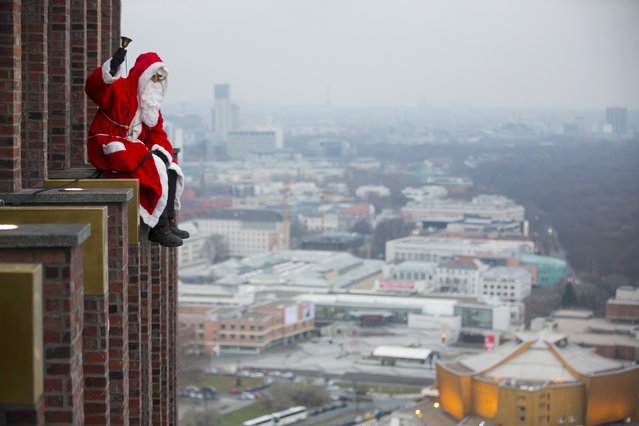
A man dressed as a Santa Claus poses at the front of the Kollhoff Tower at Potsdamer Platz square in Berlin December 14, 2014. (Photo by Hannibal Hanschke/Reuters)

A man dressed as a Santa Claus poses at the front of the Kollhoff Tower at Potsdamer Platz square in Berlin December 14, 2014. (Photo by Hannibal Hanschke/Reuters)
Details
15 Dec 2014 11:23:00
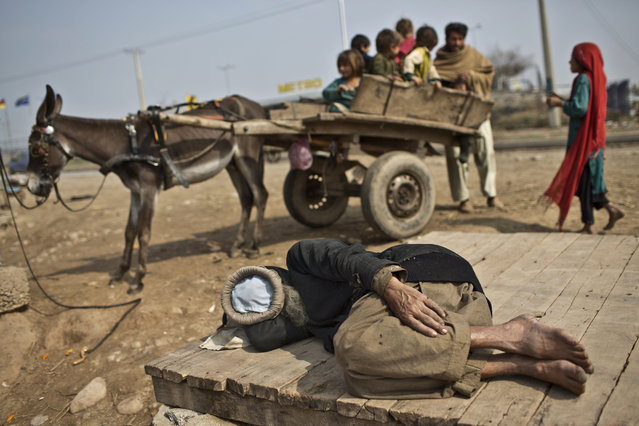
Children play on a donkey cart belonging to an elderly Afghan refugee sleeping on a roadside on the outskirts of Islamabad, Pakistan, Wednesday, February 18, 2015. (Photo by Muhammed Muheisen/AP Photo)

Children play on a donkey cart belonging to an elderly Afghan refugee sleeping on a roadside on the outskirts of Islamabad, Pakistan, Wednesday, February 18, 2015. (Photo by Muhammed Muheisen/AP Photo)
Details
06 Apr 2015 08:57:00