Revellers, dressed as “Zarramaches”, pose inside the city hall during celebrations to mark Saint Blaise's festivity in Casavieja, Spain February 3, 2017. (Photo by Sergio Perez/Reuters)
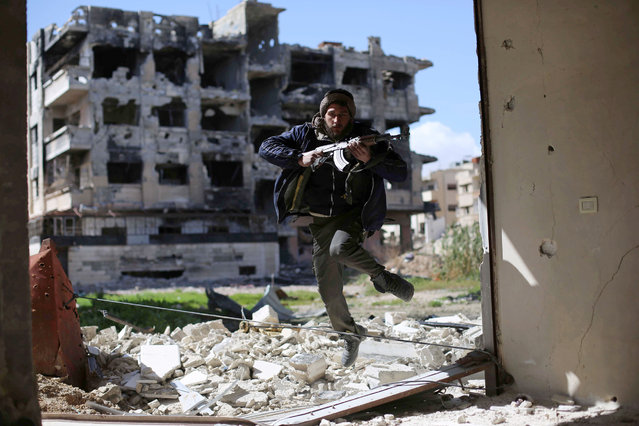
A fighter belonging to Jaish al-Islam (Islam Army) runs to take cover near the frontline on March 14, 2016 in the neighbourhood of Jobar, on the eastern outskirts of the capital Damascus. (Photo by Amer Almohibany/AFP Photo)
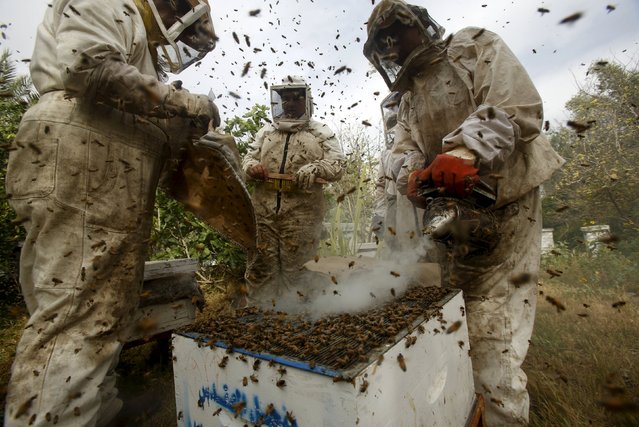
A Palestinian beekeeper uses smoke to calm bees in the process of collecting honey at a farm in Rafah, in the southern Gaza Strip April 11, 2016. Rateb Samour sees 250 patients a day, whose complaints range from hair loss to cerebral palsy and cancer. He is not a doctor and has never worked in a hospital. Samour inherited the skill of bee-sting therapy from his father. From 2003 the agricultural engineer dedicated all his time to study and develop the alternative-medicine treatment of apitherapy, which uses bee-related products from honey, propolis – or bee glue used to build hives – to venom. (Photo by Suhaib Salem/Reuters)
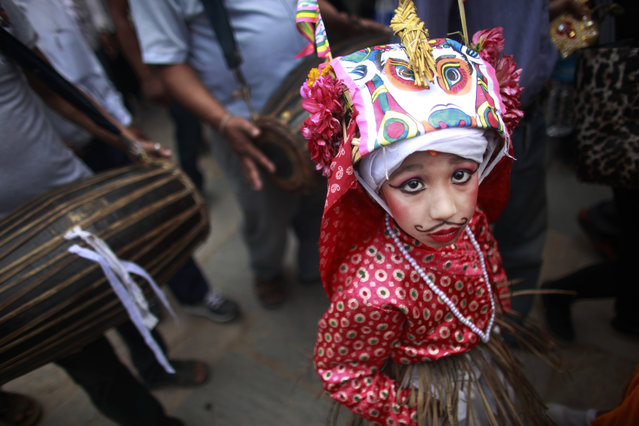
A Nepalese Hindu boy in festival attire walks in a procession during “Gai Jatra”, or Cow Festival in Kathmandu, Nepal, Friday, August 19, 2016. Members of Nepal's Newar Community celebrate the festival in memory of their family members who died the preceding year, believing that the cow will guide them in their journey to heaven. (Photo by Niranjan Shrestha/AP Photo)
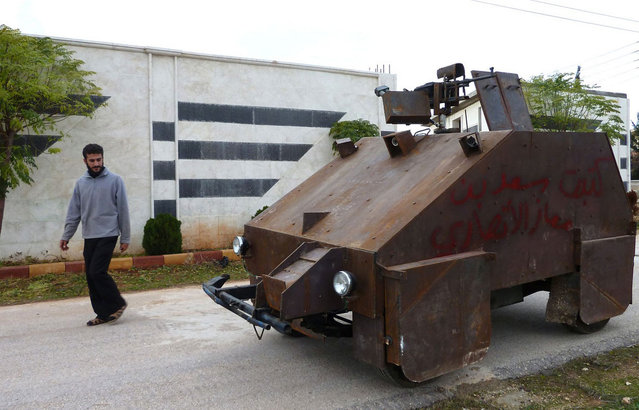
A Syrian rebel walks past Sham 2, a homemade armored vehicle, in Bishqatin, Syria, on December 8, 2012. From a distance it looks rather like a big rusty metal box but closer inspection reveals a homemade armored vehicle waiting to be deployed. Sham II, named after ancient Syria, is built from the chassis of a car and touted by rebels as “100 percent made in Syria”. (Photo by Herve Bar/AFP Photo)