Loading...
Done
A view of traditional bolinhos de bacalhau (fried codfish balls) in Rio de Janeiro, Brazil, May 7, 2016. (Photo by Sergio Moraes/Reuters)

If the most popular foods of Rio de Janeiro have one thing in common, it is their informality. You can find fine restaurants in the city, but they do not set Rio apart from other places. What does set it apart, and what invariably brings its residents, known as "Cariocas," together is the unpretentious food they eat in bright, loud, crowded bars and restaurants, on busy street corners, or after a day at the beach. Here: A view of traditional bolinhos de bacalhau (fried codfish balls) in Rio de Janeiro, Brazil, May 7, 2016. (Photo by Sergio Moraes/Reuters)
Details
05 Aug 2016 13:20:00
A catholic faithful smeared in burnt oil, takes part in the opening of the ten-day celebration of the Santo Domingo de Guzman festival in Managua, on August 1, 2019. (Photo by Inti Ocon/AFP Photo)

A catholic faithful smeared in burnt oil, takes part in the opening of the ten-day celebration of the Santo Domingo de Guzman festival in Managua, on August 1, 2019. In Central America the black devil, or El Cadejo, is an evil dog-like spirit with glowing red eyes that locals believe eats new born puppies. (Photo by Inti Ocon/AFP Photo)
Details
06 Aug 2019 00:01:00
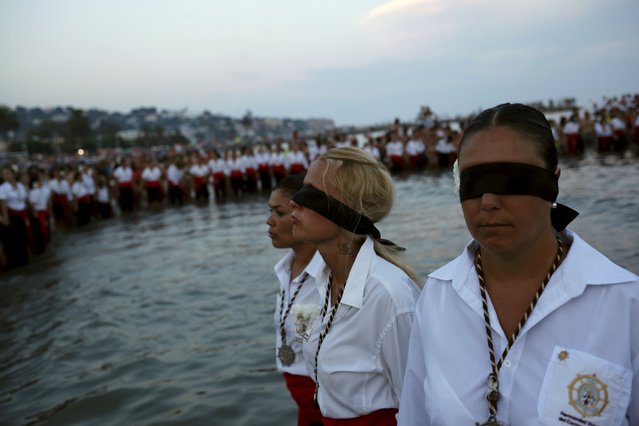
Women in traditional costumes wait for a statue of the El Carmen Virgin to be carried into the sea during a procession in Malaga July 16, 2015. (Photo by Jon Nazca/Reuters)

Women in traditional costumes wait for a statue of the El Carmen Virgin to be carried into the sea during a procession in Malaga July 16, 2015. Many seaside towns celebrate the annual feast of the El Carmen Virgin, who is worshipped as the patron saint of sailors. (Photo by Jon Nazca/Reuters)
Details
17 Jul 2015 13:31:00
A police officer pepper sprays a protester as another protester stands in front of the race director's car during a farmers' protest who attempted to block the stage' s route, during the 16 th stage of the 105 th edition of the Tour de France cycling race, between Carcassonne and Bagneres- de- Luchon, southwestern France, on July 24, 2018. The race was halted for several minutes on July 24 after tear gas was used as protesting farmers attempted to block the route. (Photo by Stephane Mahe/Reuters)

A police officer pepper sprays a protester as another protester stands in front of the race director's car during a farmers' protest who attempted to block the stage' s route, during the 16 th stage of the 105 th edition of the Tour de France cycling race, between Carcassonne and Bagneres- de- Luchon, southwestern France, on July 24, 2018. The race was halted for several minutes on July 24 after tear gas was used as protesting farmers attempted to block the route. (Photo by Stephane Mahe/Reuters)
Details
26 Jul 2018 00:01:00
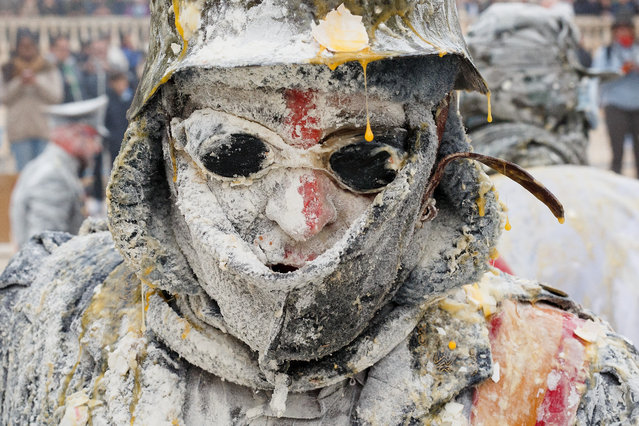
A reveller takes part in the battle of “Enfarinats”, a flour fight in celebration of the Els Enfarinats festival on December 28, 2015 in Ibi, Spain. (Photo by Pablo Blazquez Dominguez/Getty Images)

A reveller takes part in the battle of “Enfarinats”, a flour fight in celebration of the Els Enfarinats festival on December 28, 2015 in Ibi, Spain. Citizens of Ibi annually celebrate the festival with a battle using flour, eggs and firecrackers. (Photo by Pablo Blazquez Dominguez/Getty Images)
Details
30 Dec 2015 08:04:00
Romain de Tirtoff (Erte) – Symphony In Black

“Romain de Tirtoff (23 November 1892 – 21 April 1990) was a Russian-born French artist and designer known by the pseudonym Erté, the French pronunciation of his initials, R.T. He was a diversely talented 20th-century artist and designer who flourished in an array of fields, including fashion, jewellery, graphic arts, costume and set design for film, theatre, and opera, and interior decor”. – Wikipedia. Photo: Romain de Tirtoff (Erte) – “Symphony In Black” (please click to enlarge).
Details
29 Jan 2014 13:34:00
Syrian Tulin Hashemi waits for a job interview at a hotel in Vidigal slum in Rio de Janeiro, Brazil, September 22, 2015. Tulin, whose mother arrived two days ago, has been living in Brazil for two months. As she does not speak Portuguese, Tulin says it is difficult for her to find a job and therefore she is staying at the slum as it is one of the cheaper neighbourhoods to live in. (Photo by Pilar Olivares/Reuters)

Syrian Tulin Hashemi waits for a job interview at a hotel in Vidigal slum in Rio de Janeiro, Brazil, September 22, 2015. Tulin, whose mother arrived two days ago, has been living in Brazil for two months. As she does not speak Portuguese, Tulin says it is difficult for her to find a job and therefore she is staying at the slum as it is one of the cheaper neighbourhoods to live in. According to the National Committee for Refugees (CONARE), 2,077 people fleeing the Syrian civil war have settled in Brazil, whilst a quarter of the 8,400 refugees in the Latin American country come from Syria. (Photo by Pilar Olivares/Reuters)
Details
25 Sep 2015 08:05:00
Maria, 18, wearing a traditional Sevillana outfit, poses for a portrait during the traditional Feria de Abril (April fair) in the Andalusian capital of Seville April 16, 2013. (Photo by Marcelo del Pozo/Reuters)

Maria, 18, wearing a traditional Sevillana outfit, poses for a portrait during the traditional Feria de Abril (April fair) in the Andalusian capital of Seville April 16, 2013. (Photo by Marcelo del Pozo/Reuters)
Details
22 Apr 2013 06:34:00