Loading...
Done
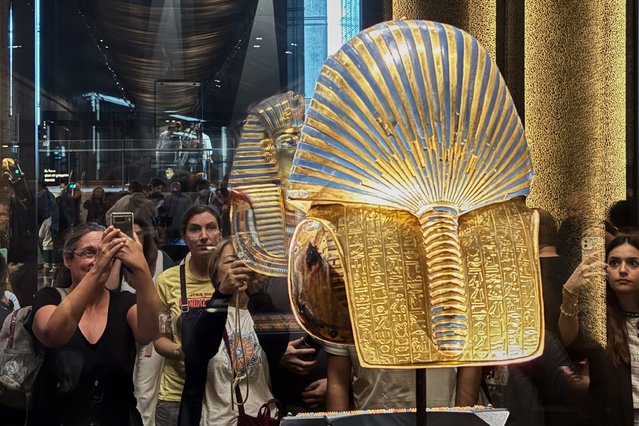
Visitors hold mobile devicecs in front of the golden burial mask of King Tutankhamun during the first day for visitors after the official opening of the Grand Egyptian Museum in Giza, Egypt, Tuesday, November 4, 2025. (Photo by Amr Nabil/AP Photo)

Visitors hold mobile devicecs in front of the golden burial mask of King Tutankhamun during the first day for visitors after the official opening of the Grand Egyptian Museum in Giza, Egypt, Tuesday, November 4, 2025. (Photo by Amr Nabil/AP Photo)
Details
10 Nov 2025 04:32:00
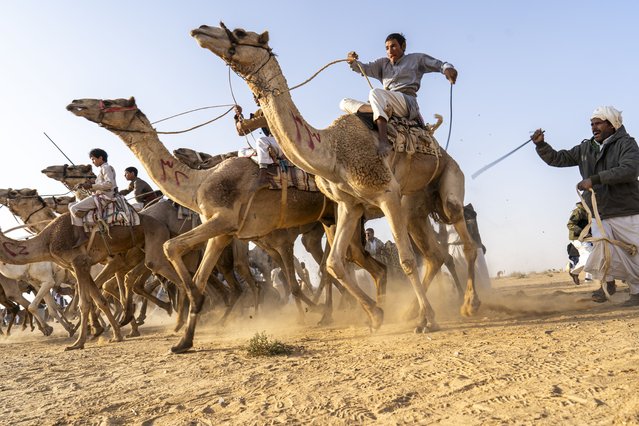
The start of the Al-Sirr camel race on November 19, 2025 in El Hassana, Egypt. The Al-Sirr camel race is one of the most culturally significant and widely celebrated sporting events among the Bedouin communities of Sinai. Every year, Bedouin tribes gather here to hold this traditional race, an event that preserves its authentic heritage. Unlike modern camel races elsewhere, the Bedouin here do not use robotic jockeys or advanced racing technologies. Instead, the camels are ridden by young boys aged approximately 5 to 16, maintaining a long-standing cultural practice. (Photo by Ali Moustafa/Getty Images)

The start of the Al-Sirr camel race on November 19, 2025 in El Hassana, Egypt. The Al-Sirr camel race is one of the most culturally significant and widely celebrated sporting events among the Bedouin communities of Sinai. Every year, Bedouin tribes gather here to hold this traditional race, an event that preserves its authentic heritage. Unlike modern camel races elsewhere, the Bedouin here do not use robotic jockeys or advanced racing technologies. Instead, the camels are ridden by young boys aged approximately 5 to 16, maintaining a long-standing cultural practice. (Photo by Ali Moustafa/Getty Images)
Details
03 Jan 2026 12:49:00
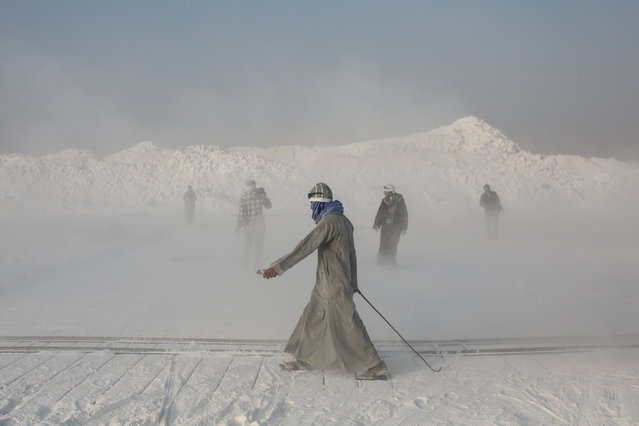
In this Wednesday, March 18, 2015 photo, limestone quarry workers walk through a cloud of dust spewed into the air by rotor blades of the stone-cutting machinery in the desert of Minya, southern Egypt. (Photo by Mosa'ab Elshamy/AP Photo)

In this Wednesday, March 18, 2015 photo, limestone quarry workers walk through a cloud of dust spewed into the air by rotor blades of the stone-cutting machinery in the desert of Minya, southern Egypt. Around 45,000 people, including children, work in an estimated 1,500 quarries, digging out stones that later will be used in construction or powdered to be used by pharmaceutical and ceramic companies. (Photo by Mosa'ab Elshamy/AP Photo)
Details
07 Apr 2015 11:41:00
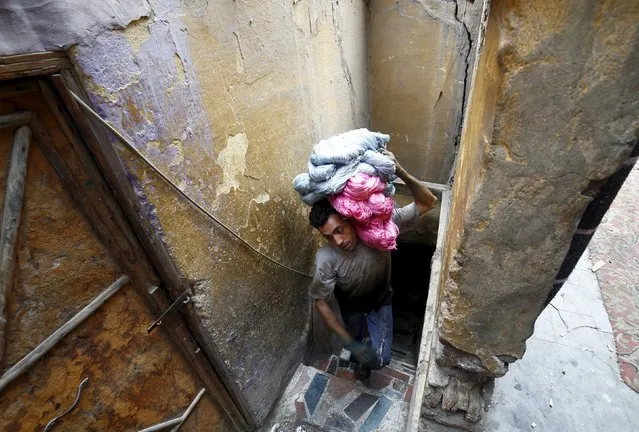
Mohamed Mostafa, 35, carries dyed yarns at a dye workshop in old Cairo, Egypt, March 17, 2016. (Photo by Amr Abdallah Dalsh/Reuters)

Mohamed Mostafa, 35, carries dyed yarns at a dye workshop in old Cairo, Egypt, March 17, 2016. Egypt's hard currency crisis and competition from modern factories in Asia and at home threaten one of the last dye workshops in Egypt. But one of its owners takes comfort in the trade's ancient resilience. Mohamed Mostafa boasts that the profession dates back 3,000 years, so it can survive anything. (Photo by Amr Abdallah Dalsh/Reuters)
Details
09 Apr 2016 13:26:00
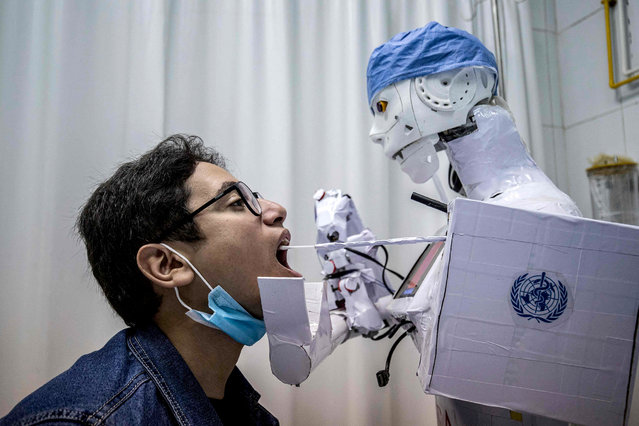
A prong extending from a remote-controlled robot prototype approaches the mouth of a volunteer to extract a throat swab sample, as part of a self-funded project to assist physicians in running tests on suspected COVID-19 coronavirus patients in a bid to limit human exposure to disease-carriers, at a private hospital in Egypt's Nile delta city of Tanta, on March 20, 2021. (Photo by Khaled Desouki/AFP Photo)

A prong extending from a remote-controlled robot prototype approaches the mouth of a volunteer to extract a throat swab sample, as part of a self-funded project to assist physicians in running tests on suspected COVID-19 coronavirus patients in a bid to limit human exposure to disease-carriers, at a private hospital in Egypt's Nile delta city of Tanta, on March 20, 2021. (Photo by Khaled Desouki/AFP Photo)
Details
24 Apr 2021 08:47:00
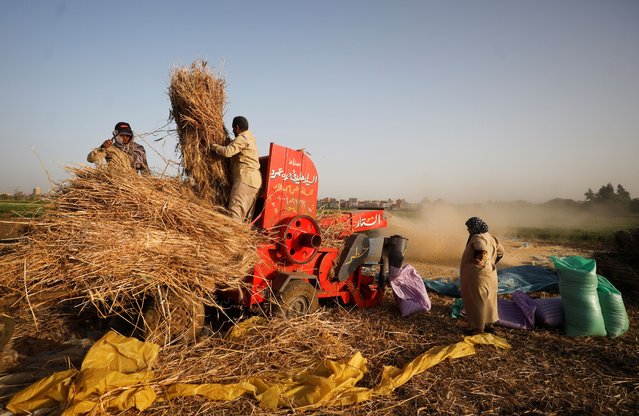
A farmer carries a bundle of wheat after harvesting it from a field in the Gharbia Governorate, as Egypt ramps up efforts to slow the spread of the coronavirus disease (COVID-19), Egypt on May 14, 2020. (Photo by Mohamed Abd El Ghany/Reuters)

A farmer carries a bundle of wheat after harvesting it from a field in the Gharbia Governorate, as Egypt ramps up efforts to slow the spread of the coronavirus disease (COVID-19), Egypt on May 14, 2020. (Photo by Mohamed Abd El Ghany/Reuters)
Details
21 May 2020 00:01:00
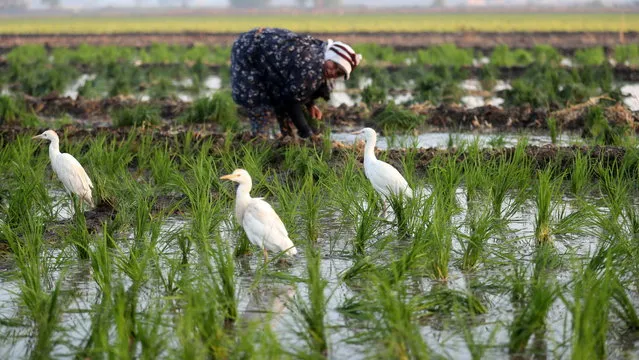
Egrets stand on a field as an Egyptian farmer plants rice seedling in Egypt's fertile Delta in Tanta, Algharbeya governorate, 100 km from Cairo, Egypt, 22 June 2022.  Egyptian Government reduced the planting of some crops that need a massive amount of irrigation water, while the government said it will reduce the rice agriculture area in Egypt, amid fear the Renaissance Dam project in Ethiopia could affect the amount of River Nile water reaching Egypt. (Photo by Khaled Elfiqi/EPA/EFE)

Egrets stand on a field as an Egyptian farmer plants rice seedling in Egypt's fertile Delta in Tanta, Algharbeya governorate, 100 km from Cairo, Egypt, 22 June 2022. Egyptian Government reduced the planting of some crops that need a massive amount of irrigation water, while the government said it will reduce the rice agriculture area in Egypt, amid fear the Renaissance Dam project in Ethiopia could affect the amount of River Nile water reaching Egypt. (Photo by Khaled Elfiqi/EPA/EFE)
Details
23 Jul 2022 04:52:00
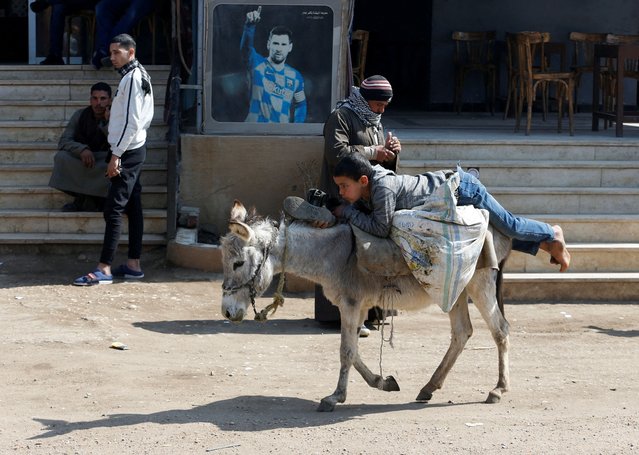
An Egyptian boy rides his donkey in front of a cafeteria with a picture of former Barcelona's forward player Lionel Messi at a village, near Giza, on the outskirts of Cairo, Egypt, February 7, 2022. (Photo by Amr Abdallah Dalsh/Reuters)

An Egyptian boy rides his donkey in front of a cafeteria with a picture of former Barcelona's forward player Lionel Messi at a village, near Giza, on the outskirts of Cairo, Egypt, February 7, 2022. (Photo by Amr Abdallah Dalsh/Reuters)
Details
10 Feb 2022 05:05:00