Loading...
Done
Leafy sea dragon

The leafy seadragon or Glauert's seadragon, Phycodurus eques, is a marine fish in the family Syngnathidae, which also includes the seahorses. It is the only member of the genus Phycodurus. It is found along the southern and western coasts of Australia. The name is derived from the appearance, with long leaf-like protrusions coming from all over the body. These protrusions are not used for propulsion; they serve only as camouflage. The leafy seadragon propels itself by means of a pectoral fin on the ridge of its neck and a dorsal fin on its back closer to the tail end. These small fins are almost completely transparent and difficult to see as they undulate minutely to move the creature sedately through the water, completing the illusion of floating seaweed.
Details
05 Sep 2012 08:51:00
Moon jellyfish and cross jellies. (Photo by David Hall)

David Hall’s photographs of scenery and creatures off the coast of Canada in the Pacific Northwest portray serenity under the water, which belie the extreme challenges he faces to get his images. For each shoot, Hall wears a dry suit, a neoprene body suit that covers all of his body but his head and traps air inside to keep him warm. Water temperature in Canada’s British Columbia typically ranges between 45 and 50 degrees Fahrenheit. Photo: Moon jellyfish and cross jellies. (Photo by David Hall)
Details
16 Sep 2014 12:57:00
People gather as a crowd of sea lions lay on floating docks at Pier 39 in San Francisco, California May 4, 2015. (Photo by Robert Galbraith/Reuters)

People gather as a crowd of sea lions lay on floating docks at Pier 39 in San Francisco, California May 4, 2015. Hundreds of sea lions began hauling out on the docks following the Loma Prieta earthquake of 1989, and face no natural predators at the pier. (Photo by Robert Galbraith/Reuters)
Details
05 May 2015 10:59:00
In this May 8, 2015 photo, sisters Zoraida Infante, left, and Graciela Trujillo pray on Fishermen's Beach before therapeutic swimming in the Pacific Ocean in Lima, Peru. Under overcast skies, the bathers practice thalassotherapy, which derives from the Greek “thalasso”, for “sea”, and draws on the ocean's healing properties. (Photo by Rodrigo Abd/AP Photo)

In this May 8, 2015 photo, sisters Zoraida Infante, left, and Graciela Trujillo pray on Fishermen's Beach before therapeutic swimming in the Pacific Ocean in Lima, Peru. Under overcast skies, the bathers practice thalassotherapy, which derives from the Greek “thalasso”, for “sea”, and draws on the ocean's healing properties. (Photo by Rodrigo Abd/AP Photo)
Details
21 May 2015 12:19:00
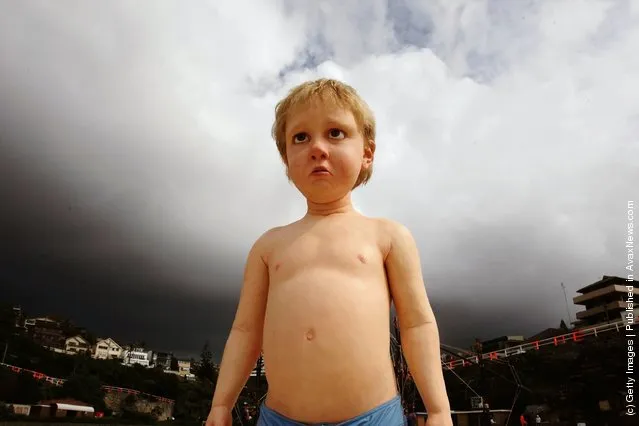
A woman stands next to a giant jandal  on Tamarama Beach as giant sculptures are installed ahead of the “Sculpture by the Sea” exhibition in Sydney on October 19, 2016. Celebrating it's 20th anniversary, Sculpture by the Sea is the world's largest annual, free-to-the-public, outdoor sculpture exhibition. (Photo by William West/AFP Photo)

A woman stands next to a giant jandal on Tamarama Beach as giant sculptures are installed ahead of the “Sculpture by the Sea” exhibition in Sydney on October 19, 2016. Celebrating it's 20th anniversary, Sculpture by the Sea is the world's largest annual, free-to-the-public, outdoor sculpture exhibition. (Photo by William West/AFP Photo)
Details
21 Oct 2016 12:42:00
“I See Sea” by Dmytriy Dokunov. The frozen Black Sea. Odessa, Ukraine; January, 2012. (Photo by Дмитрий Докунов)

“I See Sea” by Photographer Dmytriy Dokunov. The frozen Black Sea. Scene of action: Odessa, Ukraine; January, 2012. (Photo by Dmytriy Dokunov)
Details
18 Dec 2012 09:52:00
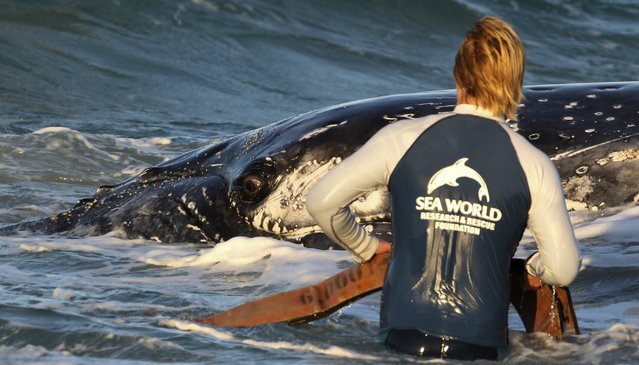
A marine rescue worker from Sea World works in a joint attempt with his colleagues to help a juvenile humpback whale stranded at Palm Beach on the Gold Coast, in Queensland July 9, 2014. (Photo by Jason O'Brien/Reuters)

A marine rescue worker from Sea World works in a joint attempt with his colleagues to help a juvenile humpback whale stranded at Palm Beach on the Gold Coast, in Queensland July 9, 2014. (Photo by Jason O'Brien/Reuters)
Details
11 Jul 2014 12:01:00
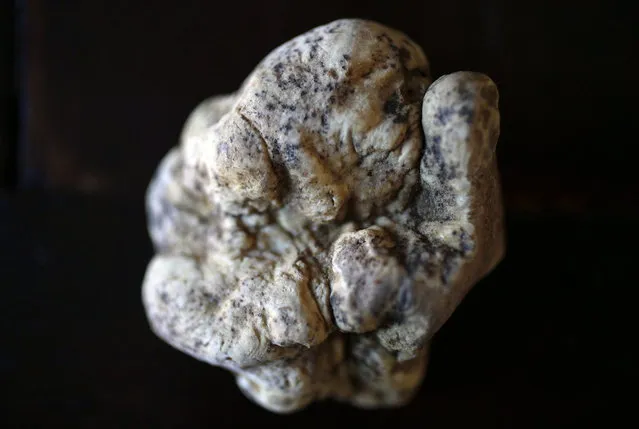
A truffle is seen on a table in Alba, north-western Italy November 11, 2013. Located in the heart of the Langhe – the hilly southern area of Italy's northwestern Piedmont region – Alba is the country's capital of white truffles, a variety of the prized fungus which grows underground. Truffles are found two to eight inches (5-20cm) below the ground near the roots of trees. (Photo by Stefano Rellandini/Reuters)

A truffle is seen on a table in Alba, north-western Italy November 11, 2013. Located in the heart of the Langhe – the hilly southern area of Italy's northwestern Piedmont region – Alba is the country's capital of white truffles, a variety of the prized fungus which grows underground. Truffles are found two to eight inches (5-20cm) below the ground near the roots of trees. They give off an odour which lasts for a limited period of time and can be detected with the assistance of well-trained dogs and experienced hunters. Output of white truffles, which are not cultivated and only grow naturally in forests, has fallen in Italy over the past few years, largely because climate change has brought a damaging mix of drought and torrential rains. (Photo by Stefano Rellandini/Reuters)
Details
31 Dec 2013 11:22:00