Loading...
Done
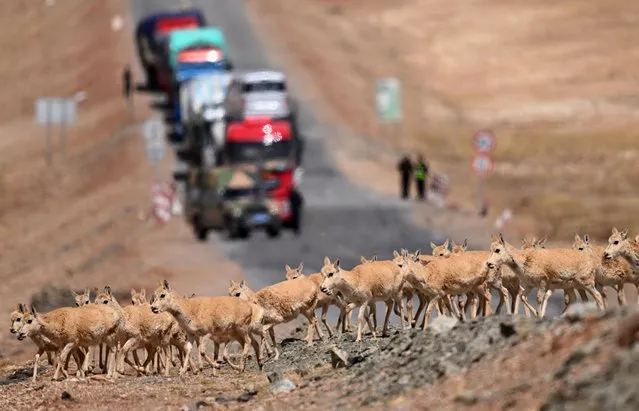
Pregnant Tibetan antelopes move across the Qinghai-Tibet highway in Hoh Xil, northwest China's Qinghai Province, May 29, 2023. A growing number of pregnant Tibetan antelopes are migrating to the heart of northwest China's Hoh Xil National Nature Reserve to give birth, according to the reserve's management office. Every year, tens of thousands of pregnant Tibetan antelopes start their migration to Hoh Xil in around May to give birth and leave with their offspring in late July. Under the first-class state protection in China, the once-endangered species is found in Tibet Autonomous Region, Qinghai Province, and Xinjiang Uygur Autonomous Region. Their population has increased over the past three decades thanks to the ban on illegal hunting and other measures implemented to improve its habitat. (Photo by Xinhua News Agency/Rex Features/Shutterstock)

Pregnant Tibetan antelopes move across the Qinghai-Tibet highway in Hoh Xil, northwest China's Qinghai Province, May 29, 2023. A growing number of pregnant Tibetan antelopes are migrating to the heart of northwest China's Hoh Xil National Nature Reserve to give birth, according to the reserve's management office. Every year, tens of thousands of pregnant Tibetan antelopes start their migration to Hoh Xil in around May to give birth and leave with their offspring in late July. (Photo by Xinhua News Agency/Rex Features/Shutterstock)
Details
08 Jun 2023 02:20:00
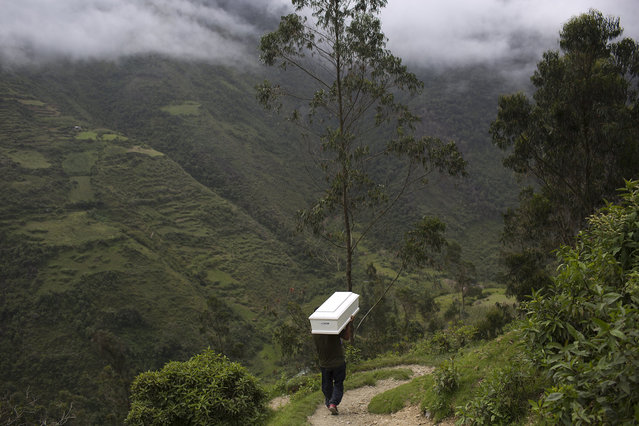
In this March 29, 2016 photo, a man shoulders a coffin with the remains of a loved one who was slain more than two decades ago by Shining Path rebels, as he walks to the cemetery for a group burial service, in Ccano, a village in the Huanta area of Ayachcuo department, Peru. Presidential candidate Keiko Fujimori's base of support is in places like Ccano, where promises to build roads, clinics and schools recall her agronomist father’s own legacy of delivering aid to the long-overlooked countryside. (Photo by Rodrigo Abd/AP Photo)

In this March 29, 2016 photo, a man shoulders a coffin with the remains of a loved one who was slain more than two decades ago by Shining Path rebels, as he walks to the cemetery for a group burial service, in Ccano, a village in the Huanta area of Ayachcuo department, Peru. Presidential candidate Keiko Fujimori's base of support is in places like Ccano, where promises to build roads, clinics and schools recall her agronomist father’s own legacy of delivering aid to the long-overlooked countryside. (Photo by Rodrigo Abd/AP Photo)
Details
08 Apr 2016 14:43:00
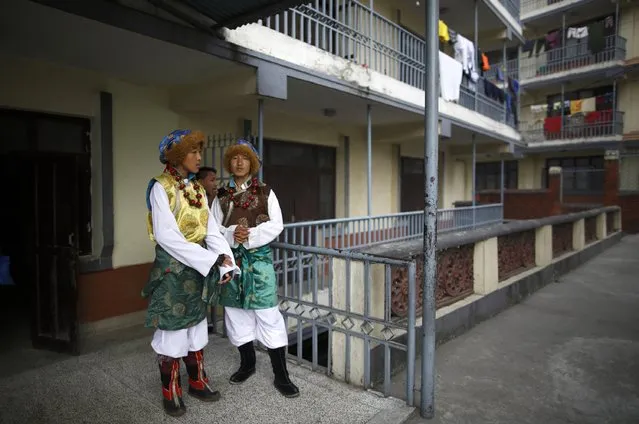
Tibetan boys dressed in traditional attire take part during a function organised by the Tibetan Refugee Community in Nepal,commemorating the 25th Anniversary of the Nobel Peace Prize conferment to exiled Tibetan spiritual leader Dalai Lama and the 66th International Human Rights Day in Kathmandu December 10, 2014. Nepal ceased issuing refugee papers to Tibetans in 1989 and recognizes Tibet to be a part of China. (Photo by Navesh Chitrakar/Reuters)

Tibetan boys dressed in traditional attire take part during a function organised by the Tibetan Refugee Community in Nepal,commemorating the 25th Anniversary of the Nobel Peace Prize conferment to exiled Tibetan spiritual leader Dalai Lama and the 66th International Human Rights Day in Kathmandu December 10, 2014. Nepal ceased issuing refugee papers to Tibetans in 1989 and recognizes Tibet to be a part of China. (Photo by Navesh Chitrakar/Reuters)
Details
11 Dec 2014 14:02:00
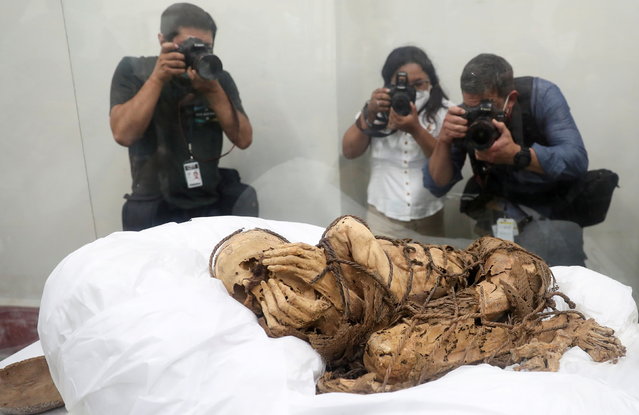
Members of the media take pictures of the pre-Inca “Mummy of Cajamarquilla”, which is presumed to be between 800 and 1200 years old, in Lima, Peru December 7, 2021. The “Mummy of Cajamarquilla” found by archaeologists from San Marcos inside a burial chamber of about three meters long and a depth of 1.40 meters in the Cajamarquilla archaeological site, east of Lima. (Photo by Sebastian Castaneda/Reuters)

Members of the media take pictures of the pre-Inca “Mummy of Cajamarquilla”, which is presumed to be between 800 and 1200 years old, in Lima, Peru December 7, 2021. The “Mummy of Cajamarquilla” found by archaeologists from San Marcos inside a burial chamber of about three meters long and a depth of 1.40 meters in the Cajamarquilla archaeological site, east of Lima. (Photo by Sebastian Castaneda/Reuters)
Details
09 Dec 2021 09:05:00
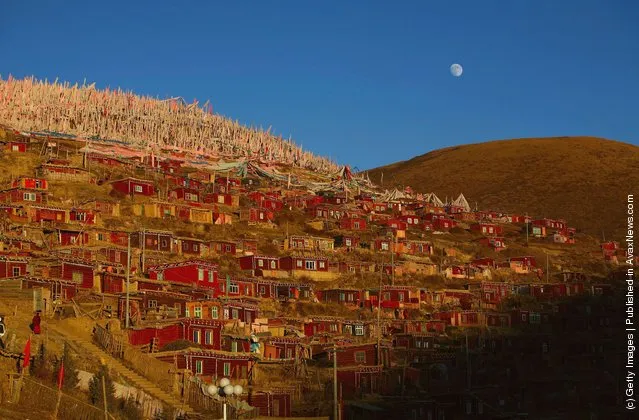
Monastic dormitories stand on the hillside at the Serthar Wuming Buddhist Study Institute in Serthar County of Garze Tibetan Autonomous Prefecture, Sichuan Province, China

Monastic dormitories stand on the hillside at the Serthar Wuming Buddhist Study Institute on November 4, 2006 in Serthar County of Garze Tibetan Autonomous Prefecture, Sichuan Province, China. The Wuming Buddhist Study Institute is located in Larung Gar Monastery on an altitude of 3,700 meters (about 12,136 feet). The institute has the largest conglomeration of monks and nuns in Tibetan Areas, with over 40,000 monastics from the Tibet Buddhism Nyingma School, Gelug School, Sakya School and Kagyu School, including more than 10,000 nuns. (Photo by China Photos/Getty Images)
Details
10 Feb 2012 11:39:00
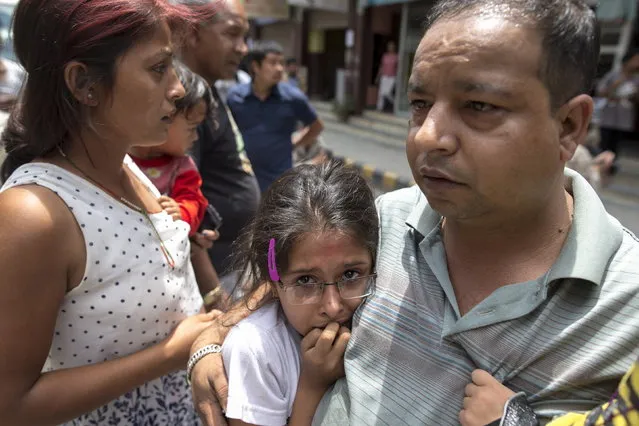
Local residents evacuate onto a street minutes after an earthquake in central Kathmandu, Nepal, May 12, 2015. (Photo by Athit Perawongmetha/Reuters)

Local residents evacuate onto a street minutes after an earthquake in central Kathmandu, Nepal, May 12, 2015. A 7.3 magnitude earthquake killed at least 37 people and spread panic in Nepal on Tuesday, bringing down buildings already weakened by a devastating tremor less than three weeks ago and unleashing landslides in Himalayan valleys near Mount Everest. The earthquake was centered 76 km (47 miles) east of the capital in a hilly area close to the border with Tibet, according to coordinates provided by the U.S. Geological Survey. (Photo by Athit Perawongmetha/Reuters)
Details
13 May 2015 11:36:00
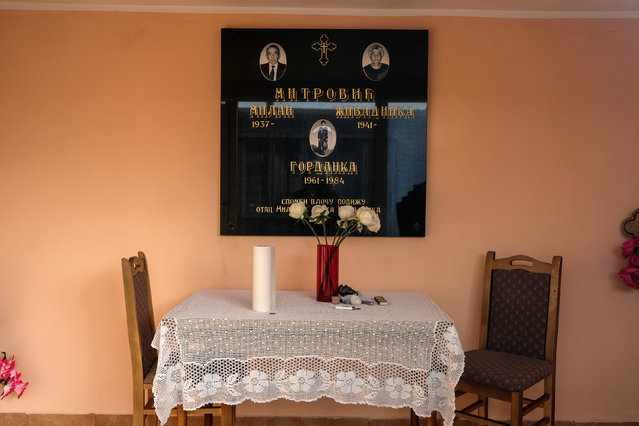
Pictures of deceased people are seen inside a chapel at a cemetery in the village of Smoljinac, Serbia, October 25, 2016. (Photo by Marko Djurica/Reuters)

Pictures of deceased people are seen inside a chapel at a cemetery in the village of Smoljinac, Serbia, October 25, 2016. From a distance, the cemetery in the eastern Serbian village of Smoljinac looks like a residential neighbourhood eerily placed among graves. But once inside the grounds, after passing a section with the usual stone slabs, visitors find rows of small bungalows painted in pastel colours. They have one or two rooms, large windows and ornate plaques – some inside, some outside – memorialising the deceased. These are the burial chapels of Smoljinac, cosy cabins with a furnished room inside, a storage place for wreaths and funeral paraphernalia, and the family crypt below. Some even have electric power inside. (Photo by Marko Djurica/Reuters)
Details
12 Nov 2016 10:37:00
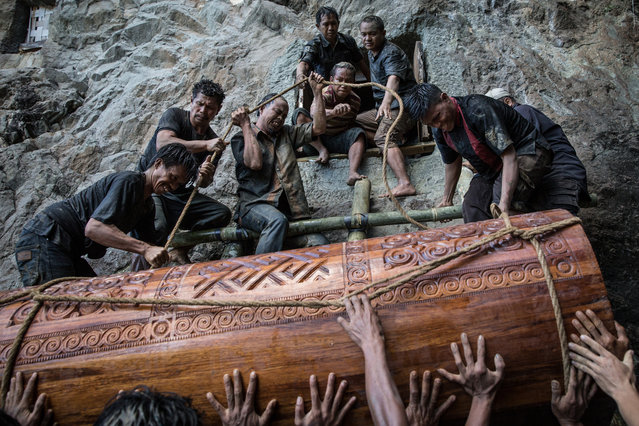
It is said that Torajans are people who “live to die”. For this Indonesian ethnic group, funerals are such extravagant events that they sometimes attract tourists. Families can postpone burials years (and the deceased are considered sick and hosted at home until the funeral) until the family can raise enough money and gather as many relatives as possible. And then it’s a jubilant multiday social event with a parade, dances and animal sacrifices. Agung Parameswara photographed these funerary practices when he traveled to South Sulawesi province, where the Torajans live. But often, their funeral isn’t the last time the dead are seen. In August, crypts are opened, coffins are slid back out and bodies delicately unsheathed. This tender ritual is known as Ma’Nene, which is customarily performed every few years. (Photo by Agung Parameswara/The Washington Post)

It is said that Torajans are people who “live to die”. For this Indonesian ethnic group, funerals are such extravagant events that they sometimes attract tourists. Families can postpone burials years (and the deceased are considered sick and hosted at home until the funeral) until the family can raise enough money and gather as many relatives as possible. And then it’s a jubilant multiday social event with a parade, dances and animal sacrifices. Agung Parameswara photographed these funerary practices when he traveled to South Sulawesi province, where the Torajans live. (Photo by Agung Parameswara/The Washington Post)
Details
06 Oct 2016 09:15:00