Loading...
Done
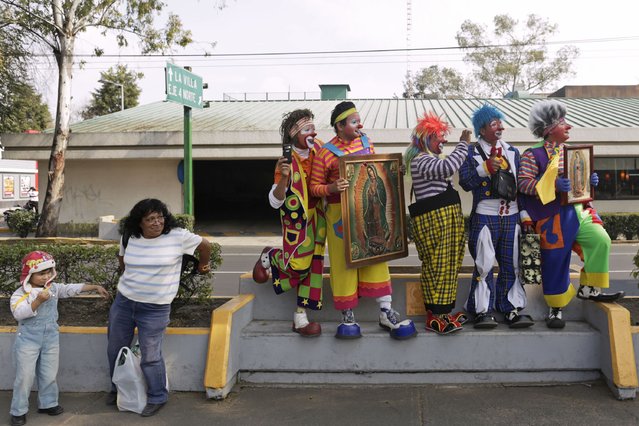
Clowns take part in the annual pilgrimage to the Basilica of Our Lady Guadalupe to pay homage to the Virgin of Guadalupe in Mexico City December 16, 2014. Dressed in colourful costumes, hundreds of clowns from all over Mexico walked towards the Basilica to give thanks to the virgin for the work they have received. (Photo by Carlos Jasso/Reuters)

Clowns take part in the annual pilgrimage to the Basilica of Our Lady Guadalupe to pay homage to the Virgin of Guadalupe in Mexico City December 16, 2014. Dressed in colourful costumes, hundreds of clowns from all over Mexico walked towards the Basilica to give thanks to the virgin for the work they have received. (Photo by Carlos Jasso/Reuters)
Details
18 Dec 2014 14:52:00
Kika-evolution, 5, an Auguste clown, poses for a photo during Mexico’s 17th annual clown convention, La Feria de la Risa, in Mexico City, October 23, 2012. Approximately 500 clowns gathered at two local theaters in the capital city to exchange ideas, compete for laughs and show off their comedy performances. (Photo by Anita BacaAP Photo)

Kika-evolution, 5, an Auguste clown, poses for a photo during Mexico’s 17th annual clown convention, La Feria de la Risa, in Mexico City, October 23, 2012. Approximately 500 clowns gathered at two local theaters in the capital city to exchange ideas, compete for laughs and show off their comedy performances. (Photo by Anita Baca/AP Photo)
Details
27 Oct 2012 07:51:00
A member of the Community Police of the FUSDEG (United Front for the Security and Development of the State of Guerrero) search for a man, who ran away upon seeing the Community Police approach as they patrolled a street, in the village of Petaquillas, on the outskirts of Chilpancingo, in the Mexican state of Guerrero, February 1, 2015. (Photo by Jorge Dan Lopez/Reuters)

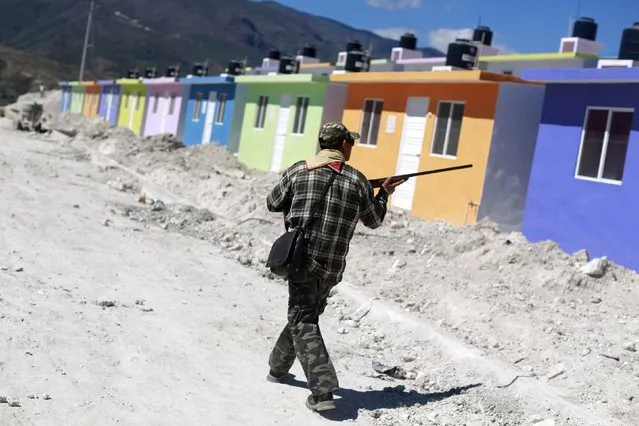
A member of the Community Police of the FUSDEG (United Front for the Security and Development of the State of Guerrero) search for a man, who ran away upon seeing the Community Police approach as they patrolled a street, in the village of Petaquillas, on the outskirts of Chilpancingo, in the Mexican state of Guerrero, February 1, 2015. Approximately 500 members of the Community Police from the FUSDEG took control of the security of the village of Petaquillas on the night of January 30 at the request of the people tired of the actions of organized crime, local media reported. (Photo by Jorge Dan Lopez/Reuters)
Details
03 Feb 2015 13:32:00
A garbage collector, with his horse and cart, prepares to unload rubbish at the municipal dump in Nezahualcoyotl, on the outskirts of Mexico City, February 18, 2015. (Photo by Henry Romero/Reuters)

A garbage collector, with his horse and cart, prepares to unload rubbish at the municipal dump in Nezahualcoyotl, on the outskirts of Mexico City, February 18, 2015. Hundreds of horse or donkey-drawn carts will disappear from the streets of a municipality in the state of Mexico, located on the outskirts of Mexico City, and will be replaced by motorized vehicles, local authorities said. (Photo by Henry Romero/Reuters)
Details
20 Feb 2015 12:43:00
In this March 18, 2015 photo, a boy rides a mechanical bull for children at the Texcoco Fair on the outskirts of Mexico City. In Mexico, these types of fairs date back to Spanish colonial times, and in some smaller communities they are organized around the feast days of Roman Catholic saints. (Photo by Eduardo Verdugo/AP Photo)

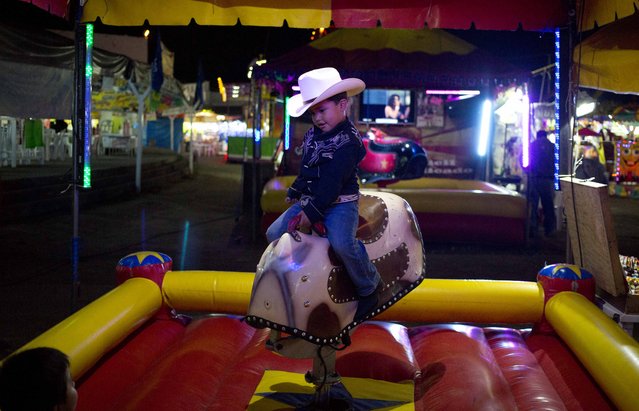
In this March 18, 2015 photo, a boy rides a mechanical bull for children at the Texcoco Fair on the outskirts of Mexico City. In Mexico, these types of fairs date back to Spanish colonial times, and in some smaller communities they are organized around the feast days of Roman Catholic saints. (Photo by Eduardo Verdugo/AP Photo)
Details
28 Apr 2015 13:45:00
Hundreds of houses painted in bright colors in what organizers claim is Mexico's largest mural, is part of a government-sponsored project is called Pachuca Paints Itself, in the Palmitas neighborhood, in Pachuca, Mexico, Thursday, July 30, 2015. German Crew is the artist collective responsible for painting the mural project. Director Enrique Gomez, who goes by MYBE, said the crew has painted 1,500 square meters with 20,000 liters of paint. (Photo by Sofia Jaramillo/AP Photo)

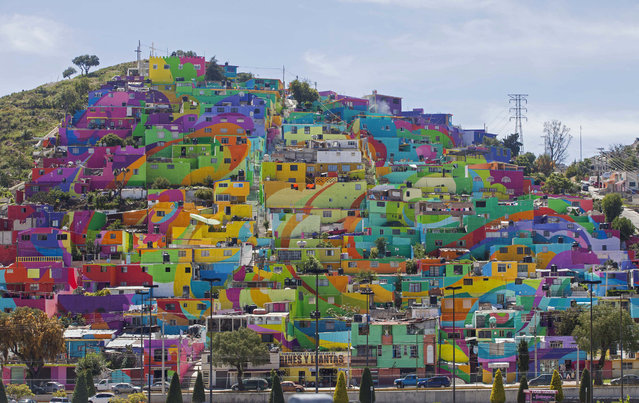
Hundreds of houses painted in bright colors in what organizers claim is Mexico's largest mural, is part of a government-sponsored project is called Pachuca Paints Itself, in the Palmitas neighborhood, in Pachuca, Mexico, Thursday, July 30, 2015. German Crew is the artist collective responsible for painting the mural project. Director Enrique Gomez, who goes by MYBE, said the crew has painted 1,500 square meters with 20,000 liters of paint. Working hand-in-hand with residents, muralists have painted the facades of 200 homes bright lavender, lime green, incandescent orange – hues more commonly found in a bag of Skittles than in the drab, cement-and-cinderblock neighborhoods where many of Mexico's poor live. The project aims to bring the community together and rehabilitate the area. (Photo by Sofia Jaramillo/AP Photo)

Details
03 Aug 2015 12:02:00
A woman fancy dressed as Catrina takes part in the “Catrinas Parade” along Reforma Avenue, in Mexico City on October 26, 2019. (Photo by Claudio Cruz/AFP Photo)

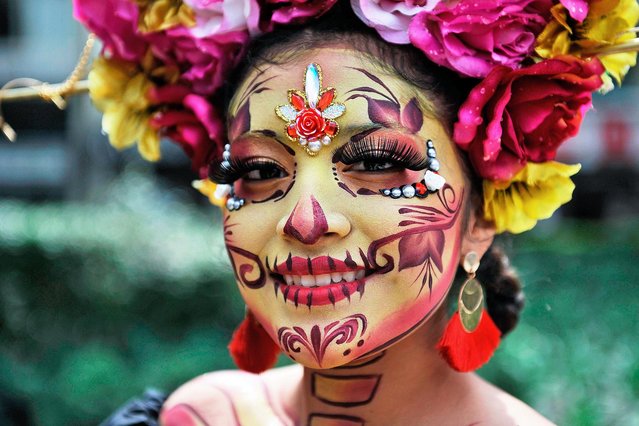
A woman fancy dressed as Catrina takes part in the “Catrinas Parade” along Reforma Avenue, in Mexico City on October 26, 2019. Mexicans get ready to celebrate the Day of the Dead highlighting the character of La Catrina which was created by cartoonist Jose Guadalupe Posada, famous for his drawings of typical local, folkloric scenes, socio-political criticism and for his illustrations of “skeletons” or skulls, including La Catrina. (Photo by Claudio Cruz/AFP Photo)
Details
29 Oct 2019 00:03:00
A woman is helped with adorning her hair with jewelry, part of the traditional clothing known as “Pollera”, before the annual Thousand Polleras parade in Las Tablas, in the province of Los Santos January 10, 2015. According to local residents, the Pollera dates back to the 18th century and was worn by the Spanish lower classes. (Photo by Carlos Jasso/Reuters)

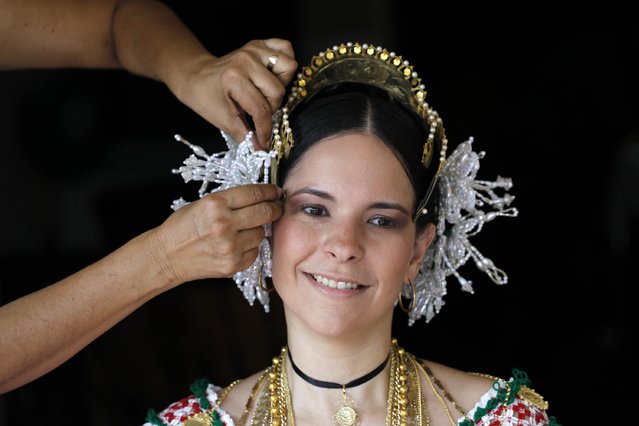
A woman is helped with adorning her hair with jewelry, part of the traditional clothing known as “Pollera”, before the annual Thousand Polleras parade in Las Tablas, in the province of Los Santos January 10, 2015. According to local residents, the Pollera dates back to the 18th century and was worn by the Spanish lower classes. Today, it has become the Panamanian national costume. The dress is made entirely by hand and the jewellery worn is pure gold and worth thousands of dollars. (Photo by Carlos Jasso/Reuters)
Details
12 Jan 2015 15:46:00