Loading...
Done
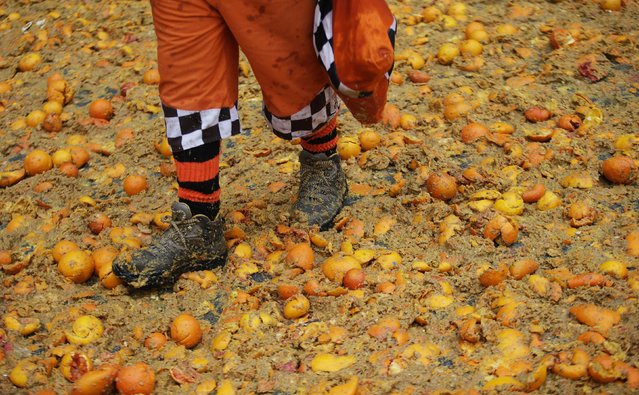
A member of a rival team walks during an annual carnival battle with oranges in the northern Italian town of Ivrea February 15, 2015. Dressed up as Middle Age kings' guards, a group of men ride in a horse-drawn carriage and pelt “foot soldiers” with oranges as thousands of people gather to re-enact a Middle Age battle when the townsfolk of Ivrea overthrew an evil king. (Photo by Max Rossi/Reuters)

A member of a rival team walks during an annual carnival battle with oranges in the northern Italian town of Ivrea February 15, 2015. Dressed up as Middle Age kings' guards, a group of men ride in a horse-drawn carriage and pelt “foot soldiers” with oranges as thousands of people gather to re-enact a Middle Age battle when the townsfolk of Ivrea overthrew an evil king. In a strange twist, instead of swords and cross bows, these days the weapons of choice are oranges. (Photo by Max Rossi/Reuters)
Details
16 Feb 2015 13:06:00
Wood Sculpture By Randall Rosenthal

A skill like woodworking takes years and thousands of hours to become more than just a proficient at, but this man invested that time to be a certifiable master. His name is Randall Rosenthal and he has talent that can result in mind-bending illusions. The project in the gallery below all started with three pieces of white pine he glued together. What he turned that block of wood into is so cool.
Details
11 Feb 2014 12:24:00
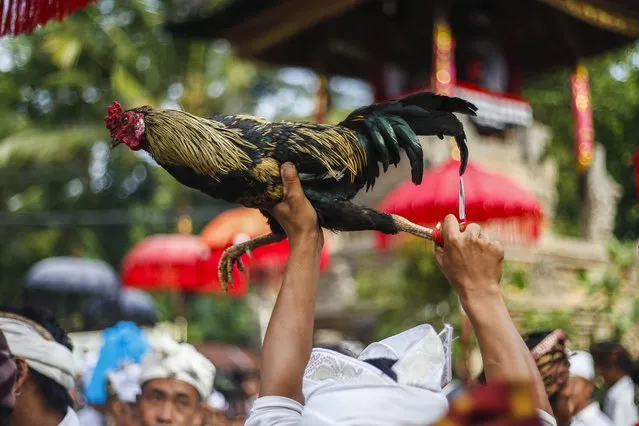
Balinese men hold cock fighters during the Tabuh Rah ceremony at a Temple in Gianyar, Bali, Indonesia, 28 December 2014. Traditional cockfighting or locally named “Tajen”, was once performed as a sacred ritual in Bali but now has become a source of gambling for many local Balinese men. Cockfighting is staged during the anniversary of a temple. The rituals are mainly aimed at preventing the evil spirits from harming people. (Photo by Made Nagi/EPA)

Balinese men hold cock fighters during the Tabuh Rah ceremony at a Temple in Gianyar, Bali, Indonesia, 28 December 2014. Traditional cockfighting or locally named “Tajen”, was once performed as a sacred ritual in Bali but now has become a source of gambling for many local Balinese men. Cockfighting is staged during the anniversary of a temple. The rituals are mainly aimed at preventing the evil spirits from harming people. (Photo by Made Nagi/EPA)
Details
04 Jan 2015 12:38:00
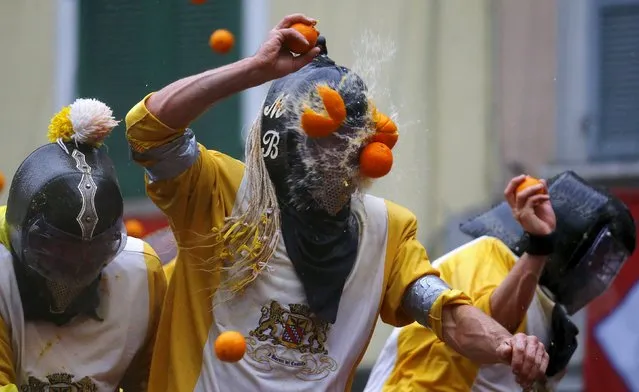
A participant is hit by an orange during an annual carnival battle in the northern Italian town of Ivrea February 7, 2016. Dressed up as Middle Age kings' guards, a group of men ride in a horse-drawn carriage and pelt “foot soldiers” with oranges as thousands of people gather to re-enact a Middle Age battle when the townsfolk of Ivrea overthrew an evil king. In a strange twist, instead of swords and cross bows, these days the weapons of choice are oranges. (Photo by Stefano Rellandini/Reuters)

A participant is hit by an orange during an annual carnival battle in the northern Italian town of Ivrea February 7, 2016. Dressed up as Middle Age kings' guards, a group of men ride in a horse-drawn carriage and pelt “foot soldiers” with oranges as thousands of people gather to re-enact a Middle Age battle when the townsfolk of Ivrea overthrew an evil king. In a strange twist, instead of swords and cross bows, these days the weapons of choice are oranges. (Photo by Stefano Rellandini/Reuters)
Details
08 Feb 2016 12:03:00
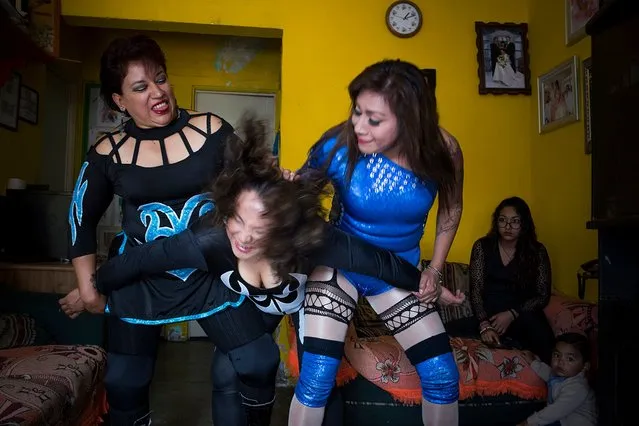
Juliza meets with colleagues at her home. (Photo by Diana Bagnoli/The Washington Post)

Lucha libre is Mexico’s version of what in the United States refer to as pro wrestling. Its dates to 1863, when a Mexican wrestler named Enrique Ugartechea developed a form of “freestyle” wrestling that was based on Greco-Roman wrestling. Lucha libre began to soar in popularity in Mexico after two Italian businessmen started promoting fights in the early 1900s. It has since become popular around the globe. Here: Juliza meets with colleagues at her home. (Photo by Diana Bagnoli/The Washington Post)
Details
15 Jun 2018 00:05:00
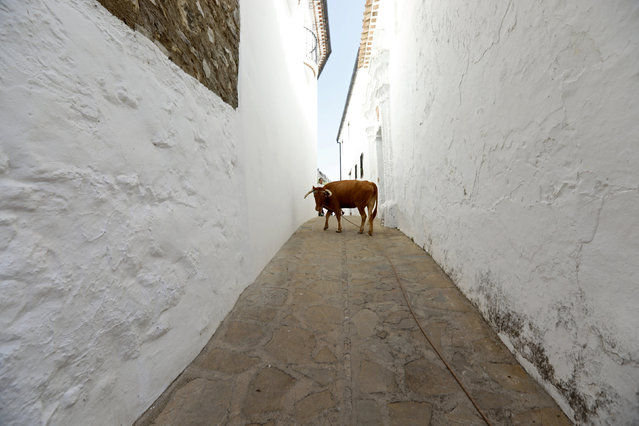
A heifer, tied with a rope, turns during “Toro de Cuerda” in the white village of Villaluenga del Rosario, southern Spain September 3, 2016. Dazzling clusters of cube-shaped houses perched on top of Andalusia's olive tree-studded mountains, the “Pueblos Blancos”, or white villages, of southern Spain are named for the lime wash the buildings are painted with to keep the interiors cool. The labyrinths of narrow alleyways are a throwback to when this region was known as Al-Andalus and was part of a medieval Muslim territory. While this region is stunningly beautiful and a big draw to tourists visiting the south of Spain, it is also one of the poorest areas in the country and has one of the highest unemployment rates in the European Union. (Photo by Marcelo del Pozo/Reuters)

A heifer, tied with a rope, turns during “Toro de Cuerda” in the white village of Villaluenga del Rosario, southern Spain September 3, 2016. Dazzling clusters of cube-shaped houses perched on top of Andalusia's olive tree-studded mountains, the “Pueblos Blancos”, or white villages, of southern Spain are named for the lime wash the buildings are painted with to keep the interiors cool. The labyrinths of narrow alleyways are a throwback to when this region was known as Al-Andalus and was part of a medieval Muslim territory. While this region is stunningly beautiful and a big draw to tourists visiting the south of Spain, it is also one of the poorest areas in the country and has one of the highest unemployment rates in the European Union. (Photo by Marcelo del Pozo/Reuters)
Details
20 Oct 2016 11:09:00
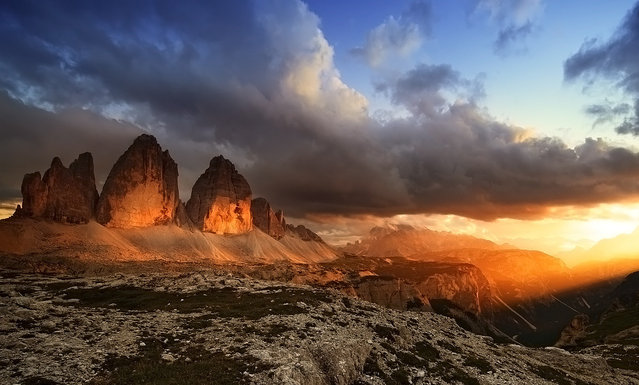
The Three Peaks Of Lavaredo

The three peaks of Lavaredo, or the “Tre Cime di Lavaredo” in Italian, are three distinctive battlement-like peaks, in the Sexten Dolomites of northeastern Italy. They are probably one of the best-known mountain groups in the Alps, and one of the most photographed in Italy. The three peaks are named, from east to west, "little peak" (Cima Piccola), "big peak" (Cima Grande) and "western peak" (Cima Ovest). The Cima Grande has an elevation of 2,999 metres (9,839 ft). It stands between the Cima Piccola, at 2,857 metres (9,373 ft), and the Cima Ovest, at 2,973 metres (9,754 ft).
Details
21 Oct 2013 10:27:00
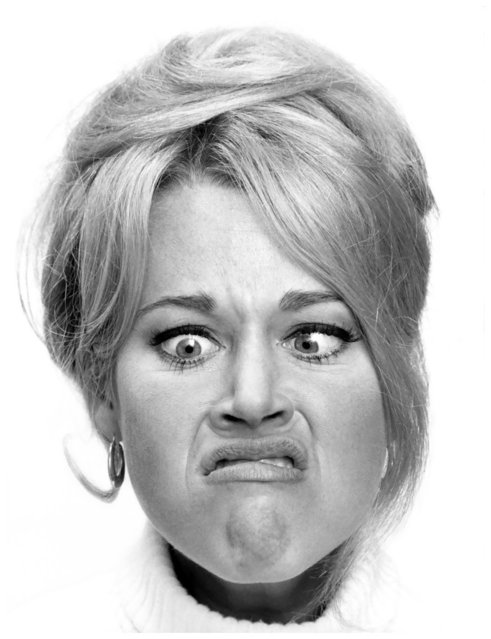
Jane Fonda, Studio Willy Rizzo, Paris, 1966. (Photo by Willy Rizzo)

“Willy Rizzo was an Italian photographer and designer. In late 1948, Willy began an illustrious twenty-year career with Paris Match that would have him photograph some of the greatest names of the golden age of photojournalism. Married later to actress Elsa Martinelli, Rizzo enjoyed unparalleled access to the stars; Brigitte Bardot, Sophia Loren, Marilyn Monroe, Vivien Leigh, Audrey Hepburn, Jane Fonda, Gene Kelly, Fred Astaire, Salvador Dalí and Pablo Picasso all found themselves in front of Rizzo’s lens”. – Wikipedia. Photo: Jane Fonda, Studio Willy Rizzo, Paris, 1966. (Photo by Willy Rizzo)
Details
28 Mar 2014 07:12:00