Loading...
Done
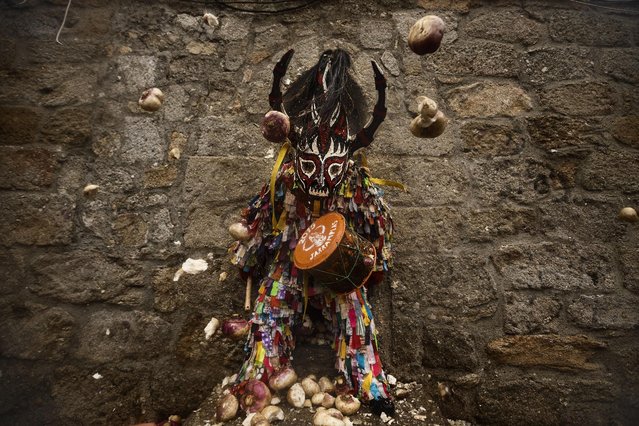
People throw turnips at the Jarramplas as he makes his way through the streets beating his drum during the Jarramplas Festival in Piornal, Spain, Tuesday, January 20, 2015. Jarramplas is a character that wears a costume made from colorful strips of fabric, and a devil-like mask and beats a drum through the streets of Piornal while residents throw turnips as a punishment for stealing cattle. (Photo by Daniel Ochoa de Olza/AP Photo)

People throw turnips at the Jarramplas as he makes his way through the streets beating his drum during the Jarramplas Festival in Piornal, Spain, Tuesday, January 20, 2015. Jarramplas is a character that wears a costume made from colorful strips of fabric, and a devil-like mask and beats a drum through the streets of Piornal while residents throw turnips as a punishment for stealing cattle. The exact origin of the festival are not known, various theories exist from the mythological punishment of Caco by Hercules, to a cattle thief ridiculed and expelled by his neighbors. The Jarramplas Festival takes place every year from the 19th till the 20th of January on Saint Sebastian Day. (Photo by Daniel Ochoa de Olza/AP Photo)
Details
21 Jan 2015 13:42:00
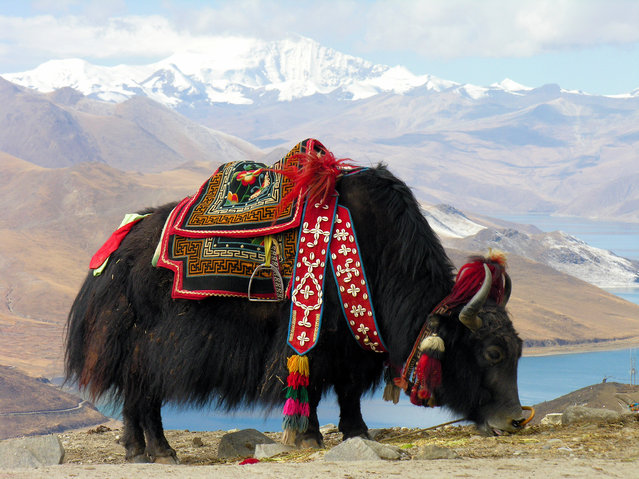
Yak near Yamdrok lake, Tibet. It is a long-haired bovinae found throughout the Himalayan region of south Central Asia, the Tibetan Plateau and as far north as Mongolia and Russia. The Tibetan economy is dominated by subsistence agriculture. Due to limited arable land, the primary occupation of the Tibetan Plateau is raising livestock, such as sheep, cattle, goats, camels, yaks, dzo, and horses. The Tibetan yak is an integral part of Tibetan life. (Photo by Dennis Jarvis)

Yak near Yamdrok lake, Tibet. It is a long-haired bovinae found throughout the Himalayan region of south Central Asia, the Tibetan Plateau and as far north as Mongolia and Russia. The Tibetan economy is dominated by subsistence agriculture. Due to limited arable land, the primary occupation of the Tibetan Plateau is raising livestock, such as sheep, cattle, goats, camels, yaks, dzo, and horses. The Tibetan yak is an integral part of Tibetan life. (Photo by Dennis Jarvis)
Details
10 Jun 2015 10:48:00
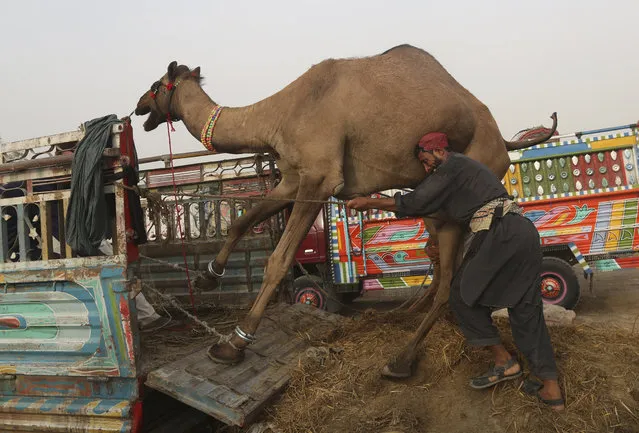
A Pakistani owner tries to load camel on a truck at a cattle market set up for the upcoming Muslim festival Eid al-Adha in Karachi, Pakistan, Friday, August 17, 2018. Eid al-Adha, or Feast of Sacrifice, most important Islamic holiday marks the willingness of the Prophet Ibrahim (Abraham to Christians and Jews) to sacrifice his son. (Photo by Shakil Adil/AP Photo)

A Pakistani owner tries to load camel on a truck at a cattle market set up for the upcoming Muslim festival Eid al-Adha in Karachi, Pakistan, Friday, August 17, 2018. Eid al-Adha, or Feast of Sacrifice, most important Islamic holiday marks the willingness of the Prophet Ibrahim (Abraham to Christians and Jews) to sacrifice his son. (Photo by Shakil Adil/AP Photo)
Details
20 Sep 2018 00:01:00
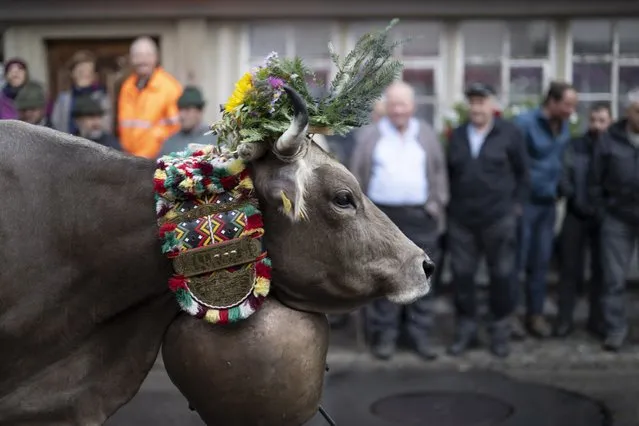
A cow carrying a bell and autumn flowers headgear walks by in front of spectators at the traditional cattle show in Schwellbrunn, Switzerland, 26 September 2022. The traditional show in the Appenzell region is held annually in autumn, when local farmers return from the alp with their groomed and cleaned cows to present them on a show ground. “The most beautiful and best performing cows are awarded prizes”, the Appenzellerland tourism office adds on their website. (Photo by Gian Ehrenzeller/EPA/EFE)

A cow carrying a bell and autumn flowers headgear walks by in front of spectators at the traditional cattle show in Schwellbrunn, Switzerland, 26 September 2022. The traditional show in the Appenzell region is held annually in autumn, when local farmers return from the alp with their groomed and cleaned cows to present them on a show ground. “The most beautiful and best performing cows are awarded prizes”, the Appenzellerland tourism office adds on their website. (Photo by Gian Ehrenzeller/EPA/EFE)
Details
23 Oct 2022 04:24:00
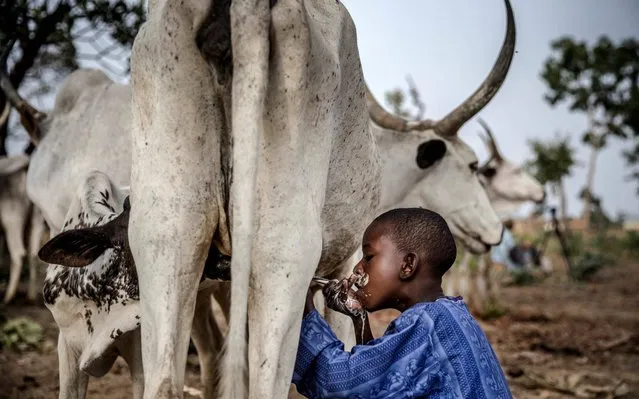
8-year-old Fulani boy Suleiman Yusuf drinks milk from a cow belonging to his father cattle near his family's house at Kachia Grazing Reserve, Kaduna State, Nigeria, on April 16, 2019. Kachia Grazing Reserve is an area set aside for the use of Fulani pastoralist and it is intended to be the foci of livestock development. The purpose for the grazing reserves is the settlement of nomadic pastoralists and inducement to sedentarisation through the provision of land for grazing and permanent water as way to avoid conflict. (Photo by Luis Tato/AFP Photo)

8-year-old Fulani boy Suleiman Yusuf drinks milk from a cow belonging to his father cattle near his family's house at Kachia Grazing Reserve, Kaduna State, Nigeria, on April 16, 2019. Kachia Grazing Reserve is an area set aside for the use of Fulani pastoralist and it is intended to be the foci of livestock development. The purpose for the grazing reserves is the settlement of nomadic pastoralists and inducement to sedentarisation through the provision of land for grazing and permanent water as way to avoid conflict. (Photo by Luis Tato/AFP Photo)
Details
10 Jul 2019 00:01:00
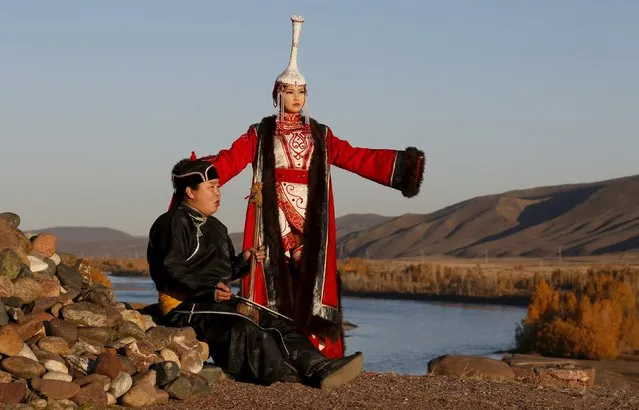
Master of throat singing (or Khoomei) Aikhan Orzhak (L) and model Choigana Kertek, dressed in traditional costume, perform during sunset at the Aldyn Bulak area on the bank of the Yenisei River outside the village of Ust-Elegest in Tuva region, Southern Siberia, Russia, October 7, 2015. The region is inhabited by Tuvans, historically cattle-herding nomads, who nowadays practise two main confessions - Buddhism and Shamanism. (Photo by Ilya Naymushin/Reuters)

Master of throat singing (or Khoomei) Aikhan Orzhak (L) and model Choigana Kertek, dressed in traditional costume, perform during sunset at the Aldyn Bulak area on the bank of the Yenisei River outside the village of Ust-Elegest in Tuva region, Southern Siberia, Russia, October 7, 2015. The region is inhabited by Tuvans, historically cattle-herding nomads, who nowadays practise two main confessions – Buddhism and Shamanism. (Photo by Ilya Naymushin/Reuters)
Details
17 Oct 2015 08:03:00
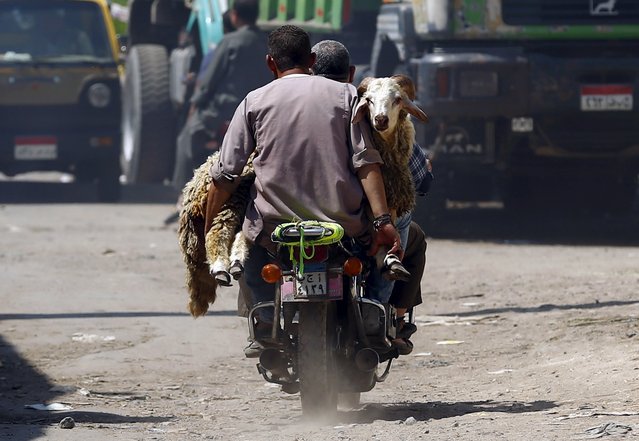
Men transport a sheep on their motorcycle after buying it at an old cattle market named “Al Emam Market” ahead of the Muslim festival Eid al-Adha in Cairo, Egypt, September 19, 2015. Muslims across the world are preparing to celebrate the annual festival of Eid al-Adha or the Festival of Sacrifice, which marks the end of the annual hajj pilgrimage, by slaughtering goats, sheep. (Photo by Amr Abdallah Dalsh/Reuters)

Men transport a sheep on their motorcycle after buying it at an old cattle market named “Al Emam Market” ahead of the Muslim festival Eid al-Adha in Cairo, Egypt, September 19, 2015. Muslims across the world are preparing to celebrate the annual festival of Eid al-Adha or the Festival of Sacrifice, which marks the end of the annual hajj pilgrimage, by slaughtering goats, sheep, cows and camels in commemoration of the Prophet Abraham's readiness to sacrifice his son to show obedience to Allah. (Photo by Amr Abdallah Dalsh/Reuters)
Details
22 Sep 2015 08:05:00
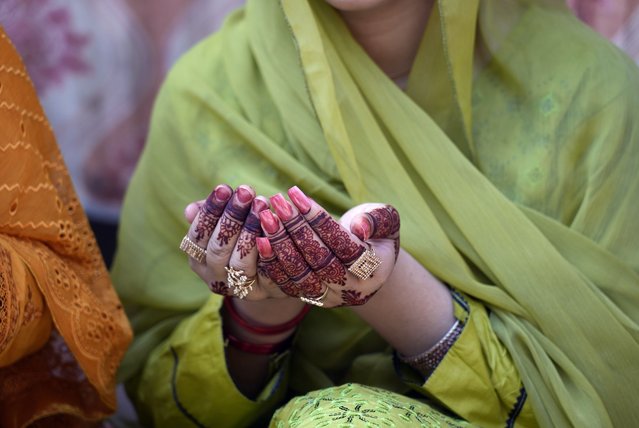
A woman has her hands painted with traditional henna as she attends Eid al-Adha prayers at historical Badshahi mosque in Lahore, Pakistan, Monday, June 17, 2024. Eid al-Adha or Feast of Sacrifice, the most important Islamic holiday, marks the willingness of the Prophet Ibrahim, Abraham to Christians and Jews, to sacrifice his son. During the holiday, which in most places lasts three days, Muslims slaughter goat, sheep or cattle, distribute part of the meat to the poor. (Photo by K.M. Chaudary/AP Photo)

A woman has her hands painted with traditional henna as she attends Eid al-Adha prayers at historical Badshahi mosque in Lahore, Pakistan, Monday, June 17, 2024. Eid al-Adha or Feast of Sacrifice, the most important Islamic holiday, marks the willingness of the Prophet Ibrahim, Abraham to Christians and Jews, to sacrifice his son. During the holiday, which in most places lasts three days, Muslims slaughter goat, sheep or cattle, distribute part of the meat to the poor. (Photo by K.M. Chaudary/AP Photo)
Details
06 Sep 2024 04:02:00