Loading...
Done
A military police officer patrols in the Roquette Pinto shantytown, part of the Mare slum complex in Rio de Janeiro, Brazil, Wednesday, April 1, 2015. The Brazilian army has begun to pull out of one of Rio de Janeiro's most violent slums, with police assuming responsibility for security in the area. (Photo by Felipe Dana/AP Photo)

A military police officer patrols in the Roquette Pinto shantytown, part of the Mare slum complex in Rio de Janeiro, Brazil, Wednesday, April 1, 2015. The Brazilian army has begun to pull out of one of Rio de Janeiro's most violent slums, with police assuming responsibility for security in the area. (Photo by Felipe Dana/AP Photo)
Details
02 Apr 2015 12:26:00
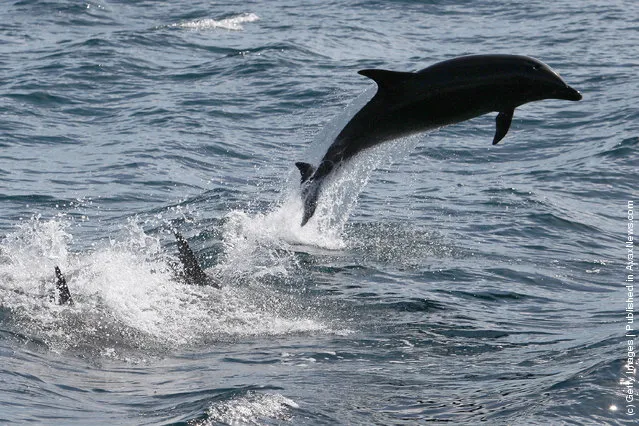
Bottlenose dolphins

Bottlenose dolphins leap off the Southern California coast on January 30, 2012 near Dana Point, California. A coalition that includes Native American tribes, Earthjustice and the Natural Resources Defense Council is on the National Marine Fisheries Service for more protection for dolphins, whales, and other migrating marine animals from the use of sonar in training by the US Navy on the West Coast. (Photo by David McNew/Getty Images)
Details
31 Jan 2012 10:23:00
In this July 11, 2016 photo, a young, masked drug trafficker poses for photos holding his guns at a slum in Rio de Janeiro, Brazil. Teenagers openly tote guns while they work as guards, lookouts and distributors for drug lords operating just a few miles from where hundreds of thousands and tourists and athletes will be for the Aug. 5-21 Olympic Games. (Photo by Felipe Dana/AP Photo)

In this July 11, 2016 photo, a young, masked drug trafficker poses for photos holding his guns at a slum in Rio de Janeiro, Brazil. Teenagers openly tote guns while they work as guards, lookouts and distributors for drug lords operating just a few miles from where hundreds of thousands and tourists and athletes will be for the Aug. 5-21 Olympic Games. (Photo by Felipe Dana/AP Photo)
Details
24 Jul 2016 10:47:00
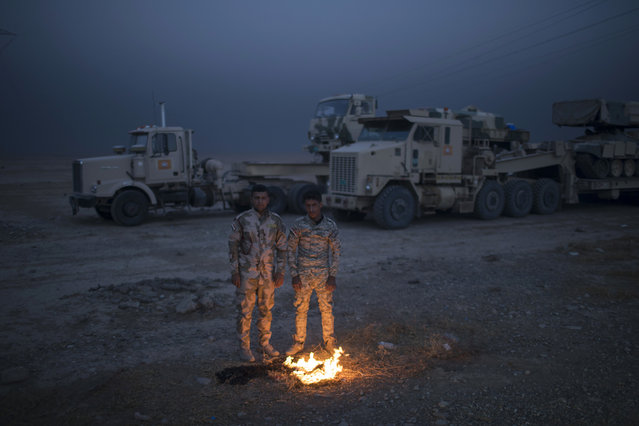
Iraqi army soldiers warm themselves next to a fire near the Qayara air base, south of Mosul, Iraq, Tuesday, November 1, 2016. The U.N. human rights office is lauding efforts by the U.S.-led coalition in the battle against the Islamic State group in Mosul. The office in Geneva says coalition flights over Iraq have largely succeeded in preventing IS from bringing in 25,000 more civilians to the city center, where the militant group has been using people as human shields as Iraqi forces advance on Mosul. (Photo by Felipe Dana/AP Photo)

Iraqi army soldiers warm themselves next to a fire near the Qayara air base, south of Mosul, Iraq, Tuesday, November 1, 2016. The U.N. human rights office is lauding efforts by the U.S.-led coalition in the battle against the Islamic State group in Mosul. The office in Geneva says coalition flights over Iraq have largely succeeded in preventing IS from bringing in 25,000 more civilians to the city center, where the militant group has been using people as human shields as Iraqi forces advance on Mosul. (Photo by Felipe Dana/AP Photo)
Details
03 Nov 2016 12:43:00
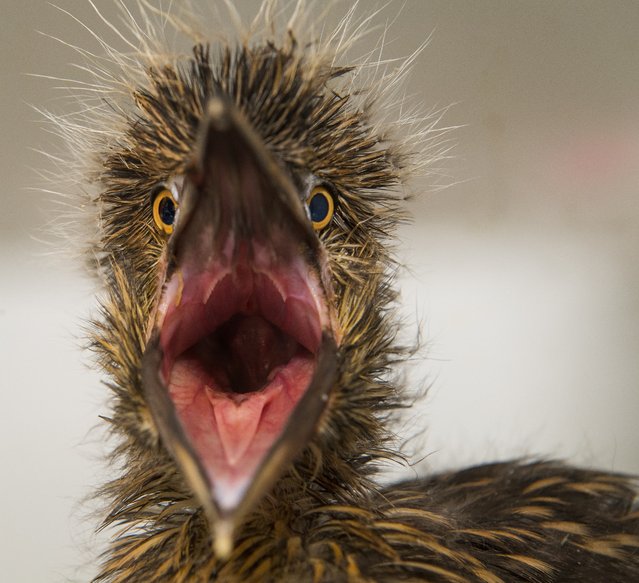
A baby Black-crowned Night Heron squawks in its incubator while being cared for at City Wildlife rescue and rehabilitation center in Washington, DC on May 31, 2017. The heron is one of several that have been brought to CW by the staff at The National Zoo over the past few years. The heron is a native bird and has made an established rookery inside the zoo grounds over a hundred years ago.  Every year at this time, some of the chicks get pushed or fall out of the nest and require human care.  Because the birds are native and not part of the Smithsonian collection, they partnered with CW to rehabilitate the herons for re-release back to the flock inside Zoo. They're reintroduced back to their flock so that they can migrate together in the Fall. The Black-crowned heron usually migrates from the DC area down to southeast North Carolina, some going as far as Jacksonville, FL in winter. The Black-crowned heron is the species of greatest conservation need in the District of Columbia because their numbers are in such rapid decline due to habitat loss. (Photo Linda Davidson/The Washington Post)

A baby Black-crowned Night Heron squawks in its incubator while being cared for at City Wildlife rescue and rehabilitation center in Washington, DC on May 31, 2017. The heron is one of several that have been brought to CW by the staff at The National Zoo over the past few years. (Photo Linda Davidson/The Washington Post)
Details
04 Jun 2017 08:04:00
Participants jump into the water during the 114th edition of the Copa Nadal (Christmas Cup) swimming race in Barcelona's Port Vell on December 25, 2023. The traditional 200-meter Christmas swimming race gathered around 300 participants on Barcelona's Port Vell (old harbour). (Photo by Josep Lago/AFP Photo)

Participants jump into the water during the 114th edition of the Copa Nadal (Christmas Cup) swimming race in Barcelona's Port Vell on December 25, 2023. The traditional 200-meter Christmas swimming race gathered around 300 participants on Barcelona's Port Vell (old harbour). (Photo by Josep Lago/AFP Photo)
Details
12 Feb 2025 04:05:00
Aspiring models wait for their turn to be judged during auditions for the upcoming Lakme Fashion Week in Mumbai, India, June 30, 2016. (Photo by Shailesh Andrade/Reuters)

Aspiring models wait for their turn to be judged during auditions for the upcoming Lakme Fashion Week in Mumbai, India, June 30, 2016. (Photo by Shailesh Andrade/Reuters)
Details
01 Jul 2016 12:48:00
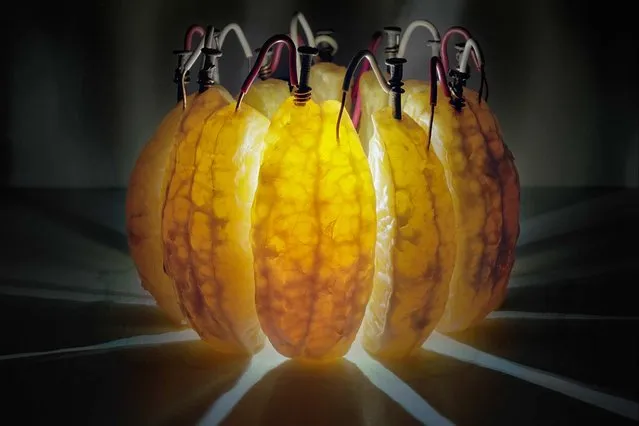
Wedges of an orange generate enough current and electrical juice – 3.5 volts – to power an LED. The fruit’s citric acid helps electrons flow from galvanized nails to copper wire in this 14-hour exposure. This image was published in September’s Visions of Earth, a trio of photos that appear in each issue of National Geographic. (Photo by Caleb Charland/National Geographic)

Wedges of an orange generate enough current and electrical juice – 3.5 volts – to power an LED. The fruit’s citric acid helps electrons flow from galvanized nails to copper wire in this 14-hour exposure. This image was published in September’s Visions of Earth, a trio of photos that appear in each issue of National Geographic. (Photo by Caleb Charland/National Geographic)
Details
06 Jan 2014 12:09:00