Loading...
Done
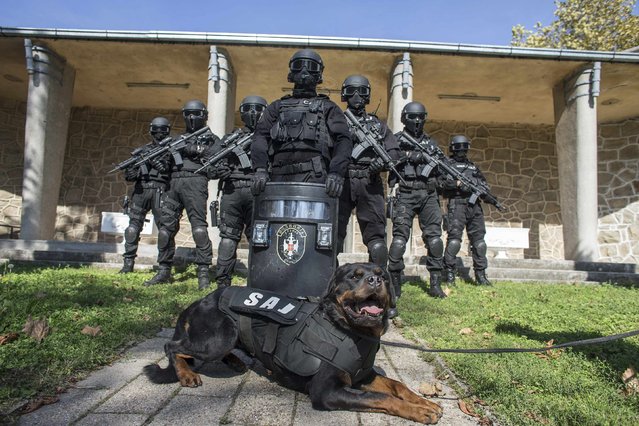
Serbian police officers of the Special Anti-Terrorist Unit pose for a picture in their base outside Belgrade October 8, 2014. (Photo by Marko Djurica/Reuters)

Serbian police officers of the Special Anti-Terrorist Unit pose for a picture in their base outside Belgrade October 8, 2014. When the killing of an unarmed black teenager by a white policeman in Ferguson, Missouri, in August sparked sometimes violent protests, the response of police in camouflage gear and armoured vehicles wielding stun grenades and assault rifles seemed more like a combat operation than a public order measure. Some U.S. police departments have recently acquired U.S. military-surplus hardware from wars abroad, but there are many law enforcers around the world whose rules of engagement also allow the use of lethal force with relatively few restrictions. But for every regulation that gives police wide scope to use firearms, there is another code that sharply limits their use. In Serbia, police may use measures ranging from batons to special vehicles, water cannon and tear gas on groups of people who have gathered illegally and are behaving in a way that is violent or could cause violence, but they may use firearms only when life is endangered. (Photo by Marko Djurica/Reuters)
Details
27 Nov 2014 14:53:00
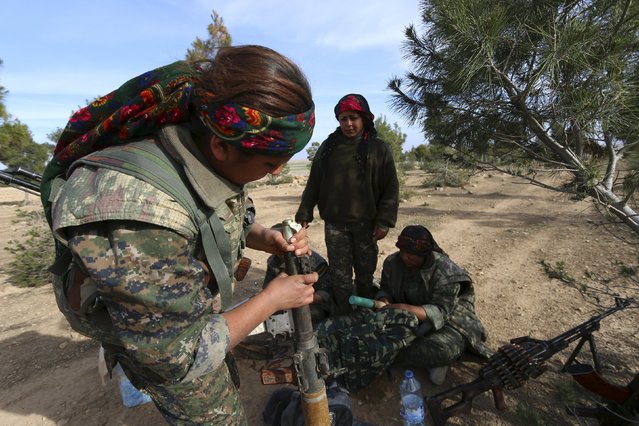
Fighters from the Democratic Forces of Syria prepare their weapons in the southwestern countryside of Hasaka, Syria February 17, 2016. Picture taken February 17, 2016. (Photo by Rodi Said/Reuters)

Fighters from the Democratic Forces of Syria prepare their weapons in the southwestern countryside of Hasaka, Syria February 17, 2016. Picture taken February 17, 2016. (Photo by Rodi Said/Reuters)
Details
19 Feb 2016 12:32:00
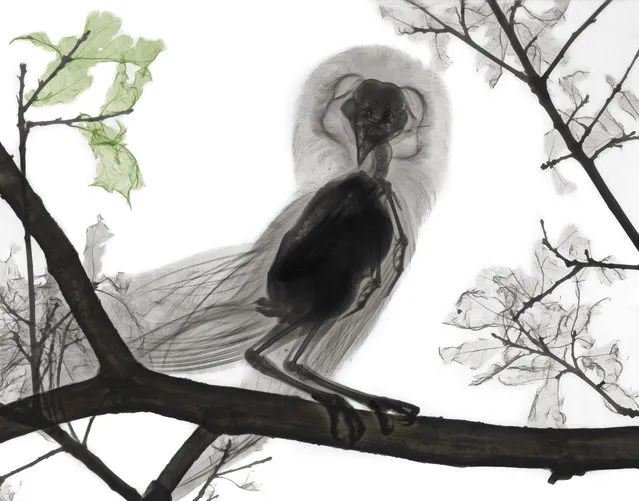
Coloured X-ray of a barn owl. A physicist has used X-ray to create an extraordinary collection of artwork. Arie van't Riets pictures reveal birds, fish, monkeys and flowers in an incredible new light. The 66-year-old, from Bathmen in the Netherlands, began X-raying flowers as a means to teach radiographers and physicians how the machine worked. But after adding a bit of colour to the pictures, the retired medical physicist realised the potential for an exciting new collection of art. (Photo by Arie van't Riet/Barcroft Media)

Coloured X-ray of a barn owl. A physicist has used X-ray to create an extraordinary collection of artwork. Arie van't Riets pictures reveal birds, fish, monkeys and flowers in an incredible new light. The 66-year-old, from Bathmen in the Netherlands, began X-raying flowers as a means to teach radiographers and physicians how the machine worked. But after adding a bit of colour to the pictures, the retired medical physicist realised the potential for an exciting new collection of art. (Photo by Arie van't Riet/Barcroft Media)
Details
08 Jul 2014 13:25:00
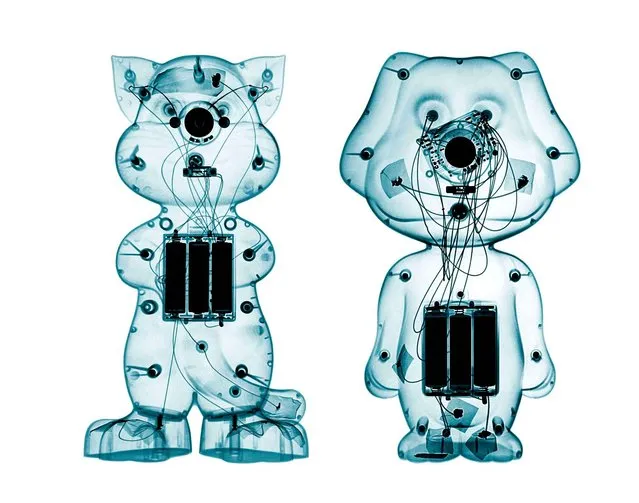
Australian photographer Brendan Fitzpatrick’s X-ray photographs expose the inner workings of toys. Fitzpatrick’s photographs are both whimsical and mechanical, evoking the curiosity of childhood and the desire to discover how things look and work from other perspectives. (Photo by Brendan Fitzpatrick)

Australian photographer Brendan Fitzpatrick’s X-ray photographs expose the inner workings of toys. Fitzpatrick’s photographs are both whimsical and mechanical, evoking the curiosity of childhood and the desire to discover how things look and work from other perspectives. The strategic placement of wires, batteries, and screws are revealed, the complexity of the inside contrasting with the seemingly simplistic design of the outside. Fitzpatrick uses chest X-ray and mammogram machines to photograph flowers, toys, and creatures, then enhances the color in the images in order to more effectively distinguish the various parts that have been exposed. This photographs are part of series he calls “Invisible Light”. (Photo by Brendan Fitzpatrick)
Details
08 Aug 2014 10:59:00
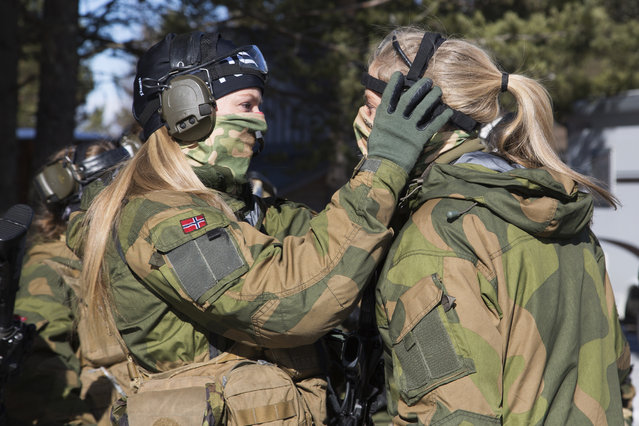
A soldier helps another with her ear protection at the Terningmoen Camp in Elverum, Norway on March 23, 2017. Capt. Ole Vidar, the officer leading the training program, said that the female unit has shown a stronger sense of solidarity among its members than the men in the elite platoon. (Photo by Carolina Reid/NBC News)

A soldier helps another with her ear protection at the Terningmoen Camp in Elverum, Norway on March 23, 2017. Soldiers demonstrate their skills and tactics during a contract drill as they train to become part of the world's first all-female special forces unit, the Jegertroppen or “hunter troops”. (Photo by Carolina Reid/NBC News)
Details
18 Apr 2017 08:50:00


“The McDonnell Douglas KC-10 Extender is an air-to-air tanker aircraft in service with the United States Air Force derived from the civilian DC-10-30 airliner. The KC-10 was the second consecutive McDonnell Douglas transport aircraft to be selected by the US Air Force following the C-9 Nightingale. The similar KDC-10 is in service with the Royal Netherlands Air Force.”

Photo: A B-52G Stratofortress aircraft takes off with another B-52G close behind. Three cells of six B-52 and KC-10 Extender aircraft will takeoff seconds apart under combat conditions during the minimum interval takeoff exercise. The exercise is a part of an operational readiness inspection by the Strategic Air Command Inspector General Team. (Photo by USAF). 1998
Details
15 Mar 2011 09:23:00
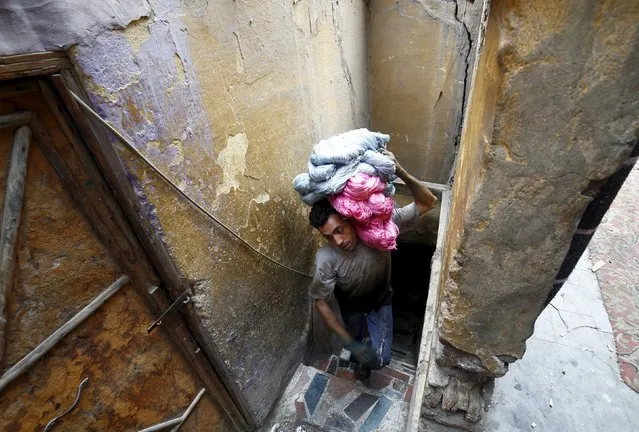
Mohamed Mostafa, 35, carries dyed yarns at a dye workshop in old Cairo, Egypt, March 17, 2016. (Photo by Amr Abdallah Dalsh/Reuters)

Mohamed Mostafa, 35, carries dyed yarns at a dye workshop in old Cairo, Egypt, March 17, 2016. Egypt's hard currency crisis and competition from modern factories in Asia and at home threaten one of the last dye workshops in Egypt. But one of its owners takes comfort in the trade's ancient resilience. Mohamed Mostafa boasts that the profession dates back 3,000 years, so it can survive anything. (Photo by Amr Abdallah Dalsh/Reuters)
Details
09 Apr 2016 13:26:00
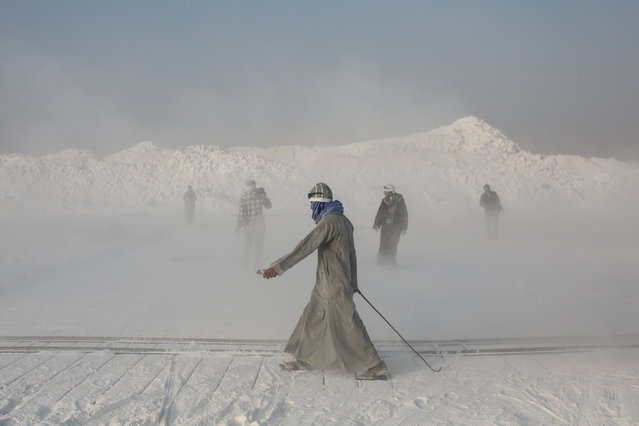
In this Wednesday, March 18, 2015 photo, limestone quarry workers walk through a cloud of dust spewed into the air by rotor blades of the stone-cutting machinery in the desert of Minya, southern Egypt. (Photo by Mosa'ab Elshamy/AP Photo)

In this Wednesday, March 18, 2015 photo, limestone quarry workers walk through a cloud of dust spewed into the air by rotor blades of the stone-cutting machinery in the desert of Minya, southern Egypt. Around 45,000 people, including children, work in an estimated 1,500 quarries, digging out stones that later will be used in construction or powdered to be used by pharmaceutical and ceramic companies. (Photo by Mosa'ab Elshamy/AP Photo)
Details
07 Apr 2015 11:41:00