Loading...
Done
Homemade Porsche 911

Making use of ULC (ultra light construction,) an Austrian car enthusiast Hannes Langeder managed to build the lightest and slowest Porsche in the world. ...
Details
15 Oct 2012 10:37:00
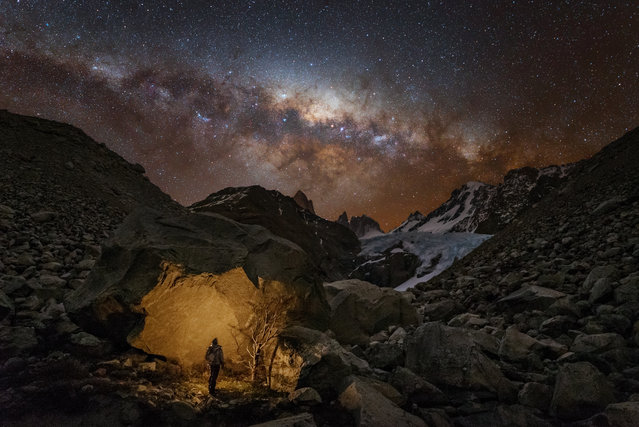
“People and Space”. Winner: Wanderer in Patagonia by Yuri Zvezdny (Russia) A lone stargazer stares up at the stars of our galaxy, the Milky Way, as they stretch across the night sky over the glacier “White Stones” (Piedras Blancas) in the Los Glaciares National Park, Argentina. El Chaltén, Santa Cruz Province, Argentina, 27 September 2016 iOptron Sky-Tracker mount, Sony A7S camera, 18 mm f/2.8 lens, ISO 5000, 30-second exposure Wanderer in Patagonia. (Photo by Yuri Zvezdny/Insight Astronomy Photographer of the Year 2017)


“People and Space”. Winner: Wanderer in Patagonia by Yuri Zvezdny (Russia) A lone stargazer stares up at the stars of our galaxy, the Milky Way, as they stretch across the night sky over the glacier “White Stones” (Piedras Blancas) in the Los Glaciares National Park, Argentina. El Chaltén, Santa Cruz Province, Argentina, 27 September 2016 iOptron Sky-Tracker mount, Sony A7S camera, 18 mm f/2.8 lens, ISO 5000, 30-second exposure Wanderer in Patagonia. (Photo by Yuri Zvezdny/Insight Astronomy Photographer of the Year 2017)

Details
18 Sep 2017 07:09:00
Ultra-Orthodox Jews dance next to a bonfire during celebrations for the Jewish holiday of Lag Ba-Omer in Jerusalem's Mea Shearim neighbourhood May 25, 2016. (Photo by Ronen Zvulun/Reuters)

Ultra-Orthodox Jews dance next to a bonfire during celebrations for the Jewish holiday of Lag Ba-Omer in Jerusalem's Mea Shearim neighbourhood May 25, 2016. This day marks the hillula (celebration, interpreted by some as anniversary of death) of Rabbi Shimon bar Yochai, a Mishnaic sage and leading disciple of Rabbi Akiva in the 2nd century, and the day on which he revealed the deepest secrets of kabbalah in the form of the Zohar (Book of Splendor), a landmark text of Jewish mysticism. (Photo by Ronen Zvulun/Reuters)
Details
26 May 2016 12:54:00
Ultra-Orthodox Jews knead dough in a bakery in an Orthodox neighborhood in Jerusalem, 29 March 2015. Matzah, or unleavened bread, is used instead of bread during the week-long Jewish holiday of Passover, commemorating the Jewish exodus from Egypt in Biblical times. (Photo by Abir Sultan/EPA)

Ultra-Orthodox Jews knead dough in a bakery in an Orthodox neighborhood in Jerusalem, 29 March 2015. Matzah, or unleavened bread, is used instead of bread during the week-long Jewish holiday of Passover, commemorating the Jewish exodus from Egypt in Biblical times. (Photo by Abir Sultan/EPA)
Details
01 Apr 2015 11:57:00
An ultra-Orthodox Jewish man holds a chicken before he performs the Kaparot ritual, where white chickens are slaughtered as a symbolic gesture of atonement, ahead of Yom Kippur, the Jewish Day of Atonement in Bnei Brak, Israel in Bnei Brak October 9, 2016. (Photo by Baz Ratner/Reuters)

An ultra-Orthodox Jewish man holds a chicken before he performs the Kaparot ritual, where white chickens are slaughtered as a symbolic gesture of atonement, ahead of Yom Kippur, the Jewish Day of Atonement in Bnei Brak, Israel in Bnei Brak October 9, 2016. (Photo by Baz Ratner/Reuters)
Details
11 Oct 2016 11:06:00
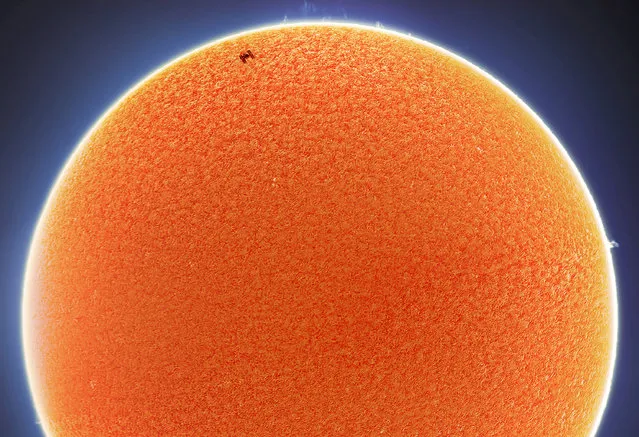
The International Space Station (ISS) moving in front of the sun in November 2020 by astrophotographer Andrew McCarthy. These incredible photos capture the clearest images ever taken of the International Space Station (ISS) moving in front of both the moon and the sun. The photos, taken within days of one another, were captured in the space of less than a second, as the space station could be clearly seen zooming across against the bright backdrops of both moon and sun. Photographer Andrew McCarthy, from California, USA, said the photo of the ISS in front of the sun, in broad daylight, was “one of my trickiest shots ever”. (Photo by Andrew McCarthy/South West News Service)

The International Space Station (ISS) moving in front of the sun in November 2020 by astrophotographer Andrew McCarthy. These incredible photos capture the clearest images ever taken of the International Space Station (ISS) moving in front of both the moon and the sun. The photos, taken within days of one another, were captured in the space of less than a second, as the space station could be clearly seen zooming across against the bright backdrops of both moon and sun. Photographer Andrew McCarthy, from California, USA, said the photo of the ISS in front of the sun, in broad daylight, was “one of my trickiest shots ever”. (Photo by Andrew McCarthy/South West News Service)
Details
28 Nov 2020 00:05:00
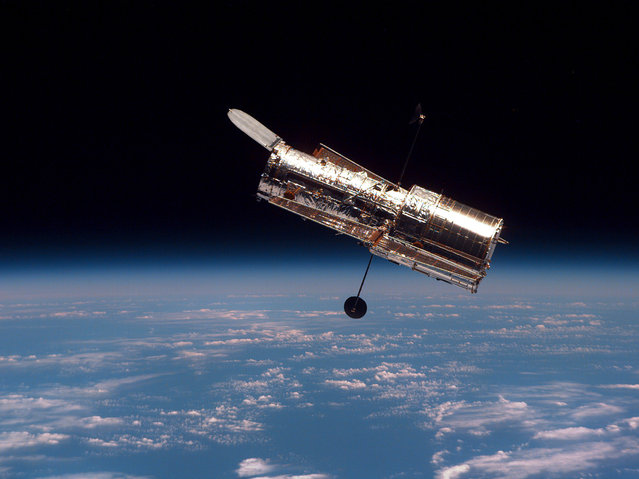
The Hubble Space Telescope is shown following its release from the space shuttle Discovery Wednesday, February 19, 1997. The Hubble Space Telescope, one of NASA'S crowning glories, marks its 25th anniversary on Friday, April 24, 2015. With more than 1 million observations, including those of the farthest and oldest galaxies ever beholden by humanity, no man-made satellite has touched as many minds or hearts as Hubble. (Photo by AP Photo/NASA)

The Hubble Space Telescope is shown following its release from the space shuttle Discovery Wednesday, February 19, 1997. The Hubble Space Telescope, one of NASA'S crowning glories, marks its 25th anniversary on Friday, April 24, 2015. With more than 1 million observations, including those of the farthest and oldest galaxies ever beholden by humanity, no man-made satellite has touched as many minds or hearts as Hubble. (Photo by AP Photo/NASA)
Details
24 Apr 2015 11:25:00
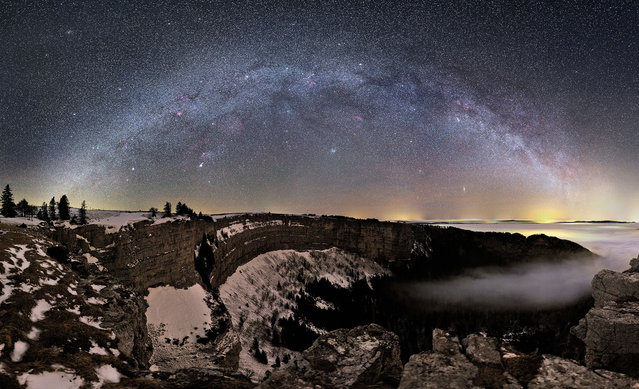
Milky Way over Switzerland

Milky Way over Switzerland

The Milky Way is the galaxy in which Earth is contained. This name derives from its appearance as a dim “milky” glowing band arching across the night sky, in which the naked eye cannot distinguish individual stars. The term “Milky Way” is a translation of the Classical Latin via lactea, from the Hellenistic Greek γαλαξίας κύκλος (pr. galaxías kýklos, “milky circle”). The Milky Way appears like a band because it is a disk-shaped structure being viewed from inside. The fact that this faint band of light is made up of stars was proven in 1610 when Galileo Galilei used his telescope to resolve it into individual stars. In the 1920s, observations by astronomer Edwin Hubble showed that the Milky Way is just one of many galaxies.


Details
20 Jun 2012 10:11:00