Loading...
Done
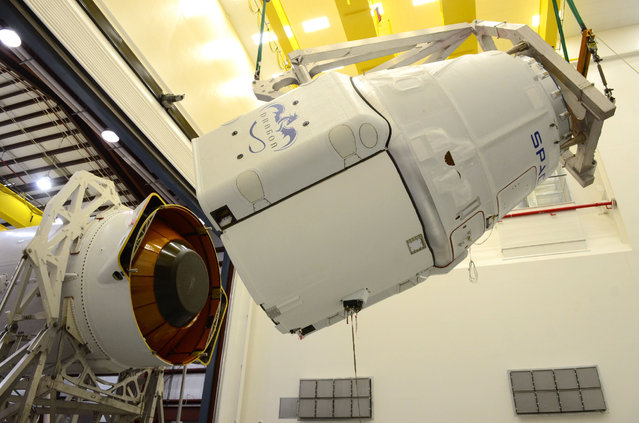
SpaceX’s Dragon spacecraft, March 6, 2014. SpaceX's Falcon 9 rocket and Dragon spacecraft launched from Launch Complex 40 at the Cape Canaveral Air Force Station, Florida, for their third official Commercial Resupply (CRS) mission to the orbiting lab on April 18, 2014. Dragon is the only operational spacecraft capable of returning a significant amount of supplies back to Earth, including experiments. (Photo by Ron Lin/SpaceX Photos)

SpaceX’s Dragon spacecraft, March 6, 2014. SpaceX's Falcon 9 rocket and Dragon spacecraft launched from Launch Complex 40 at the Cape Canaveral Air Force Station, Florida, for their third official Commercial Resupply (CRS) mission to the orbiting lab on April 18, 2014. Dragon returned to Earth with a parachute-assisted splashdown off the coast of southern California on May 14, 2014. Dragon is the only operational spacecraft capable of returning a significant amount of supplies back to Earth, including experiments. (Photo by Ron Lin/SpaceX Photos)
Details
30 Mar 2015 13:11:00
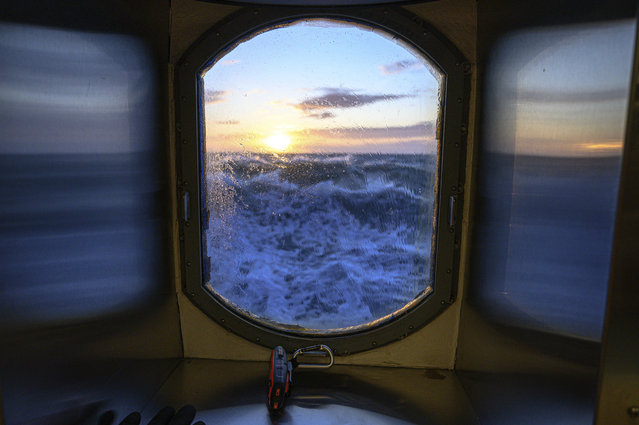
This November 8, 2019, photo provided by John Guillote shows a view from the main lab of the Sikuliaq in the Chukchi Sea. University of Washington scientists onboard the research vessel are studying the changes and how less sea ice will affect coastlines, which already are vulnerable to erosion because increased waves delivered by storms. More erosion would increase the chance of winter flooding in villages and danger to hunters in small boats. (Photo by John Guillote via AP Photo)

This November 8, 2019, photo provided by John Guillote shows a view from the main lab of the Sikuliaq in the Chukchi Sea. University of Washington scientists onboard the research vessel are studying the changes and how less sea ice will affect coastlines, which already are vulnerable to erosion because increased waves delivered by storms. More erosion would increase the chance of winter flooding in villages and danger to hunters in small boats. (Photo by John Guillote via AP Photo)
Details
26 Aug 2021 08:22:00
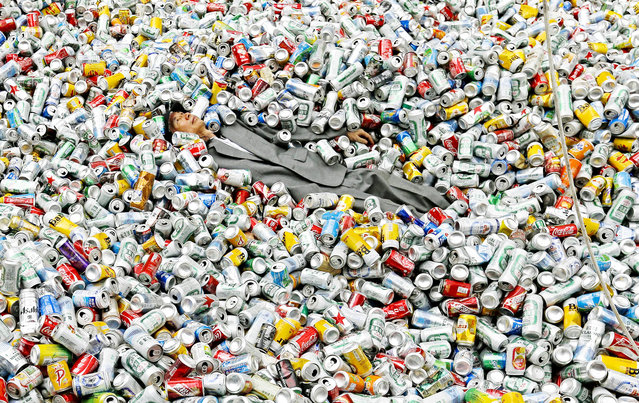
Taiwanese-US artist Chin Chih Yang poses for a photograph with 30,000 aluminum cans after his performance called “Kill Me or Change” in Taipei, Taiwan, 23 April 2016. “Kill Me or Change!” is a performance piece that aims to raise awareness of the benefits of recycling and, encourage people to recycle to conserve resources. (Photo by Ritchie B. Tongo/EPA)

Taiwanese-US artist Chin Chih Yang poses for a photograph with 30,000 aluminum cans after his performance called “Kill Me or Change” in Taipei, Taiwan, 23 April 2016. “Kill Me or Change!” is a performance piece that aims to raise awareness of the benefits of recycling and, encourage people to recycle to conserve resources. (Photo by Ritchie B. Tongo/EPA)
Details
24 Apr 2016 09:53:00
ROBOY: Tendon Driven Humanoid Robot

Roboy has a bright future, as he represents a completely new generation of robots. The pioneer project of the Artificial Intelligence Laboratory (AI Lab) of the University of Zurich started six months ago, with the target of developing one of the most modern humanoid robots within nine months. Now the robot has received a new face and is able to move his arms driven by maxon DC motors. On March 9, 2013, Roboy will be presented to the public at the “Robots on Tour” robotics exhibition held in Zurich on the 25th anniversary of the lab.
Details
06 Mar 2013 10:10:00
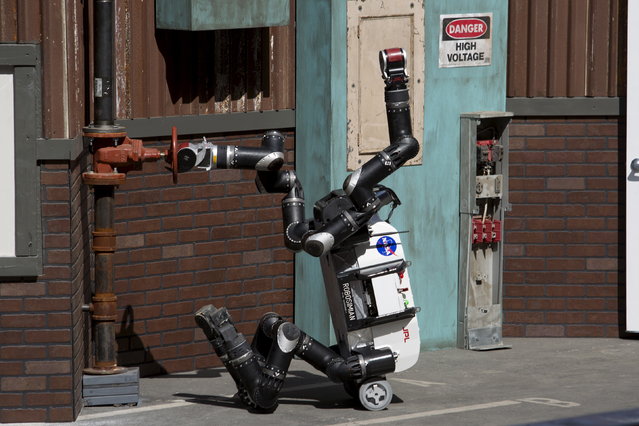
The Jet Propulsion Lab team's RoboSimian robot turns on a valve at a simulated disaster-response course during day one of the Defense Advanced Research Projects Agency (DARPA) Robotics Challenge finals in Pomona, California, June 5, 2015. (Photo by David McNew/Reuters)

The Jet Propulsion Lab team's RoboSimian robot turns on a valve at a simulated disaster-response course during day one of the Defense Advanced Research Projects Agency (DARPA) Robotics Challenge finals in Pomona, California, June 5, 2015. (Photo by David McNew/Reuters)
Details
13 Dec 2015 08:29:00
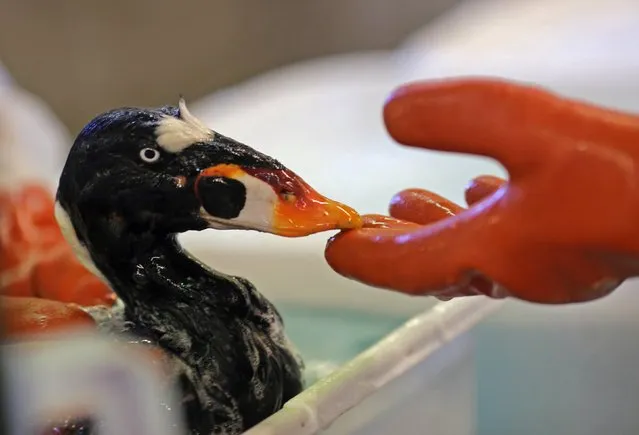
A bird is cleaned at the International Bird Rescue in Fairfield, California January 20, 2015. A gooey, unknown material discovered on the eastern shores of San Francisco Bay is clinging to the feathers of birds, and more than 100 birds, mostly species of oceangoing, diving ducks, have died after their feathers were fouled by the viscous substance now undergoing testing at state labs in Sacramento. (Photo by Robert Galbraith/Reuters)

A bird is cleaned at the International Bird Rescue in Fairfield, California January 20, 2015. A gooey, unknown material discovered on the eastern shores of San Francisco Bay is clinging to the feathers of birds, and more than 100 birds, mostly species of oceangoing, diving ducks, have died after their feathers were fouled by the viscous substance now undergoing testing at state labs in Sacramento. (Photo by Robert Galbraith/Reuters)
Details
22 Jan 2015 14:03:00
“Don't look at me, I'm not ready!!!!” (Photo and caption by Yves Lecoq)

“Don't look at me, I'm not ready!!!!” (Photo and caption by Yves Lecoq)
Details
11 Apr 2015 09:25:00
“Shoot Me to the Stars”. (Photo and comment by Dave Morrow)

“Shoot Me to the Stars”. (Photo and comment by Dave Morrow)

Details
22 Feb 2013 16:23:00