Loading...
Done
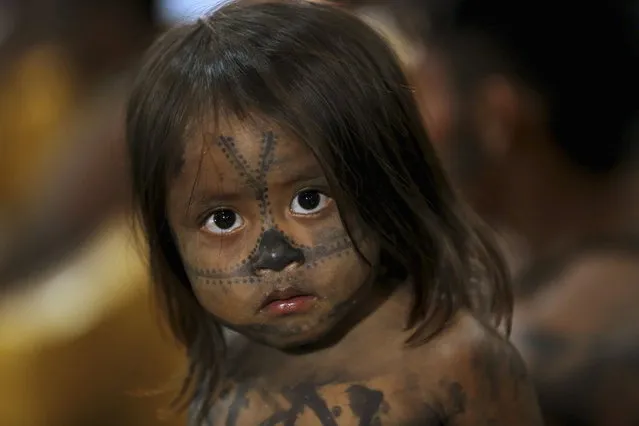
A Munduruku Indian child is pictured at the Planalto Palace, where a meeting with Minister of the General Secretariat of the Presidency of Brazil Gilberto Carvalho was being held with other Munduruku Indians, in Brasilia, June 4, 2013. (Photo by Ueslei Marcelino/Reuters)

A Munduruku Indian child is pictured at the Planalto Palace, where a meeting with Minister of the General Secretariat of the Presidency of Brazil Gilberto Carvalho was being held with other Munduruku Indians, in Brasilia, June 4, 2013. President Dilma Rousseff's government sought on Tuesday to defuse mounting conflicts with indigenous groups over its decision to stop setting aside farm land for Indians and plans to build more hydroelectric dams in the Amazon. The government flew 144 Munduruku Indians to Brasilia for talks to end a week-long occupation of the controversial Belo Monte dam on the Xingu river, a huge project aimed at feeding Brazil's fast-growing demand for electricity. (Photo by Ueslei Marcelino/Reuters)
Details
06 Jun 2013 09:25:00
Business Flourishes For Brass Bands During Indian Wedding Season

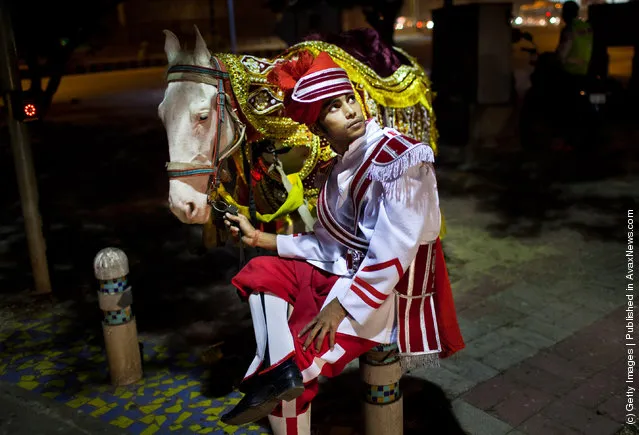
A musician from the Rajan Band, Kotla Mubarakpur holds on to a decorated horse as he and others wait prior to performing at a wedding on November 22, 2011 in New Delhi, India. (Photo by Daniel Berehulak/Getty Images)
Details
27 Nov 2011 14:43:00
In this February 1, 2017 photo, Anjali Lama, a transgender model from Nepal, looks at her mobile phone backstage during Lakme Fashion week in Mumbai, India. (Photo by Rafiq Maqbool/AP Photo)

In this February 1, 2017 photo, Anjali Lama, a transgender model from Nepal, looks at her mobile phone backstage during Lakme Fashion week in Mumbai, India. Growing up as the fifth son in a poor farming family in rural Nepal the dream to be a fashion model came late in life.(Photo by Rafiq Maqbool/AP Photo)
Details
05 Feb 2017 01:02:00
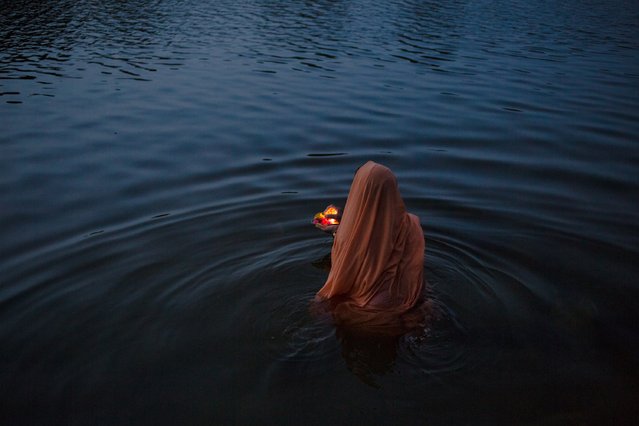
An Indian women offers early-morning prayers or a “puja” at a ghat early in the morning on the banks of the Betawa River in Orchha in the state of Madhya Pradesh on July 5, 2015. (Photo by Rebecca Conway/AFP Photo)

An Indian women offers early-morning prayers or a “puja” at a ghat early in the morning on the banks of the Betawa River in Orchha in the state of Madhya Pradesh on July 5, 2015. (Photo by Rebecca Conway/AFP Photo)
Details
08 Jul 2015 11:56:00
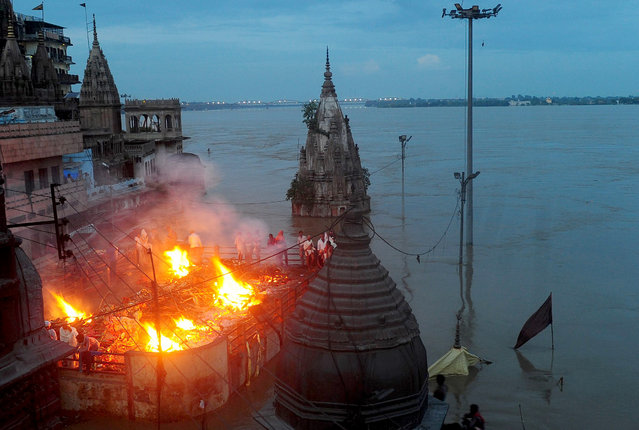
Indian mourners perform a cremation on the roof of a building overlooking The Manikarnika Ghat in Varanasi on August 23, 2016. India's holy city of Varanasi has been forced to halt cremations along the banks of the sacred river Ganges as deadly floods from monsoon rains hit parts of the country, an official said. More than 100,000 people have been forced from their homes in recent days in northern Uttar Pradesh and neighbouring Bihar states as rain-swollen rivers burst their banks. (Photo by Sanjay Kanojia/AFP Photo)

Indian mourners perform a cremation on the roof of a building overlooking The Manikarnika Ghat in Varanasi on August 23, 2016. India's holy city of Varanasi has been forced to halt cremations along the banks of the sacred river Ganges as deadly floods from monsoon rains hit parts of the country, an official said. More than 100,000 people have been forced from their homes in recent days in northern Uttar Pradesh and neighbouring Bihar states as rain-swollen rivers burst their banks. (Photo by Sanjay Kanojia/AFP Photo)
Details
28 Aug 2016 09:57:00
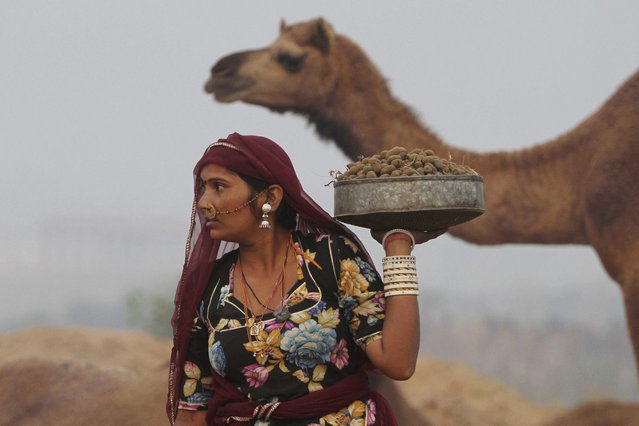
An Indian woman collects camel dung during the annual cattle fair in Pushkar, in the western Indian state of Rajasthan, Sunday, November 10, 2013. Pushkar, located on the banks of Pushkar Lake, is a popular Hindu pilgrimage spot that is also frequented by foreign tourists who come to the town for the annual cattle fair and camel races. (Photo by Ajit Solanki/AP Photo)

An Indian woman collects camel dung during the annual cattle fair in Pushkar, in the western Indian state of Rajasthan, Sunday, November 10, 2013. Pushkar, located on the banks of Pushkar Lake, is a popular Hindu pilgrimage spot that is also frequented by foreign tourists who come to the town for the annual cattle fair and camel races. (Photo by Ajit Solanki/AP Photo)
Details
11 Nov 2013 10:59:00
A participant from Indonesia waits to perform a dance during the last day of World Culture Festival on the banks of the river Yamuna in New Delhi, India, March 13, 2016. (Photo by Adnan Abidi/Reuters)

A participant from Indonesia waits to perform a dance during the last day of World Culture Festival on the banks of the river Yamuna in New Delhi, India, March 13, 2016. The festival opened on the banks of the Yamuna River in the Indian capital Friday despite concerns the sprawling construction of roads, ramps and pontoon bridges would irreparably damage the river's floodplains. (Photo by Adnan Abidi/Reuters)
Details
14 Mar 2016 11:07:00
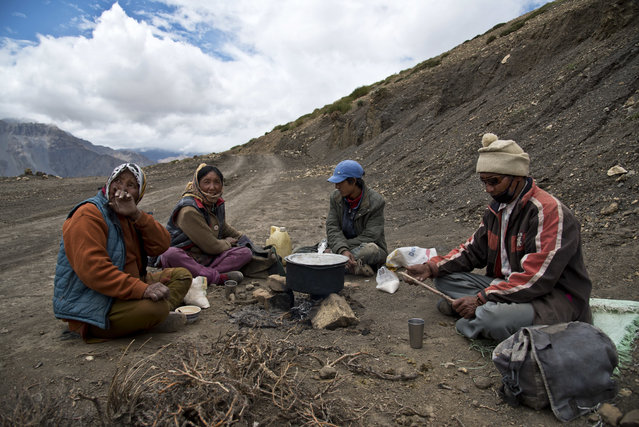
In this August 17, 2016, photo, from left to right, Chhering Chodom, 60, Tashi Yangzom, 50, Lobsang Chhering, 27, and Dorje Tandup, 58, drink milk tea on the side of the road. For centuries, the sleepy valley nestled in the Indian Himalayas remained a hidden Buddhist enclave forbidden to outsiders. Enduring the harsh year-round conditions of the high mountain desert, the people of Spiti Valley lived by a simple communal code – share the Earth's bounty, be hospitable to neighbors, and eschew greed and temptation at all turns. That's all starting to change, for better or worse. Since India began allowing its own citizens as well as outsiders to visit the valley in the early 1990s, tourism and trade have boomed. And the marks of modernization, such as solar panels, asphalt roads and concrete buildings, have begun to appear around some of the villages that dot the remote landscape at altitudes above 4,000 meters (13,000 feet). (Photo by Thomas Cytrynowicz/AP Photo)

In this August 17, 2016, photo, from left to right, Chhering Chodom, 60, Tashi Yangzom, 50, Lobsang Chhering, 27, and Dorje Tandup, 58, drink milk tea on the side of the road. For centuries, the sleepy valley nestled in the Indian Himalayas remained a hidden Buddhist enclave forbidden to outsiders. Enduring the harsh year-round conditions of the high mountain desert, the people of Spiti Valley lived by a simple communal code – share the Earth's bounty, be hospitable to neighbors, and eschew greed and temptation at all turns. That's all starting to change, for better or worse. (Photo by Thomas Cytrynowicz/AP Photo)
Details
15 Sep 2016 09:22:00