Loading...
Done


Soviet cosmonaut and the first man to travel in space, Yury Alekseyvich Gagarin (1934–1968) arriving in London for a Russian trade fair. (Photo by Douglas Miller/Getty Images)
Details
11 Apr 2011 10:24:00
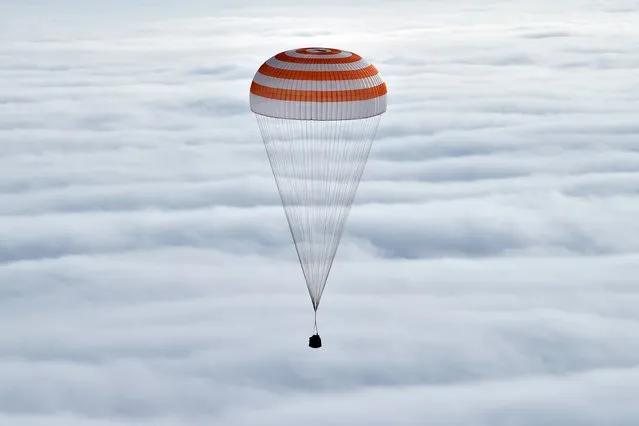
A Soyuz capsule carrying International Space Station (ISS) crew members U.S. astronaut Scott Kelly, Russian cosmonauts Sergei Volkov and Mikhail Korniyenko descends beneath a parachute near the town of Dzhezkazgan (Zhezkazgan), Kazakhstan, March 2, 2016. (Photo by Kirill Kudryavtsev/Reuters)

A Soyuz capsule carrying International Space Station (ISS) crew members U.S. astronaut Scott Kelly, Russian cosmonauts Sergei Volkov and Mikhail Korniyenko descends beneath a parachute near the town of Dzhezkazgan (Zhezkazgan), Kazakhstan, March 2, 2016. (Photo by Kirill Kudryavtsev/Reuters)
Details
03 Mar 2016 11:12:00
A Sign in Space by The photography of Lennart Nilsson

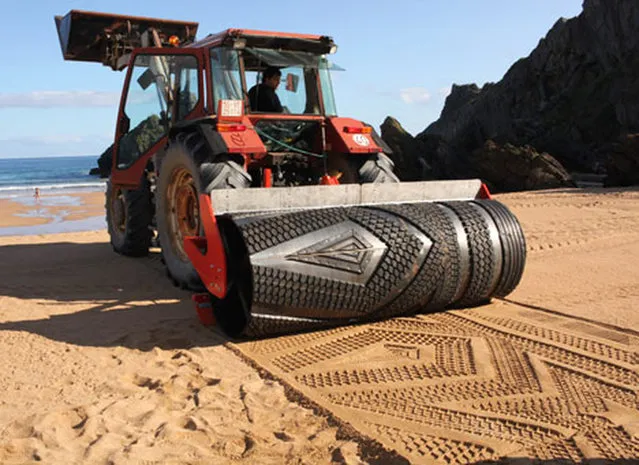
Stars are printed in the sand by a tractor as it drags a giant roller back and forth across the beach, then left to fade at the mercy of footsteps and the tide in this installation by Swedish artist Gunilla Klingberg.
Details
09 Oct 2012 14:15:00
Open Space Office By Tito Mouraz

The photos, created by Tito Mouraz in Portugal, look too surreal, and it takes a while to realize that these are actually not painting but reality. The way people can completely transform the terrain is very reminiscent of the way people tend to change themselves. Chip away the granite of their soul, turning it into something that fits their idea of perfection. However, in the end, most of them end up with an obscene parody of beauty, rather than something truly marvelous. The reason for it is probably that people are actually oblivious to the true image of beauty, making them stumble around in the dark, hoping to find something that might not exist at all. (Photo by Tito Mouraz)
Details
30 Oct 2014 13:13:00
A small section of the expanding remains of the Veil Nebula, a massive star that exploded about 8,000 years ago. The entire nebula is 110 light-years across, covering six full moons on the sky as seen from Earth, and resides about 2,100 light-years away in the constellation Cygnus, the Swan. Image taken by NASA's Hubble Space Telescope. Released September 24, 2015. (Photo by Reuters/NASA/ESA/Hubble Heritage Team)

A small section of the expanding remains of the Veil Nebula, a massive star that exploded about 8,000 years ago. The entire nebula is 110 light-years across, covering six full moons on the sky as seen from Earth, and resides about 2,100 light-years away in the constellation Cygnus, the Swan. Image taken by NASA's Hubble Space Telescope. Released September 24, 2015. (Photo by Reuters/NASA/ESA/Hubble Heritage Team)
Details
10 Dec 2015 08:01:00
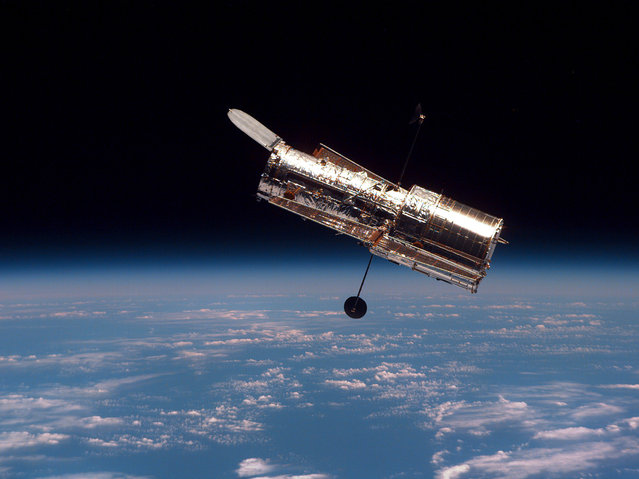
The Hubble Space Telescope is shown following its release from the space shuttle Discovery Wednesday, February 19, 1997. The Hubble Space Telescope, one of NASA'S crowning glories, marks its 25th anniversary on Friday, April 24, 2015. With more than 1 million observations, including those of the farthest and oldest galaxies ever beholden by humanity, no man-made satellite has touched as many minds or hearts as Hubble. (Photo by AP Photo/NASA)

The Hubble Space Telescope is shown following its release from the space shuttle Discovery Wednesday, February 19, 1997. The Hubble Space Telescope, one of NASA'S crowning glories, marks its 25th anniversary on Friday, April 24, 2015. With more than 1 million observations, including those of the farthest and oldest galaxies ever beholden by humanity, no man-made satellite has touched as many minds or hearts as Hubble. (Photo by AP Photo/NASA)
Details
24 Apr 2015 11:25:00
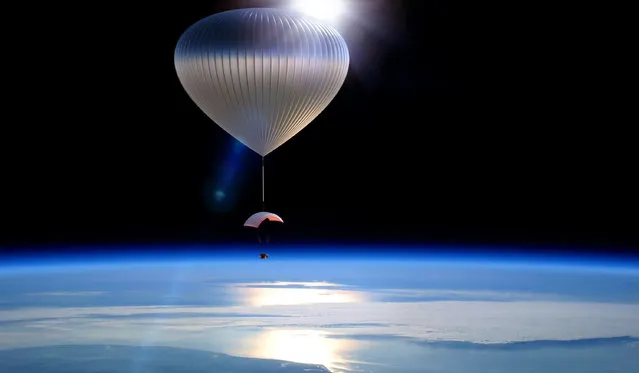
This undated image provided by World View shows World View capsule and balloon spacecraft that will rise to 100,000 feet above Earth for passengers to see the curvature of the planet and the blackness of space. (Photo by World View via AP Photo)

This undated image provided by World View shows World View capsule and balloon spacecraft that will rise to 100,000 feet above Earth for passengers to see the curvature of the planet and the blackness of space. Space tourism companies are employing designs including winged vehicles, vertical rockets with capsules and high-altitude balloons. While developers envision ultimately taking people to orbiting habitats, the moon or beyond, the immediate future involves short flights into or near the lowest reaches of space without going into orbit. (Photo by World View via AP Photo)
Details
15 Feb 2016 10:28:00
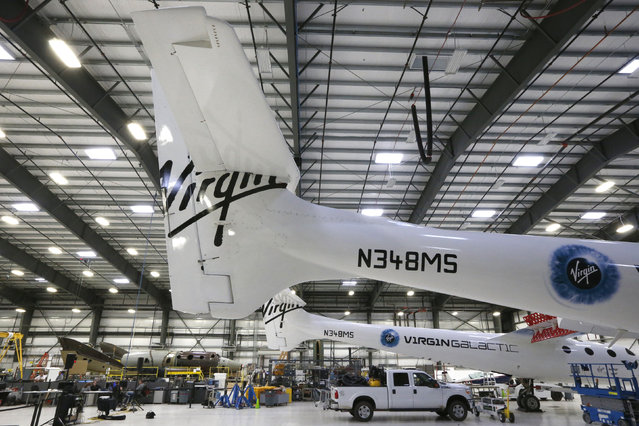
Virgin Galactic's new spaceship N202VG (bottom L) is seen behind the WhiteKnightTwo carrier aircraft mothership (front), which landed safely after splitting from SpaceShipTwo, in a hangar at Mojave Air and Space Port in Mojave, California, November 4, 2014. (Photo by Lucy Nicholson/Reuters)

Virgin Galactic's new spaceship N202VG (bottom L) is seen behind the WhiteKnightTwo carrier aircraft mothership (front), which landed safely after splitting from SpaceShipTwo, in a hangar at Mojave Air and Space Port in Mojave, California, November 4, 2014. (Photo by Lucy Nicholson/Reuters)
Details
05 Nov 2014 12:07:00