Loading...
Done
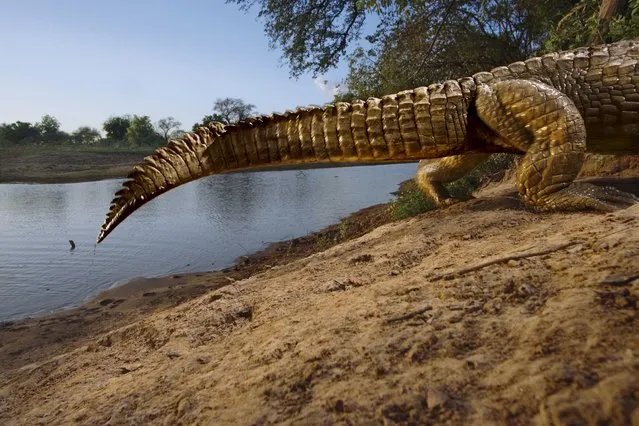
CT4 Crocodile cave on the Salamat river. Set up with Nathan Williamson last chip rain came while we were with the nomads. (Photo by Michael Nichols/National Geographic)

National Geographic has created “Air, Land & Sea: the 50 greatest wildlife photographs” exhibition. Here: CT4 Crocodile cave on the Salamat river. Set up with Nathan Williamson last chip rain came while we were with the nomads. (Photo by Michael Nichols/National Geographic)
Details
13 Sep 2018 00:03:00
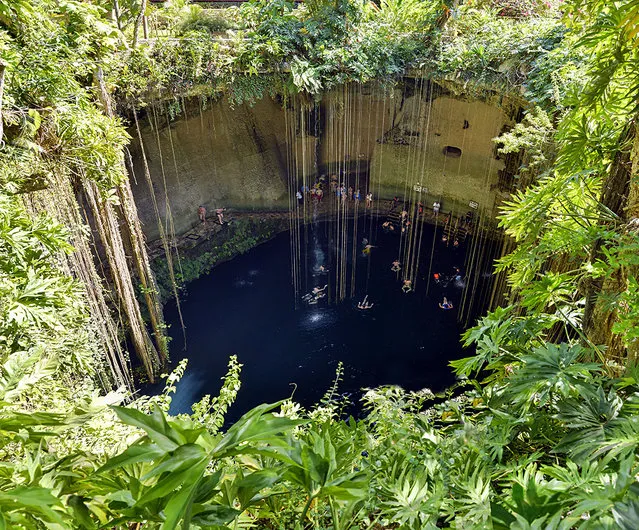
Cenote In Mexico

A cenote is a natural phenomenon, a sinkhole in the Earth’s surface. The Yucatan Peninsula in Mexico has an estimated 7,000 cenotes because it is primarily made up of porous limestone. For millions of years, rainfall slowly ate away at the limestone and a huge system of underground caves and caverns was formed. Many filled with water from rain or from the underground water table. When the roof of a water filled cave collapses, a cenote is born. The water found in a cenote may be fresh water, salt water, or both. Structurally it may be completely open, like a lake, almost completely closed with just a small opening at the top, or somewhere in between.
Details
06 Oct 2013 09:45:00
A Malaysian Hindu devotee (C) reacts in a state of trance as she walks towards the Batu caves temple during the Thaipusam festival celebrations in Kuala Lumpur on January 24, 2016. More than a million Hindus celebrate the festival of “Thaipusam” at temples across the country. (Photo by Manan Vatsyayana/AFP Photo)

A Malaysian Hindu devotee (C) reacts in a state of trance as she walks towards the Batu caves temple during the Thaipusam festival celebrations in Kuala Lumpur on January 24, 2016. More than a million Hindus celebrate the festival of “Thaipusam” at temples across the country. (Photo by Manan Vatsyayana/AFP Photo)
Details
25 Jan 2016 11:52:00
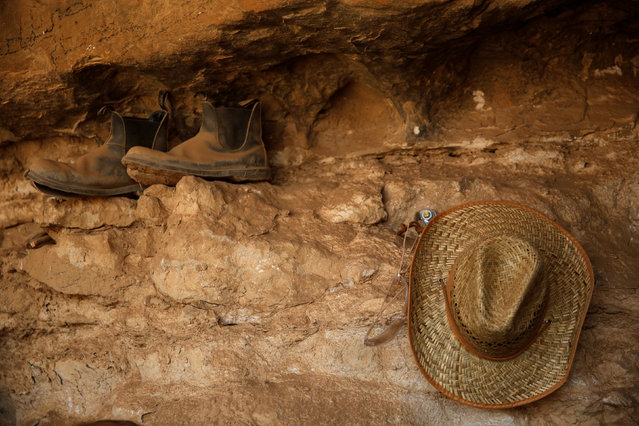
A hat and boots belonging to a volunteer with the Israeli Antique Authority are seen inside the Cave of the Skulls, an excavation site in the Judean Desert near the Dead Sea, Israel June 1, 2016. (Photo by Ronen Zvulun/Reuters)

A hat and boots belonging to a volunteer with the Israeli Antique Authority are seen inside the Cave of the Skulls, an excavation site in the Judean Desert near the Dead Sea, Israel June 1, 2016. A team of volunteers and archaeologists are searching for remains of The Dead Sea Scrolls, one of the oldest known Hebrew texts, in a national bid, initiated by the Israel Antiquities Authority (IAA), to prevent the robbery of such important artefacts and once found to hand them over to the state for preservation. (Photo by Ronen Zvulun/Reuters)
Details
02 Jun 2016 12:17:00
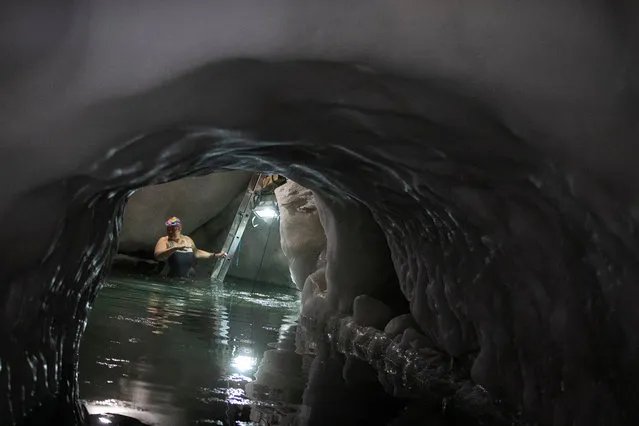
Ice swimmer Klaudia prepares to swim in a filled up water kettle in an ice cave inside the Nature Ice Palace, with a hight of 3,250 meters (10,663 feet) above sea level, at Hintertux Glacier near Hintertux, some 480 kilometers (298 miles) western of Vienna, Austria, 28 July 2018. (Photo by Christian Bruna/EPA/EFE)

Ice swimmer Klaudia prepares to swim in a filled up water kettle in an ice cave inside the Nature Ice Palace, with a hight of 3,250 meters (10,663 feet) above sea level, at Hintertux Glacier near Hintertux, some 480 kilometers (298 miles) western of Vienna, Austria, 28 July 2018. (Photo by Christian Bruna/EPA/EFE)
Details
08 Aug 2018 00:03:00
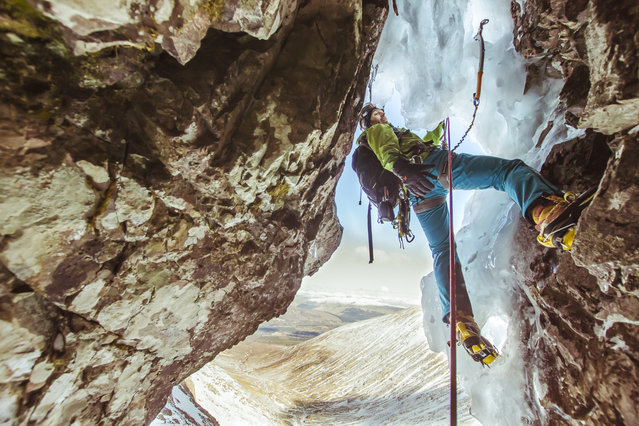
“Winter Climbing from inside Ben Nevis”. The view from inside the mountain, as a winter climber passes through the cave on Minus Three gully. Photo location: Ben Nevis, Fort William, Scotland. (Photo and caption by Daniel Wildey/National Geographic Photo Contest)

“Winter Climbing from inside Ben Nevis”. The view from inside the mountain, as a winter climber passes through the cave on Minus Three gully. Photo location: Ben Nevis, Fort William, Scotland. (Photo and caption by Daniel Wildey/National Geographic Photo Contest)
Details
24 Jun 2014 12:18:00
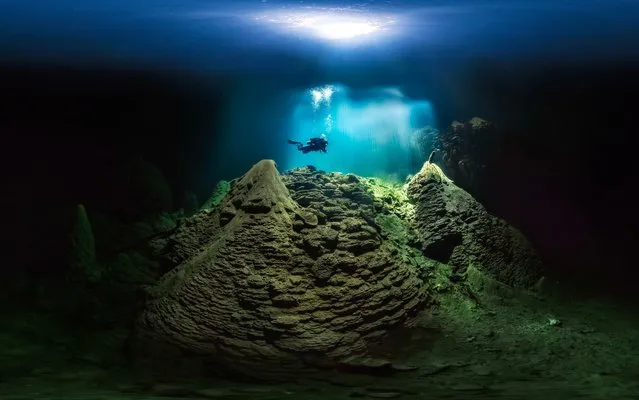
Cave Diver, Anhumas Abyss, Bonito, Brazil: The Anhumas Abyss is an underground cavern with a crystal-clear lake below, more than 260 feet (79 m) deep. A visitor must enter through a narrow opening at the top of the chamber and rappel into the cave. Snorkeling and scuba diving in the lake reveal amazing scenery. Distinctive, conical limestone stalagmites and stalactites occupy the lake and the surrounding area, some reaching 65 feet (20 m) high. “One must rappel about 235 feet (72 m) to get down into this deep lake. The photo was taken at a depth of 50 feet (15 m). It was a challenge to create the image because of the high contrast, plus the diver could not see into the darkness, making communication impossible”. (Photo by Marcio Cabral/Nature’s Best Photography Awards 2017)

Cave Diver, Anhumas Abyss, Bonito, Brazil: The Anhumas Abyss is an underground cavern with a crystal-clear lake below, more than 260 feet (79 m) deep. A visitor must enter through a narrow opening at the top of the chamber and rappel into the cave. Snorkeling and scuba diving in the lake reveal amazing scenery. Distinctive, conical limestone stalagmites and stalactites occupy the lake and the surrounding area, some reaching 65 feet (20 m) high. (Photo by Marcio Cabral/Nature’s Best Photography Awards 2017)
Details
26 Oct 2017 08:10:00
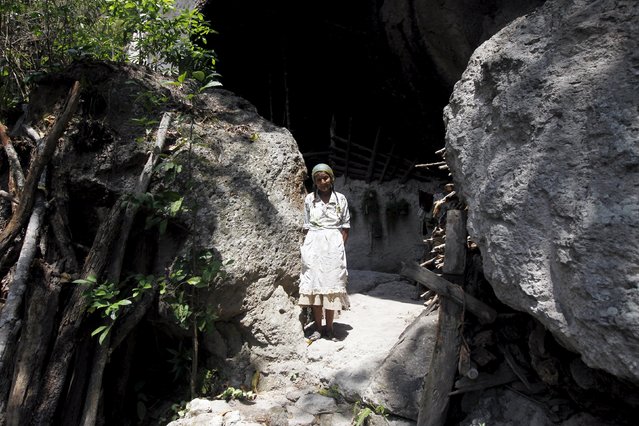
Francisca Gomez stands at an entrance to her home, a cave where she has been living for the past 50 years, in the mountains on the outskirts of Chusmuy April 21, 2015. (Photo by Jorge Cabrera/Reuters)

Francisca Gomez stands at an entrance to her home, a cave where she has been living for the past 50 years, in the mountains on the outskirts of Chusmuy, Honduras April 21, 2015. The 75-year old widow receives help from neighbors and friends and she makes a little money by selling wood she collects, according to a local newspaper. (Photo by Jorge Cabrera/Reuters)
Details
24 Apr 2015 10:38:00