Loading...
Done


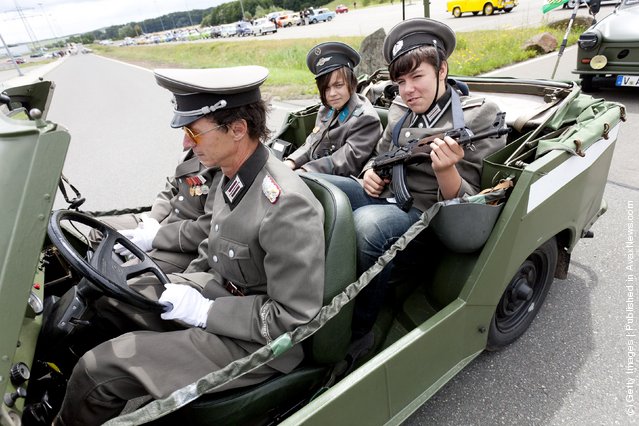
“The Trabant is a car that was produced by former East German auto maker VEB Sachsenring Automobilwerke Zwickau in Zwickau, Sachsen. It was the most common vehicle in East Germany, and was also exported to countries both inside and outside the communist bloc. The main selling points was that it had room for four adults and luggage in a compact, light and durable shell and that it was fast (when introduced) and durable. With its mediocre performance, smoky two-stroke engine, and production shortages, the Trabant is often cited as an example of the disadvantages of centralized planning; on the other hand, it is regarded with derisive affection as a symbol of the failed former East Germany and of the fall of communism (in former West Germany, as many East Germans streamed into West Berlin and West Germany in their Trabants after the opening of the Berlin Wall in 1989). It was in production without any significant changes for nearly 30 years with 3,096,099 Trabants produced in total”. – Wikipedia

Photo: Enthusiasts weared in uniforms of the former eastern german army trive in a military Trabant car as fans and owners of East German-era Trabant cars gather at the 2011 International Trabantfahrer Treffen (International Trabant Drivers Meeting) on June 26, 2011 in Zwickau, Germany. The Trabant, also known as the Trabi, was among the main cars produced in communist East Germany and built by VEB Sachsenring Automobilwerke in Zwickau for 30 years until 1989. Today the car has cult status for many followers and one company, IndiKar, is even seeking to revive the brand in a modern, electric version. (Photo by Carsten Koall/Getty Images)
Details
27 Jun 2011 12:21:00
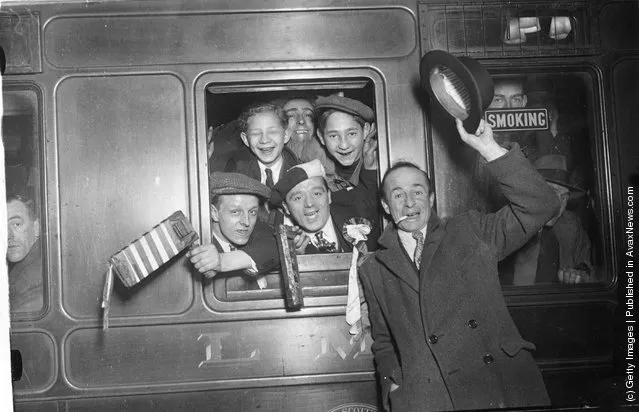
Football Fans 1900–1940

Arsenal football supporters cheering from the train carriage window as they leave Euston Station, London, on their way to Birmingham for their team's match against Aston Villa which they lost 3-5. (Photo by Douglas Miller/Topical Press Agency/Getty Images). 19th November 1932
Details
28 Aug 2011 13:57:00
A Brazil soccer fan wearing contact lenses that mimic the Brazilian flag reacts as she watches her team play Germany in a World Cup semifinal game via live telecast inside the FIFA Fan Fest area on Copacabana beach in Rio de Janeiro, Brazil, Tuesday, July 8, 2014. (Photo by Leo Correa/AP Photo)

A Brazil soccer fan wearing contact lenses that mimic the Brazilian flag reacts as she watches her team play Germany in a World Cup semifinal game via live telecast inside the FIFA Fan Fest area on Copacabana beach in Rio de Janeiro, Brazil, Tuesday, July 8, 2014. (Photo by Leo Correa/AP Photo)
Details
09 Jul 2014 13:24:00
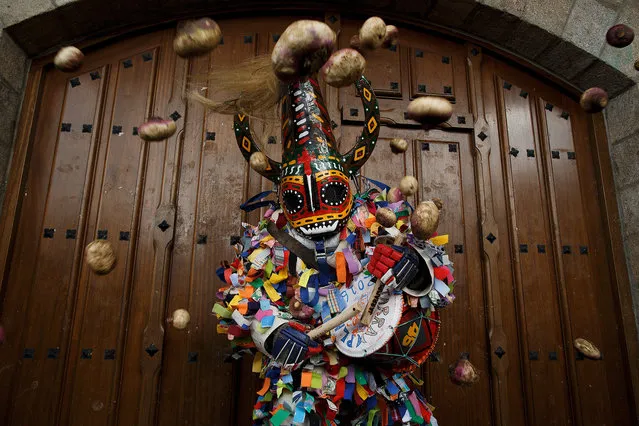
People throw turnips at the Jarramplas as he comes out from the church beating his drum during the Jarramplas Festival on January 20, 2016 in Piornal, Caceres province, Spain. The centuries old Jarramplas festival takes place annually every January 19-20 on Saint Sebastian Day and this year they expect to use more than 20 thousand kilogrames of turnips. Even though the exact origins of the festival are not known, various theories exist including the mythological punishment of Caco by Hercules. (Photo by Pablo Blazquez Dominguez/Getty Images)

People throw turnips at the Jarramplas as he comes out from the church beating his drum during the Jarramplas Festival on January 20, 2016 in Piornal, Caceres province, Spain. The centuries old Jarramplas festival takes place annually every January 19-20 on Saint Sebastian Day and this year they expect to use more than 20 thousand kilogrames of turnips. Even though the exact origins of the festival are not known, various theories exist including the mythological punishment of Caco by Hercules, a relation to ceremonies celebrated by the American Indians that were seen by the first conquerors, to a cattle thief ridiculed and expelled by his village neighbours. It is generally believed to symbolize the expulsion of everything bad. (Photo by Pablo Blazquez Dominguez/Getty Images)
Details
21 Jan 2016 13:21:00
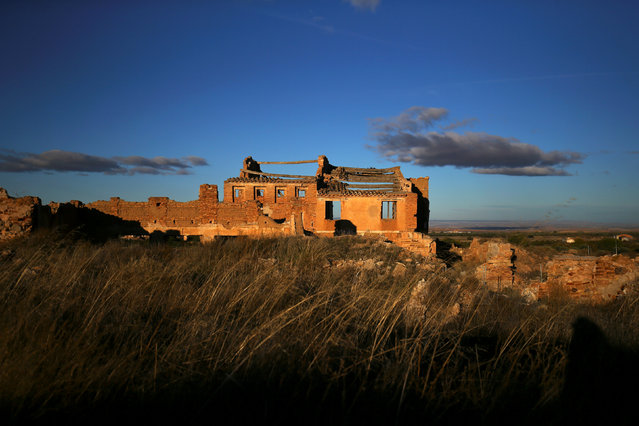
Ruins of a building are seen in the old village of Belchite, in northern Spain, November 13, 2016. (Photo by Andrea Comas/Reuters)

Ruins of a building are seen in the old village of Belchite, in northern Spain, November 13, 2016. Almost 80 years ago Tomas Ortin fled under the cover of night from his home in the small town of Belchite on Spain's northern plains to escape with hundreds of others from one of the bloodiest battles of the country's civil war. At 94 years old, Ortin now lives just across the road from Belchite, which has lain in ruins since Republican forces attacked it, a symbol of the destruction caused by the 1936-1939 war in which an estimated 500,000 people died. (Photo by Andrea Comas/Reuters)
Details
30 Nov 2016 12:31:00
Star Wars fan Mike Deguzman practices with a toy lightsaber after purchasing some new toys that went on sale at midnight in advance of the film “Star Wars: The Force Awakens” in Times Square in the Manhattan borough of New York, September 4, 2015. (Photo by Carlo Allegri/Reuters)

Star Wars fan Mike Deguzman practices with a toy lightsaber after purchasing some new toys that went on sale at midnight in advance of the film “Star Wars: The Force Awakens” in Times Square in the Manhattan borough of New York, September 4, 2015. (Photo by Carlo Allegri/Reuters)
Details
05 Sep 2015 12:34:00
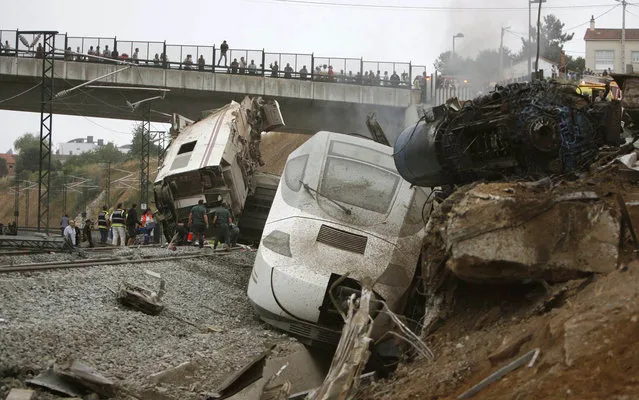
Emergency personnel respond to the scene of a train derailment in Santiago de Compostela, Spain, on Wednesday, July 24, 2013. A train derailed in northwestern Spain on Wednesday night, toppling passenger cars on their sides and leaving at least one torn open as smoke rose into the air. Dozens were feared dead, with possibly even more injured. (Photo by Antonio Hernandez/AP Photo/El correo Gallego)

Emergency personnel respond to the scene of a train derailment in Santiago de Compostela, Spain, on Wednesday, July 24, 2013. A train derailed in northwestern Spain on Wednesday night, toppling passenger cars on their sides and leaving at least one torn open as smoke rose into the air. Dozens were feared dead, with possibly even more injured. (Photo by Antonio Hernandez/AP Photo/El correo Gallego)
Details
25 Jul 2013 09:06:00
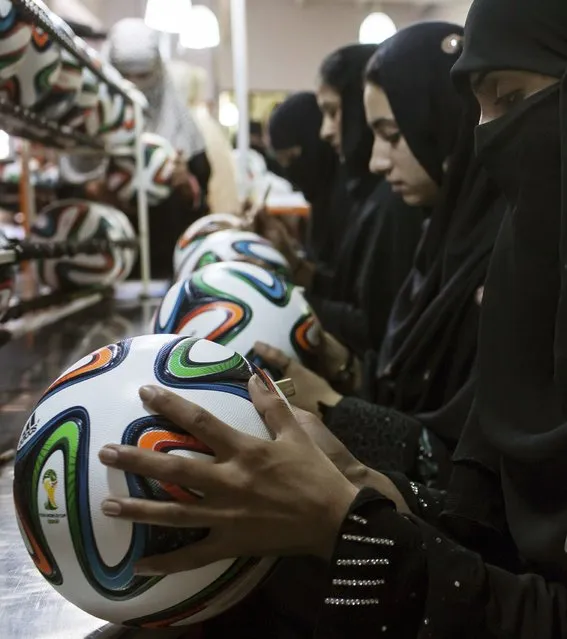
Employees conduct a final check to fix any cavities in the seams of balls inside the soccer ball factory that produces official match balls for the 2014 World Cup in Brazil, in Sialkot, Punjab province May 16, 2014. (Photo by Sara Farid/Reuters)

Employees conduct a final check to fix any cavities in the seams of balls inside the soccer ball factory that produces official match balls for the 2014 World Cup in Brazil, in Sialkot, Punjab province May 16, 2014. It was when he felt the roar of the crowd at the 2006 World Cup in Germany that Pakistani factory owner Khawaja Akhtar first dreamt up a goal of his own: to manufacture the ball for the biggest soccer tournament on the planet. Last year he finally got his chance – but only 33 days to make it happen. (Photo by Sara Farid/Reuters)
Details
26 May 2014 13:59:00