Loading...
Done
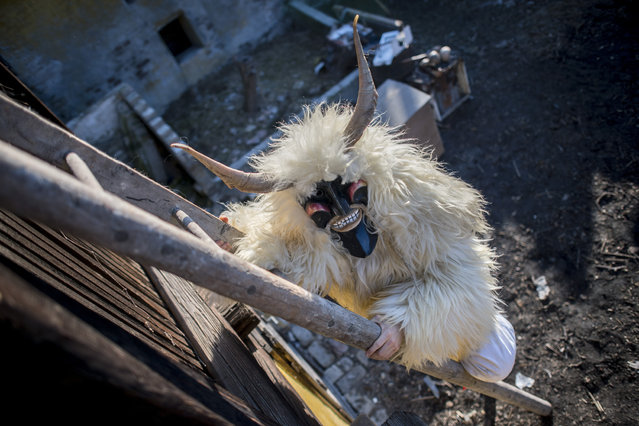
A man wears a busho mask and a costume made of sheep pelt while climbing up a ladder outside a barn in Mohacs, Hungary, 20 February 2020, on the first day of carnival. The traditional Busho carnival, which marks the end of winter, dates back to the 16th century. According to local legend, members of an ethnic South Slavic group living in Mohacs at the time dressed up in similar costumes and wore wooden masks to scare away Ottoman invaders, who mistook them for demons. (Photo by Tamas Soki/EPA/EFE)

A man wears a busho mask and a costume made of sheep pelt while climbing up a ladder outside a barn in Mohacs, Hungary, 20 February 2020, on the first day of carnival. The traditional Busho carnival, which marks the end of winter, dates back to the 16th century. According to local legend, members of an ethnic South Slavic group living in Mohacs at the time dressed up in similar costumes and wore wooden masks to scare away Ottoman invaders, who mistook them for demons. (Photo by Tamas Soki/EPA/EFE)
Details
23 Feb 2020 00:07:00
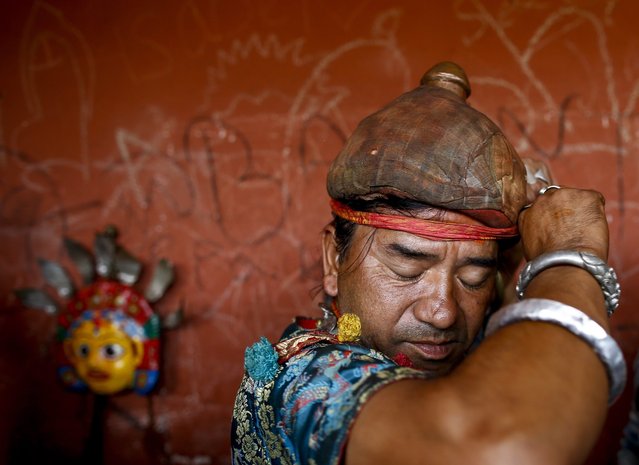
A Nepalese devotee prepares for a religious mask performance during the Seekaali Festival in Khokna village, near Kathmandu, Nepal, 07 October 2016. During the 300-year-old Seekali festival, elderly ethnic Newari devotees wear masks of 14 various goddesses including Lord Ganesha, Lord Shiva, Lord Laxmi, Lord Brahma and Lord Bishnu. The Khokna people celebrate the Seekaali festival as an alternative of the Dashain festival which is biggest festival of Nepalese Hindus that celebrates the victory of the gods over demons. (Photo by Narendra Shrestha/EPA)

A Nepalese devotee prepares for a religious mask performance during the Seekaali Festival in Khokna village, near Kathmandu, Nepal, 07 October 2016. During the 300-year-old Seekali festival, elderly ethnic Newari devotees wear masks of 14 various goddesses including Lord Ganesha, Lord Shiva, Lord Laxmi, Lord Brahma and Lord Bishnu. The Khokna people celebrate the Seekaali festival as an alternative of the Dashain festival which is biggest festival of Nepalese Hindus that celebrates the victory of the gods over demons. (Photo by Narendra Shrestha/EPA)
Details
09 Oct 2016 07:14:00
Glass Paintings By Loren Stump

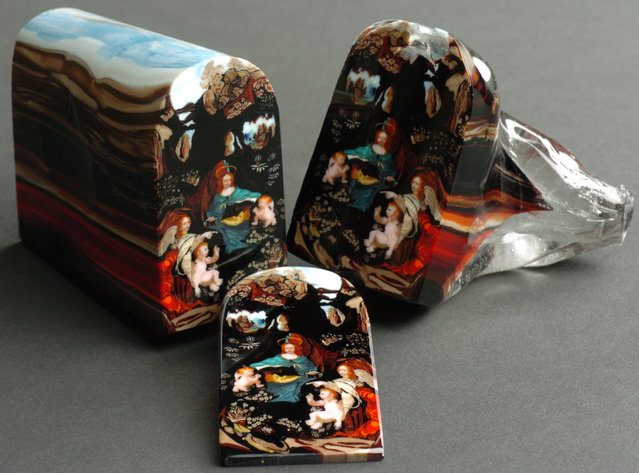
California-based glass artist Loren Stump specializes in a form of glasswork called murrine, where rods of glass are melted together and then sliced to reveal elaborate patterns and forms. While the murrina process appeared in the Mideast some 4,000 years ago, Stump has perfected his own technique over the past 35 years to the point where he can now layer entire portraits and paintings in glass before slicing them to see the final results. His most complex piece to date is a detailed interpretation of Leonardo da Vinci’s Virgin of the Rocks, which involved hundreds of glass components that were melted into a final piece.
Details
11 Jun 2014 14:11:00
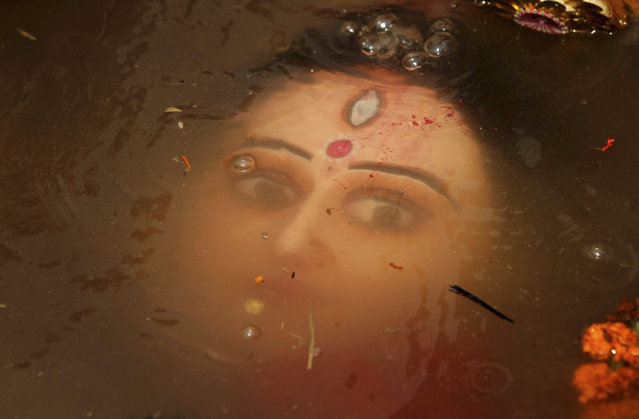
An idol of Hindu goddess Durga floats in water as devotees immerse the same in the River Kuakhai after the Durga Puja festival in Bhubaneswar, India, Saturday, October 24, 2015. The immersion of idols marks the end of the festival that commemorates the slaying of a demon king by lion-riding, 10-armed goddess Durga, marking the triumph of good over evil. (Photo by Biswaranjan Rout/AP Photo)

An idol of Hindu goddess Durga floats in water as devotees immerse the same in the River Kuakhai after the Durga Puja festival in Bhubaneswar, India, Saturday, October 24, 2015. The immersion of idols marks the end of the festival that commemorates the slaying of a demon king by lion-riding, 10-armed goddess Durga, marking the triumph of good over evil. (Photo by Biswaranjan Rout/AP Photo)
Details
26 Oct 2015 08:04:00
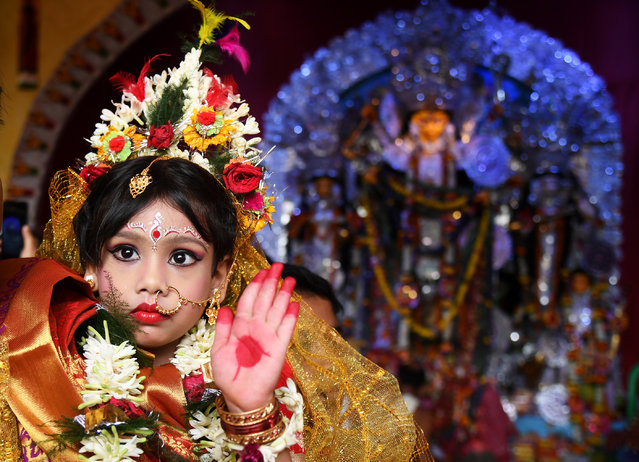
An Indian priest worships six-year-old Hindu girl Anushka Chetterjee (C) dressed as the Hindu goddess Durga at a “pandal” for the celebrations of the “Durga Puja” festival in Kolkata on September 28, 2017. The five-day Durga Puja festival, which commemorates the slaying of the demon king Mahishasur by the goddess Durga, marks the triumph of good over evil. (Photo by Dibyangshu Sarkar/AFP Photo)

An Indian priest worships six-year-old Hindu girl Anushka Chetterjee dressed as the Hindu goddess Durga at a “pandal” for the celebrations of the “Durga Puja” festival in Kolkata on September 28, 2017. The five-day Durga Puja festival, which commemorates the slaying of the demon king Mahishasur by the goddess Durga, marks the triumph of good over evil. (Photo by Dibyangshu Sarkar/AFP Photo)
Details
01 Oct 2017 06:52:00
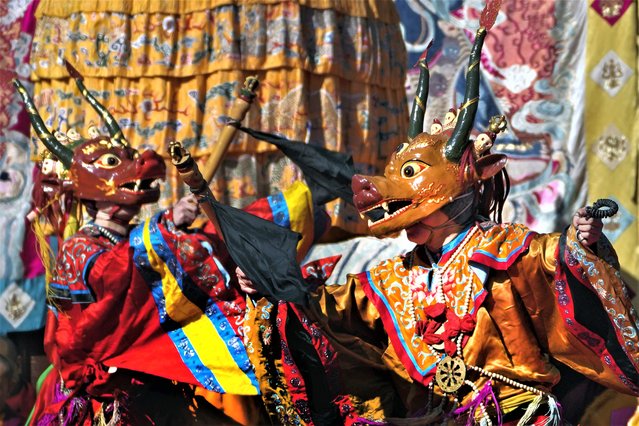
Tibetan monks in ghoulish costumes perform during a ceremony to chase away the “demon king” to bring peace and happiness for the Tibetan New Year at the Yonghegong Lama Temple in Beijing, Sunday, February 19, 2023. The annual event has returned after China lifted all bans on public gatherings from the outbreak of COVID-19. (Photo by Andy Wong/AP Photo)

Tibetan monks in ghoulish costumes perform during a ceremony to chase away the “demon king” to bring peace and happiness for the Tibetan New Year at the Yonghegong Lama Temple in Beijing, Sunday, February 19, 2023. The annual event has returned after China lifted all bans on public gatherings from the outbreak of COVID-19. (Photo by Andy Wong/AP Photo)
Details
02 Mar 2023 05:35:00
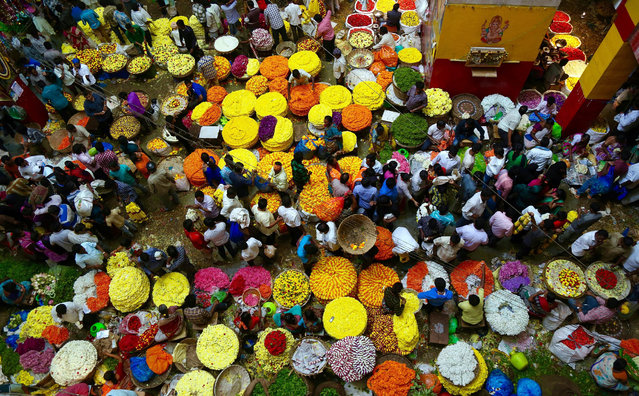
Visitors buy flowers at a flower market on the eve of Hindu goddess Durga Puja festival in Bangalore, India, 10 October 2016. The nine-day Hindu festival celebrates the killing of a demon king by the Goddess Durga representing the victory of good over evil and ends with colourful celebrations all over the country. Navratri festival runs from 03 to 11 October. (Photo by Jagadeesh N.V./EPA)

Visitors buy flowers at a flower market on the eve of Hindu goddess Durga Puja festival in Bangalore, India, 10 October 2016. The nine-day Hindu festival celebrates the killing of a demon king by the Goddess Durga representing the victory of good over evil and ends with colourful celebrations all over the country. Navratri festival runs from 03 to 11 October. (Photo by Jagadeesh N.V./EPA)
Details
29 Oct 2016 11:39:00
Anamorphic Art By Jonty Hurwitz

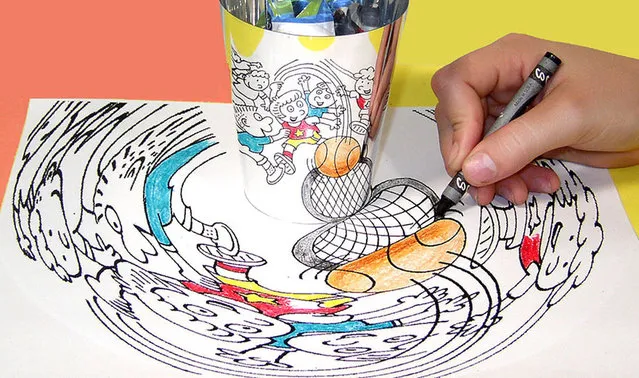
The truth can never be seen right away. Only by looking from a certain angle can we view the true nature of things. At other times, only with the help of some special object can we discern order in chaos. Anamorphosis is a form of art that allows us to see an object only by viewing it from a certain angle or by using cylindrical or conical mirror. Unsurprisingly, the first person in history to ever use this type of technique was the Leonardo Da Vinci. During late Renaissance period this technique was popularized as a children’s toy. Now, however, few people use this form of imagery due to its intricacy. Istvan Orosz, born in 1951, is one of the few people who specialize in anamorphosis. In our opinion, his most stunning piece of art is the one where a shipwreck scene turns into a portrait when viewed through a cylindrical mirror. (Photo by Jonty Hurwitz)
Details
05 Jan 2015 13:07:00