Loading...
Done
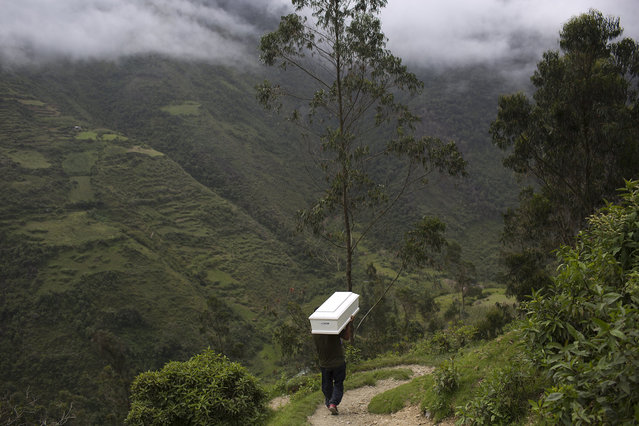
In this March 29, 2016 photo, a man shoulders a coffin with the remains of a loved one who was slain more than two decades ago by Shining Path rebels, as he walks to the cemetery for a group burial service, in Ccano, a village in the Huanta area of Ayachcuo department, Peru. Presidential candidate Keiko Fujimori's base of support is in places like Ccano, where promises to build roads, clinics and schools recall her agronomist father’s own legacy of delivering aid to the long-overlooked countryside. (Photo by Rodrigo Abd/AP Photo)

In this March 29, 2016 photo, a man shoulders a coffin with the remains of a loved one who was slain more than two decades ago by Shining Path rebels, as he walks to the cemetery for a group burial service, in Ccano, a village in the Huanta area of Ayachcuo department, Peru. Presidential candidate Keiko Fujimori's base of support is in places like Ccano, where promises to build roads, clinics and schools recall her agronomist father’s own legacy of delivering aid to the long-overlooked countryside. (Photo by Rodrigo Abd/AP Photo)
Details
08 Apr 2016 14:43:00
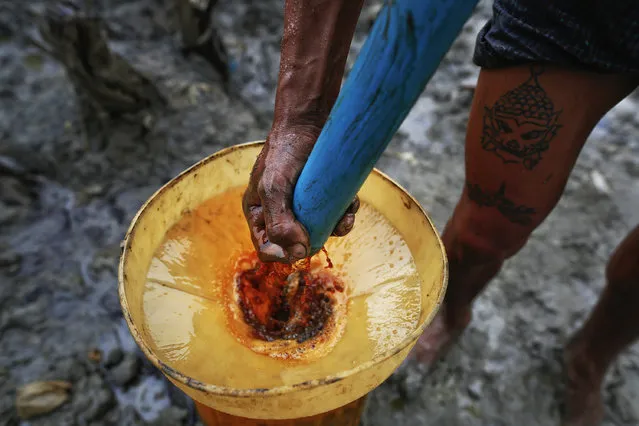
Ko Min, 26, manually extracts oil from one of three 300 feet deep wells he works on in the Minhla township of the Magwe district October 27, 2013. Everyday, Ko Min makes around $30 extracting crude oil from three small wells after he bought rights to use them for close to $1000 from a farmer who owns the land. (Photo by Damir Sagolj/Reuters)

Ko Min, 26, manually extracts oil from one of three 300 feet deep wells he works on in the Minhla township of the Magwe district October 27, 2013. Everyday, Ko Min makes around $30 extracting crude oil from three small wells after he bought rights to use them for close to $1000 from a farmer who owns the land. In Myanmar, an impoverished country rich with natural resources, people from poor communities find ways to supplement their income by exploiting such resources, such as the Minhla township, traditionally rich with oil, often using primitive and dangerous methods. (Photo by Damir Sagolj/Reuters)
Details
21 Apr 2014 10:06:00
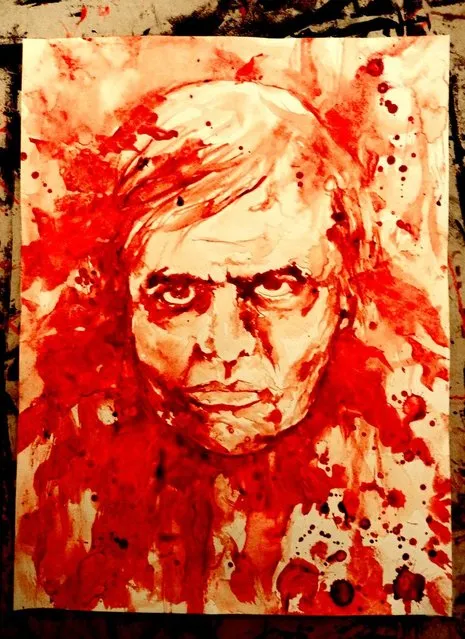
Blood Paintings By Maxime Taccardi

Maxime Taccardi is an artist who is most notable for his unusual method – creating his pieces using his own blood. He studied art in collage, his thesis focusing on the monstrosity and what is considered abnormal by society. Currently he is a middle school art teacher, but plans to continue furthering his creative career. His catalogue of work is varied, including painting, drawing, filmmaking and music.
Details
28 May 2014 09:21:00
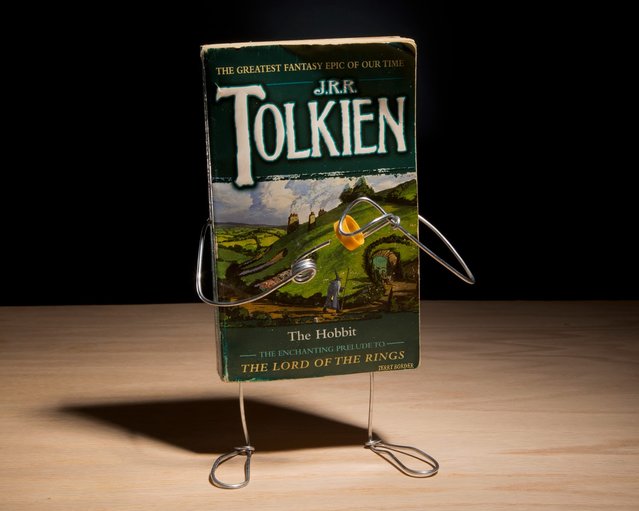
Books Brought To Life By Terry Border

Artist Terry Border gives new life to old books in his latest series titled Wiry Limbs, Paper Backs. The artist, who is no stranger to breathing new life into inanimate objects, utilizes his handcrafted technique of bending wires to serve as limbs and combines it with a great sense of humor. Each whimsical creation in the ongoing project is a sculptural work that stands on its own, reflecting its respective text.
Details
18 Jul 2014 11:40:00
 Surreal Paintings by Robert Dowling Jr

Maine-based Robert Dowling Jr. creates wonderfully whimsical stories with a slightly surreal touch. The self-taught artist, who works primarily in acrylics and oils, often paints characters with their faces covered or turned away. Love art like this that both children and adults can enjoy in their own unique way.
Details
10 Jul 2013 13:37:00
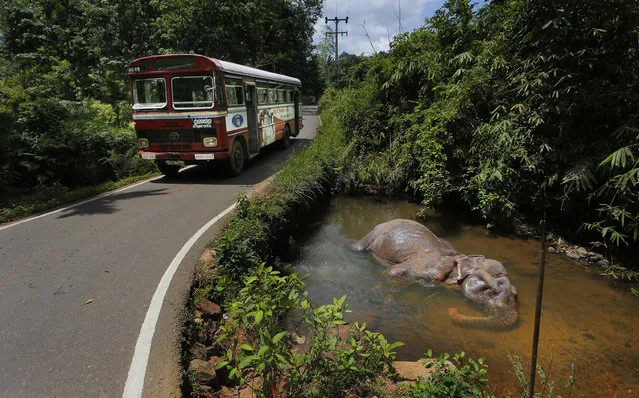
In this July 5, 2016 photo, a tamed elephant rests in a pool of water by a road in Baduraliya, a village outside Colombo, Sri Lanka. Even as the country cracks down on illegal ownership, the enduring demand for elephants has the government planning to set up its own pool of captive animals to be hired out to temples for ceremonies and maintained with budget funds. For Buddhists, who make up 70 percent of the island's 20 million population, elephants are believed to have been a servant of the Buddha and even a previous incarnation of the holy man himself. (Photo by Eranga Jayawardena/AP Photo)

In this July 5, 2016 photo, a tamed elephant rests in a pool of water by a road in Baduraliya, a village outside Colombo, Sri Lanka. Even as the country cracks down on illegal ownership, the enduring demand for elephants has the government planning to set up its own pool of captive animals to be hired out to temples for ceremonies and maintained with budget funds. (Photo by Eranga Jayawardena/AP Photo)
Details
04 Jan 2017 08:10:00
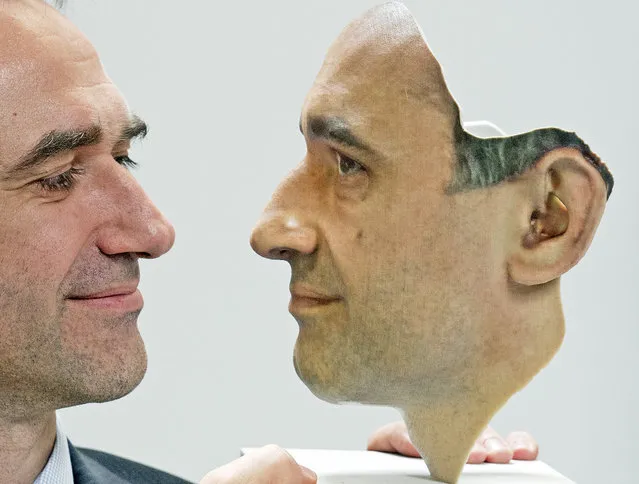
Mario Huettenhofer, chief of the German company 3D Fab, presents his own face as 3d print during the international fairs FabCon 3.D and Rapid.Tech in Erfurt, Germany, Thursday, May 15, 2014. 130 exhibitors from all over the world present the entire world of 3D printing. (Photo by Jens Meyer/AP Photo)

Mario Huettenhofer, chief of the German company 3D Fab, presents his own face as 3d print during the international fairs FabCon 3.D and Rapid.Tech in Erfurt, Germany, Thursday, May 15, 2014. 130 exhibitors from all over the world present the entire world of 3D printing. The trade fairs are accompanied by specialist programs featuring 80 scientists, practitioners and trend analysts from ten countries, who will explain the latest findings, trends and applications for additive processes in industry and for 3D printing in the private sector to newcomers, experts and consumers alike. (Photo by Jens Meyer/AP Photo)
Details
17 May 2014 13:06:00
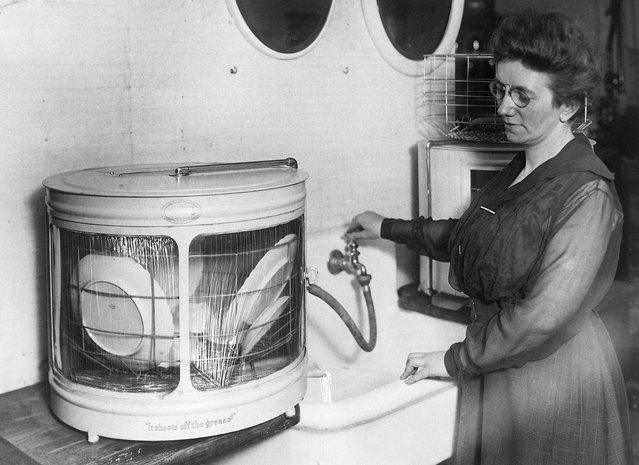
All the drugery of dishwashing in this three-times -a day task, which comes to the house wife who does her own house work, has been eliminated by the new dish washer shown in the photograph on April 25, 1921. It is the invention of a Cincinnati school teacher, who sought to make things a bit more pleasant for his wife. Incedently, his idea was worth 12,00 to him, for a manufacturing concern thought so much of the “dish-washer” they purchased the rights and will seek to add a little joy to thousands of other housewives. With the aid of only hot water, dishes placed in a wire rack and set into the drum are made clean and spotless in two minutes. (Photo by Bettmann Archive/Getty Images)

All the drugery of dishwashing in this three-times -a day task, which comes to the house wife who does her own house work, has been eliminated by the new dish washer shown in the photograph on April 25, 1921. It is the invention of a Cincinnati school teacher, who sought to make things a bit more pleasant for his wife. Incedently, his idea was worth 12,00 to him, for a manufacturing concern thought so much of the “dish-washer” they purchased the rights and will seek to add a little joy to thousands of other housewives. With the aid of only hot water, dishes placed in a wire rack and set into the drum are made clean and spotless in two minutes. (Photo by Bettmann Archive/Getty Images)
Details
08 Jul 2021 10:25:00