Loading...
Done
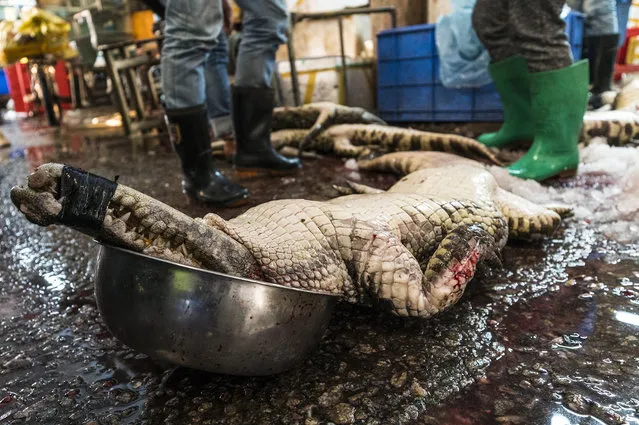
A dead crocodile is seen on Huangsha Seafood Market in Guangzhou, Guandong Province, China, 22 January 2018. Tsukiji Market of China or Huangsha Seafood Market is biggest one in Southern China and one of the biggest in China, as there are literally hundreds of different varieties of fish and seafood scattered throughout the market. Since the proximity of the fish market is so close to the Zhujiang River, it's quite easy for the large fishing vessels and fishermen to unload their fresh catch right at the market, which ensures that the fish and seafood remain fresh. Fish and other seafood are coming there from all around the globe. Seafood Market is full of different kinds of live fish, live shellfish, and live seafood on display in crystal clear tanks and it's common to see 5-star chefs, retailers and expats to source for fresh and high-quality seafood supplies for reasonable prices. While it is a wholesale fish market, since many Guangzhou restaurants and businesses come to purchase their seafood here, the public is welcome to come and even purchase. Many local Chinese have the vendors slice up fresh salmon fillets to take home or carry seafood into one of the nearby specialty restaurants, where they will cook if for them and serve it with vegetables and other side dishes of their choice. One of the biggest attractions for both, tourists and buyers, on market are crocodiles, which are brought there alive in wooden cases with taped jaws so they can?t accidentally bite. They are from crocodile farms from Guangdong, China and from Vietnam. Crocodile meat is popular in most Asian countries and it is consider as delicate one. Crocodiles weight from 10 to 25 kg and bigger ones are about 2 years old. They cost about 70 RMB (8.90 EURO) when bout as whole, or if you buy as parts most expensive and appreciated parts are paws 120 RMB (15.26 EURO) per kg, and tail 100 RMB (12.72 EURO) per kg. (Photo by Aleksandar Plavevski/EPA/EFE)

A dead crocodile is seen on Huangsha Seafood Market in Guangzhou, Guandong Province, China, 22 January 2018. Tsukiji Market of China or Huangsha Seafood Market is biggest one in Southern China and one of the biggest in China, as there are literally hundreds of different varieties of fish and seafood scattered throughout the market. (Photo by Aleksandar Plavevski/EPA/EFE)
Details
17 Apr 2020 00:05:00
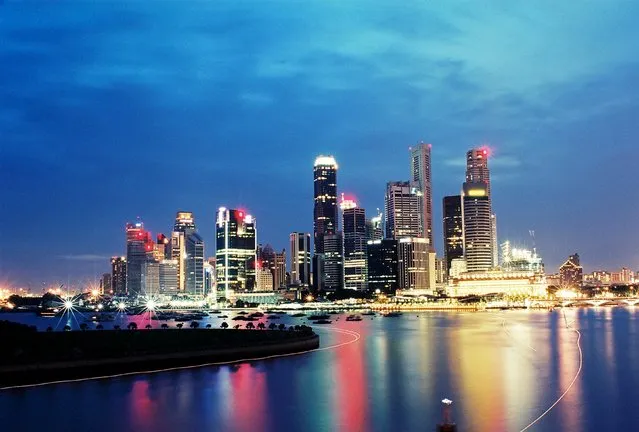
Small transportation boats, known as bumboats, leave trails of light as they travel across Marina Bay past the skyline of Singapore in this photo taken in 2004. Singapore holds a Jubilee weekend from 7 to 10 August to celebrate the 50th anniversary of its independence. (Photo by Edgar Su/Reuters)

Small transportation boats, known as bumboats, leave trails of light as they travel across Marina Bay past the skyline of Singapore in this photo taken in 2004. Singapore holds a Jubilee weekend from 7 to 10 August to celebrate the 50th anniversary of its independence. Fifty years ago, hundreds of small boats lined the Singapore river in the city centre. Today, most small boats are gone, except a handful of neon-lit tourist ferries. Maritime trade is still the backbone of the city-state but after decades of rapid growth Singapore, which at less than half the size of London is among the world’s most densely populated nations, is also a popular tourist destination and a thriving global financial hub. (Photo by Edgar Su/Reuters)
Details
01 Aug 2015 12:26:00
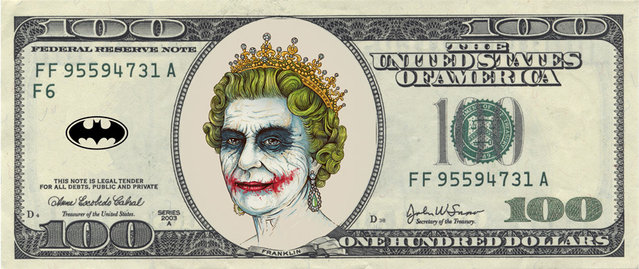
Make Your Franklin By Martin Joubert Part 1

Having $100 in your pocket would be so much cooler if it was designed by Martin Joubert. He went all out and created a number of different designs for the 100 USD banknotes, ranging from silly to witty. We especially liked the one with “That’s right. This is real money” written on it, showing just how many cups of coffee, basketballs, and guns you can buy with 100 dollars. All in all, even the currency that we have today is nothing but paper, even though it looks official and strict. There is nothing backing it up except for our noble military that ensures that Gulf States sell their oil using only the “green” kind of currency. (Photo by Martin Joubert)
Details
17 Dec 2014 11:19:00
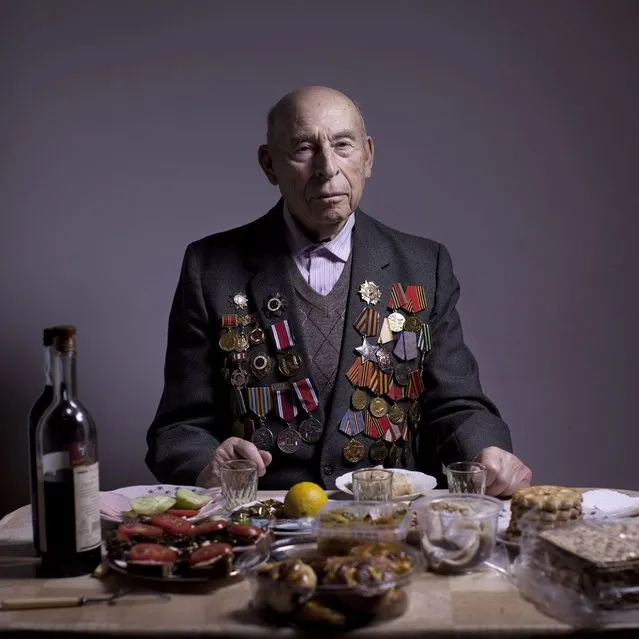
In this photo made Thursday, April 11, 2013, Soviet Jewish World War Two veteran Boris Ginsburg poses for a portrait at his house in the southern Israeli city of Ashdod. Ginsburg, born in Belorussia, was kept by a German garrison in the Lenin ghetto since 1941 until its destruction by partisan units in September 1942. (Photo by Oded Balilty/AP Photo)

In this photo made Thursday, April 11, 2013, Soviet Jewish World War Two veteran Boris Ginsburg poses for a portrait at his house in the southern Israeli city of Ashdod. Ginsburg, born in Belorussia, was kept by a German garrison in the Lenin ghetto since 1941 until its destruction by partisan units in September 1942. In 1942 he joined the partisans for two years and in 1944 he joined the Red Army as a combat soldier and fought till the and of the war. Ginsubrg demobilized in 1947 and immigrated to Israel in 2001. About 500,000 Soviet Jews served in the Red Army during World War Two, and the majority of those still alive today live in Israel. (Photo by Oded Balilty/AP Photo)
Details
07 May 2013 08:08:00
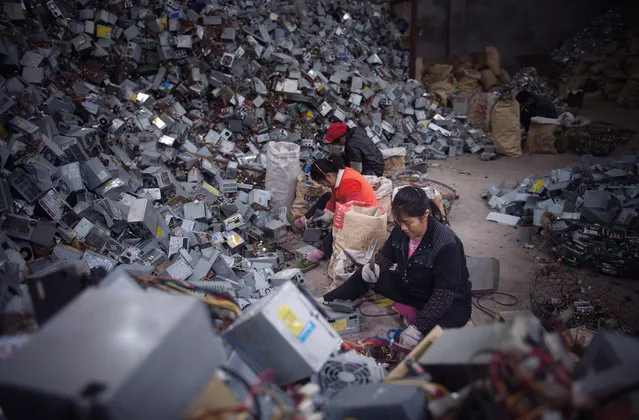
“The sustainable development goals cannot be met unless waste management is addressed as a priority”, says UK waste management charity Waste Aid. “E-waste is one of the fastest growing categories of the 7-10bn tonnes of waste produced globally every year”, adds director Mike Webster. “In our view, decent waste management is a basic right and we want governments around the world take this issue much more seriously – in 2012 only 0.2% of international aid went on improving solid waste management – it’s just not enough”. (Photo by Kai Loeffelbein/laif Agentur)

Sustainable development goal target 12.5 is to reduce waste. But with a planet increasingly dependent on technology, is that even possible? As of today, over 30m tonnes of electronic waste has been thrown out so far this year, according to the World Counts. Most e-waste is sent to landfills in Asia and Africa where it is recycled by hand, exposing the people who do it to environmental hazards. Kai Loeffelbein’s photographs of e-waste recycling in Guiyu, southern China show what happens to discarded computers. (Photo by Kai Loeffelbein/laif Agentur)
Details
19 Oct 2016 12:14:00
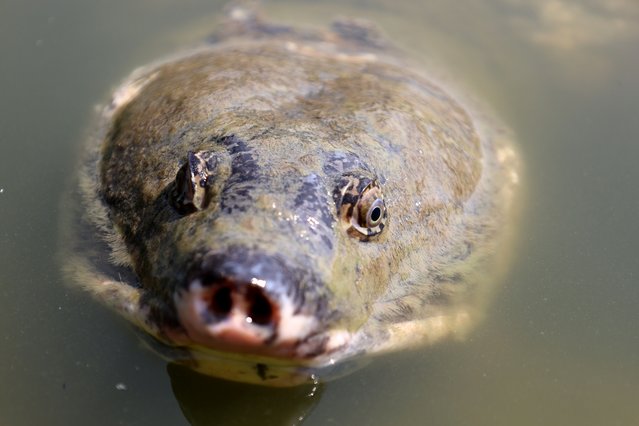
Black softshell turtle or Bostami turtle (Nilssonia nigricans), extremely rare and critically endangered species of tortoise is seen in a pond in Chittagong, Bangladesh on March 1, 2022. For decades, the breeding grounds have shrunk and their habitat has been threatened by habitat pollution. Through conservation methods and protection of the species, some of these turtles can be found today throughout the wild, and scientists and environmental biologists are continuing to work hard to preserve this endangered species and their natural habitat. (Photo by Mohammad Shajahan/Anadolu Agency via Getty Images)

Black softshell turtle or Bostami turtle (Nilssonia nigricans), extremely rare and critically endangered species of tortoise is seen in a pond in Chittagong, Bangladesh on March 1, 2022. For decades, the breeding grounds have shrunk and their habitat has been threatened by habitat pollution. (Photo by Mohammad Shajahan/Anadolu Agency via Getty Images)
Details
26 May 2024 04:02:00


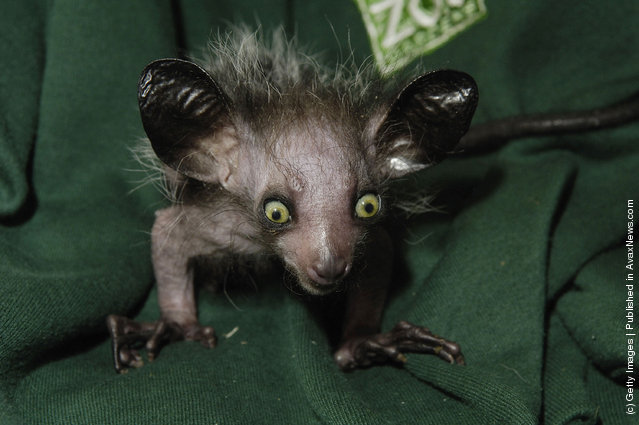
“The aye-aye (Daubentonia madagascariensis) is a lemur, a strepsirrhine primate native to Madagascar that combines rodent-like teeth and a special thin middle finger to fill the same ecological niche as a woodpecker. It is the world's largest nocturnal primate, and is characterized by its unusual method of finding food; it taps on trees to find grubs, then gnaws holes in the wood and inserts its narrow middle finger to pull the grubs out. The only other animal species known to find food in this way is the striped possum. From an ecological point of view the aye-aye fills the niche of a woodpecker as it is capable of penetrating wood to extract the invertebrates within”. – Wikipedia

Photo: In this handout image from Bristol Zoo is seen the first captive bred aye-aye in the UK named “Kintana” (meaning star in Malagasy) April 15, 2005 at Bristol Zoo Gardens, England. The zoo announced today only the second baby aye-aye to be hand-reared in the world (the first was in Jersey Zoo) and has now made his first public appearance since his birth on 11 February 2005. (Photo by Rob Cousins/Bristol Zoo via Getty Images)
Details
13 Apr 2011 13:33:00
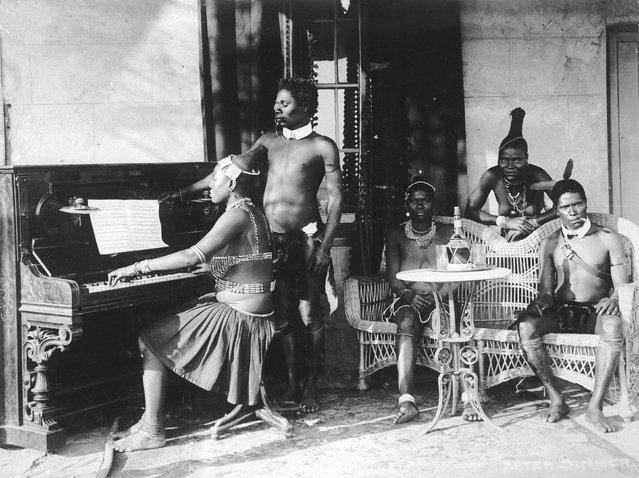
circa 1925:  A Zulu woman playing the piano while a group of others sit and listen.  (Photo by General Photographic Agency/Getty Images)

“The Zulu are the largest South African ethnic group, with an estimated 10–11 million people living mainly in the province of KwaZulu-Natal. Small numbers also live in Zimbabwe, Zambia, and Mozambique. Their language, Zulu, is a Bantu language; more specifically, part of the Nguni subgroup. The Zulu Kingdom played a major role in South African history during the 19th and 20th centuries. Under apartheid, Zulu people were classed as third-class citizens and suffered from state-sanctioned discrimination. They remain today the most numerous ethnic group in South Africa, and now have equal rights along with all other citizens”. – Wikipedia.

Photo: A Zulu woman playing the piano while a group of others sit and listen (to put it briefly, Englishmen scoff over Zulu). South Africa, circa 1925. (Photo by General Photographic Agency)

Details
03 Feb 2014 09:40:00