Loading...
Done
Civilians, who fled the violence in Manbij city, arrive to the southeastern rural area of Manbij, in Aleppo Governorate, Syria June 19, 2016. (Photo by Rodi Said/Reuters)

Civilians, who fled the violence in Manbij city, arrive to the southeastern rural area of Manbij, in Aleppo Governorate, Syria June 19, 2016. (Photo by Rodi Said/Reuters)
Details
20 Jun 2016 12:53:00
People wearing bear furs perform during a festival of New Year ritual dances attended by hundreds in Comanesti, northern Romania, Wednesday, December 30 2015. In pre-Christian rural traditions, dancers wearing colored costumes or animal furs, toured from house to house in villages singing and dancing to ward off evil, in the present the tradition has moved to Romania's cities too, where dancers travel to perform the ritual for money. (Photo by Vadim Ghirda/AP Photo)

People wearing bear furs perform during a festival of New Year ritual dances attended by hundreds in Comanesti, northern Romania, Wednesday, December 30 2015. In pre-Christian rural traditions, dancers wearing colored costumes or animal furs, toured from house to house in villages singing and dancing to ward off evil, in the present the tradition has moved to Romania's cities too, where dancers travel to perform the ritual for money. (Photo by Vadim Ghirda/AP Photo)
Details
31 Dec 2015 08:52:00
Romain de Tirtoff (Erte) – Symphony In Black

“Romain de Tirtoff (23 November 1892 – 21 April 1990) was a Russian-born French artist and designer known by the pseudonym Erté, the French pronunciation of his initials, R.T. He was a diversely talented 20th-century artist and designer who flourished in an array of fields, including fashion, jewellery, graphic arts, costume and set design for film, theatre, and opera, and interior decor”. – Wikipedia. Photo: Romain de Tirtoff (Erte) – “Symphony In Black” (please click to enlarge).
Details
29 Jan 2014 13:34:00
A man holds a copy of the Koran during a protest against Niger President Mahamadou Issoufou's attendance last week at a Paris rally in support of French satirical weekly Charlie Hebdo, which featured a cartoon of the Prophet Mohammad as the cover of its first edition since an attack by Islamist gunmen, in Niamey January 17, 2015. (Photo by Tagaza Djibo/Reuters)

A man holds a copy of the Koran during a protest against Niger President Mahamadou Issoufou's attendance last week at a Paris rally in support of French satirical weekly Charlie Hebdo, which featured a cartoon of the Prophet Mohammad as the cover of its first edition since an attack by Islamist gunmen, in Niamey January 17, 2015. (Photo by Tagaza Djibo/Reuters)
Details
18 Jan 2015 13:24:00
Cheng Liping, whose husband Ju was onboard Malaysia Airlines Flight MH370 which disappeared on March 8, 2014, shows a picture of she and her husband together and an old card with a message given by her husband, at a park near her house where she and her husband used to visit during an interview with Reuters in Beijing July 24, 2014. (Photo by Kim Kyung-Hoon/Reuters)

Cheng Liping, whose husband Ju was onboard Malaysia Airlines Flight MH370 which disappeared on March 8, 2014, shows a picture of she and her husband together and an old card with a message given by her husband, at a park near her house where she and her husband used to visit during an interview with Reuters in Beijing July 24, 2014. Cheng said her life has been totally changed since the incident. Their two little sons, who don't know about this incident, keep asking her when their dad is coming back. Six months after Malaysia Airlines Flight MH370, with 239 mostly Chinese people on board, disappeared about an hour into a routine journey from Kuala Lumpur to Beijing March 8, loved ones of missing passengers derive what comfort they can from what's left behind after the world's greatest aviation mystery. More than two dozen countries have been involved in the air, sea and underwater search for the Boeing 777 but months of sorties failed to turn up any trace – even after narrowing the search area to the southern Indian Ocean – long after batteries on the black box voice and data recorders had gone flat. (Photo by Kim Kyung-Hoon/Reuters)
Details
05 Sep 2014 11:27:00
American Yoga teacher Dashama poses on a Yoga-board during a preview of the 46th International Boat Fair in Duesseldorf January 16, 2015. The BOOT 2015 watersports fair, with more than 1,600 international exhibitors will run in Duesseldorf from January 17 to January 25. (Photo by Ina Fassbender/Reuters)

American Yoga teacher Dashama poses on a Yoga-board during a preview of the 46th International Boat Fair in Duesseldorf January 16, 2015. The BOOT 2015 watersports fair, with more than 1,600 international exhibitors will run in Duesseldorf from January 17 to January 25. (Photo by Ina Fassbender/Reuters)
Details
17 Jan 2015 12:37:00
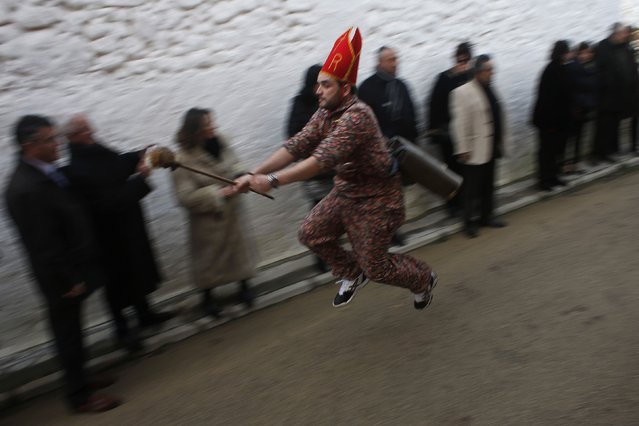
A believer dressed as a “diablo” (devil) jumps at the San Blas' (Saint Blaise) procession during the “Endiablada” festival in Almonacid del Marquesado, in central Spain February 3, 2015. In the “Endiablada”, an undated traditional festival in honour of the Candelaria Virgin and San Blas. (Photo by Susana Vera/Reuters)

A believer dressed as a “diablo” (devil) jumps at the San Blas' (Saint Blaise) procession during the “Endiablada” festival in Almonacid del Marquesado, in central Spain February 3, 2015. In the “Endiablada”, an undated traditional festival in honour of the Candelaria Virgin and San Blas, believers are dressed in colourful costumes, wear a mitre with lead cowbells tied to their waists that ring as they wander around the village and in front of the saints' statues during their processions. (Photo by Susana Vera/Reuters)
Details
05 Feb 2015 12:02:00
While the lido was described as bringing “modernism to the masses” on the British coast it was just the latest example of a trend that had been developing since Victorian times – transforming seaside towns into resorts for leisure and entertainment. In the latter half of the nineteenth century, the fashion was for local authorities to build great piers stretching from the promenade out into the sea

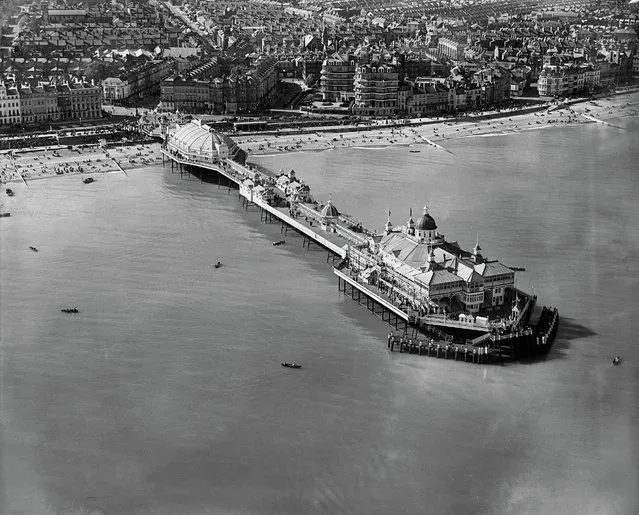
While the lido was described as bringing “modernism to the masses” on the British coast it was just the latest example of a trend that had been developing since Victorian times – transforming seaside towns into resorts for leisure and entertainment. In the latter half of the nineteenth century, the fashion was for local authorities to build great piers stretching from the promenade out into the sea. The Eastbourne Pier, pictured here in May 1931, was erected between 1866 and 1870 to an ingenious design by Eugenius Birch, which saw the structure sitting on special cups allowing the supporting struts to “move” in bad weather. Arranged on the pier's 1,000-foot length were kiosks, a theatre, a ballroom and a camera obscura. 1931. (Photo by Aerofilms Collection via “A History of Britain From Above”)
Details
25 Feb 2014 12:59:00