“Kids of Sapa”. Four little beautiful Hmong girls from Lao Chai Village, near Sapa, Vietnam. (Photo and caption by Felipe Hanower/National Geographic Traveler Photo Contest)
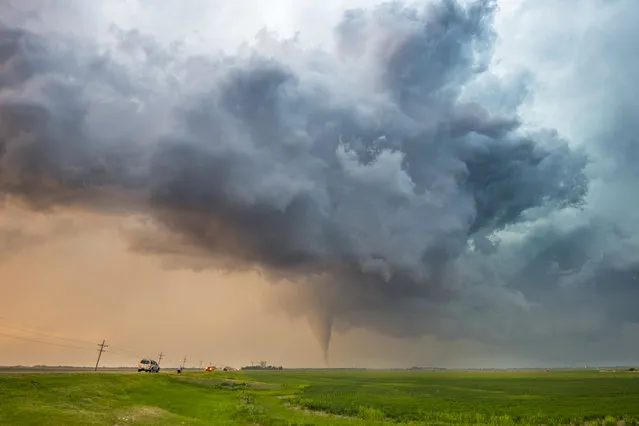
“The Sunsetter”. An EF-4 tornado rips through the open space of farmland near Rozel, Kansas. This tornado moves slowly but powerful towards the setting sun an gets its beautiful color right before sunset. Storm Chasers are spotting on the left side. Photo location: Rozel, Kansas. (Photo and caption by Dennis Oswald/National Geographic Photo Contest)
ATTENTION! All pictures are presented in high resolution. To see Hi-Res images – just TWICE click on any picture. In other words, click small picture – opens the BIG picture. Click BIG picture – opens VERY BIG picture.
Festival-goers wash on Shipyard Island, the venue of the 24th Sziget (Island) Festival in Northern Budapest, Hungary, 15 August 2016. The venue, one of the biggest cultural events of Europe, offers art exhibitions, theatrical and circus performances and above all music concerts from 10 to 17 August. (Photo by Szabó Gábor/Origo.hu)
A Filipino dancer performs with fire to mark the Chinese Lunar New Year in Manila's Chinatown, Philippines, 28 January 2017. Chinese around the world celebrate the Lunar New Year on 28 January 2017, the first day of the year of rooster. (Photo by Francis R. Malasig/EPA)
People who fled the violence from Islamic State-controlled northern Syrian town of al-Bab arrive in the rebel-held outskirts of the town, Syria February 3, 2017. (Photo by Khalil Ashawi/Reuters)
Visitors review their cell phone photos of an installation called “Plexus A1” by artist Gabriel Dawe, one of nine large-scale art installations displayed at the “Wonders” exhibit at the Renwick Art Gallery in Washington, DC, Wednesday, January 13, 2016. Built in the 1860s, the Renwick was the first American building to be designed specifically as an art museum; it recently reopened after a two year renovation. (Photo by Jim Lo Scalzo/EPA)

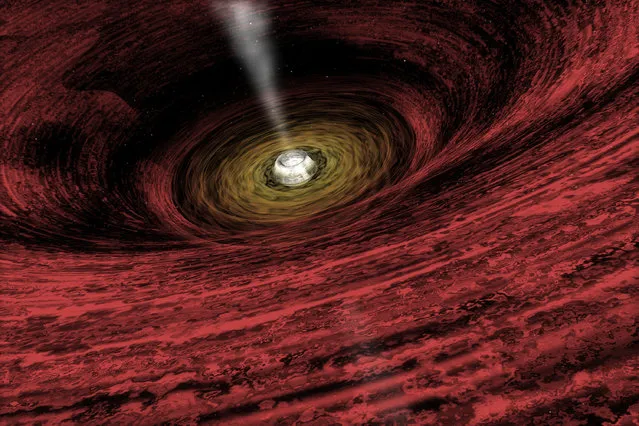
An artist's impression of a growing supermassive black hole located in the early Universe is seen in this NASA handout illustration released on June 15, 2011. Using the deepest X-ray image ever taken, astronomers found the first direct evidence that massive black holes were common in the early universe. This discovery from NASA's Chandra X-Ray Observatory shows that very young black holes grew more aggressively than previously thought, in tandem with the growth of their host galaxies. (Photo by Reuters/NASA/Chandra X-Ray Observatory/A.Hobart)