Loading...
Done
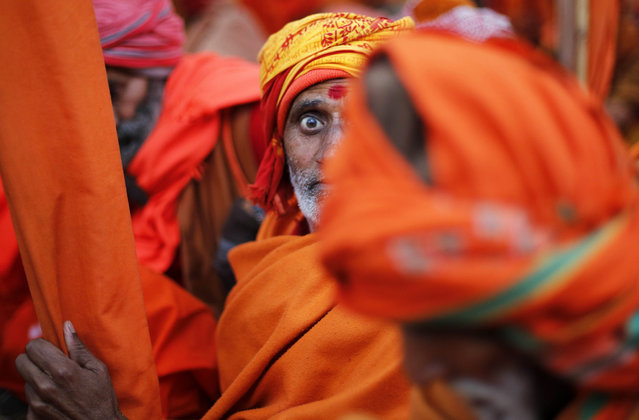
An Indian Sadhu, or Hindu holy man, sits for a community feast at the Sangam, the confluence of the Rivers Ganges, Yamuna and mythical Saraswati, during the annual month-long Magh Mela religious fair in Allahabad, India, Friday, January 16, 2015. (Photo by Rajesh Kumar Singh/AP Photo)

An Indian Sadhu, or Hindu holy man, sits for a community feast at the Sangam, the confluence of the Rivers Ganges, Yamuna and mythical Saraswati, during the annual month-long Magh Mela religious fair in Allahabad, India, Friday, January 16, 2015. Hundreds of thousands of devout Hindus are expected to take holy dips at the confluence during the astronomically auspicious period of over 45 days celebrated as Magh Mela. (Photo by Rajesh Kumar Singh/AP Photo)
Details
17 Jan 2015 11:54:00
Contestants of a tourism beauty pageant balance eggs on their collarbones as they cruise along the Yellow River in Jiyuan, Henan province, China, June 22, 2015. The contestants believe that if they are slim enough, their collarbones will allow them to balance the eggs securely on their bodies. (Photo by Reuters/Stringer)

Contestants of a tourism beauty pageant balance eggs on their collarbones as they cruise along the Yellow River in Jiyuan, Henan province, China, June 22, 2015. The contestants believe that if they are slim enough, their collarbones will allow them to balance the eggs securely on their bodies. (Photo by Reuters/Stringer)
Details
30 Jun 2015 12:09:00
Auditioning performers follow resident choreographer Erik Sorensen, center back, at the Sydney Dance Company in a routine during castings in Moulin Rouge's current show “Féerie”, in Sydney, Australia, Thursday, July 28, 2016. (Photo by Rob Griffith/AP Photo)

Auditioning performers follow resident choreographer Erik Sorensen, center back, at the Sydney Dance Company in a routine during castings in Moulin Rouge's current show “Féerie”, in Sydney, Australia, Thursday, July 28, 2016. The show's artistic team is in Australia to choose new talent to perform with one of the most famous cabarets that has been illuminating Paris since 1889. (Photo by Rob Griffith/AP Photo)
Details
29 Jul 2016 13:05:00
A boat is stranded on Poyang Lake in Lushan City, China during low-water season on November 3, 2016. (Photo by  Xinhua/Barcroft Images)

A boat is stranded on Poyang Lake in Lushan City, China during low-water season on November 3, 2016. (Photo by Xinhua/Barcroft Images)
Details
04 Nov 2016 12:14:00
Hygrocybe graminicolor. (Photo and caption by Steve Axford)

Hygrocybe graminicolor. (Photo and caption by Steve Axford)
Details
19 May 2013 07:11:00
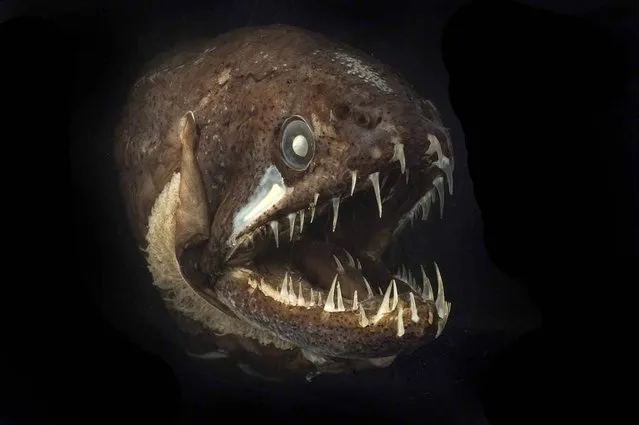
Imagine living in the sea where it is permanently dark, cold, and food is hard to find. For many animals at depth, it may be weeks to months between meals. If you find something to eat, you have to hang on to it

Imagine living in the sea where it is permanently dark, cold, and food is hard to find. For many animals at depth, it may be weeks to months between meals. If you find something to eat, you have to hang on to it. This is why so many deep-sea fishes have lots of big teeth. This dragonfish, spotted off the coast of Australia, even has teeth on its tongue. They would be terrifying animals ... if they weren’t the size of a banana. (Photo by Julian Finn/Museum Victoria)
Details
21 May 2012 12:14:00
On August 31, 2012, a long filament of solar material that had been hovering in the sun's atmosphere, the corona, erupted out into space at 4:36 p.m. EDT. The coronal mass ejection, or CME, traveled at over 900 miles per second. The CME did not travel directly toward Earth, but did connect with Earth's magnetic environment, or magnetosphere, causing aurora to appear on the night of Monday, September 3. (Photo by NASA/GSFC/SDO)

On August 31, 2012, a long filament of solar material that had been hovering in the sun's atmosphere, the corona, erupted out into space at 4:36 p.m. EDT. The coronal mass ejection, or CME, traveled at over 900 miles per second. The CME did not travel directly toward Earth, but did connect with Earth's magnetic environment, or magnetosphere, causing aurora to appear on the night of Monday, September 3. (Photo by NASA/GSFC/SDO via The Atlantic)
Details
14 Sep 2012 09:01:00
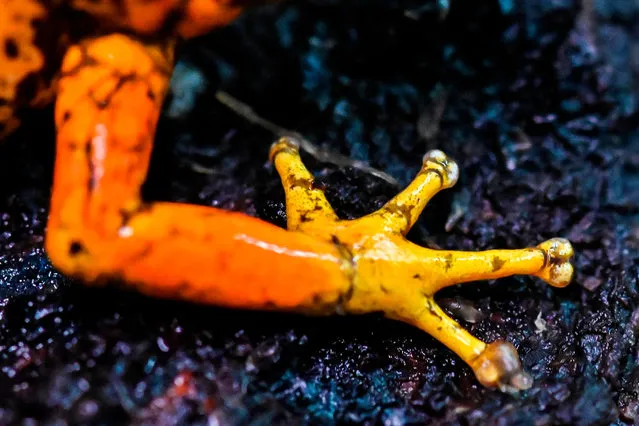
A leg of a “diablito” frog (Oophaga sylvatica) is photographed in a laboratory at a laboratory in the zoo of Cali, Colombia, on July 19, 2019. Colombia is the second country with the largest number of amphibians in the world after Brazil. More than 40% of amphibian species worldwide are in danger of extinction. (Photo by Luis Robayo/AFP Photo)

A leg of a “diablito” frog (Oophaga sylvatica) is photographed in a laboratory at a laboratory in the zoo of Cali, Colombia, on July 19, 2019. Colombia is the second country with the largest number of amphibians in the world after Brazil. More than 40% of amphibian species worldwide are in danger of extinction. (Photo by Luis Robayo/AFP Photo)
Details
28 Nov 2020 00:03:00