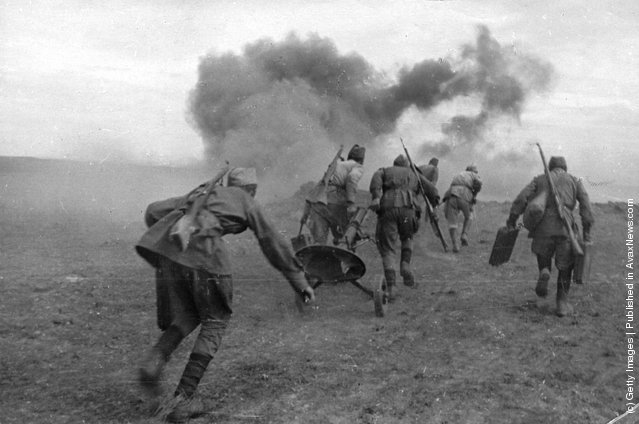
A Russian trenchmortar crew run to take up a new firing position in the Stalingrad area during the Great Patriotic War. (Photo by Keystone/Getty Images). October 1942
Photo: Vladimir Ilyich Lenin (1870 – 1924) lying in state in the Kremlin. (Photo by Hulton Archive/Getty Images). 1924
Important! For the same article in Russian language click here.
Something quite intriguing is happening within Russian-speaking internet during the last few – should you type a fully academic inquiry (at least, according to Russian academic requirements) in national search engines for "Lenin's mausoleum" – the first thing you get (even in top 10 searches) is website pages talking about black magic and occult. Website authors view this construction differently, but unconditionally agree on one thing: the mausoleum of the "leader of the world proletariat” – the essence of a magical artifact, a sort of “energy vampire”. It was built with a certain purpose: to drain the energy out of miserable Soviet citizens on one hand; and to poison the anthroposphere of one-sixth part of the earth with its vibes (the exact territory that was occupied by the former Soviet Union), depriving the Russian people of will to resist on the other hand. Complete nonsense? No doubt. Nevertheless, an intriguing one. Well, probably because some oddities do exist in mausoleum's history. These oddities are the thing we are going to discuss this time. First, let me refresh you memory on the subject.
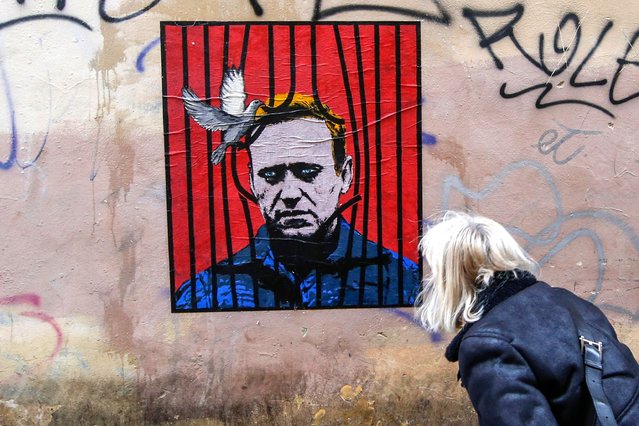
A view of a large poster depicting Russian opposition leader Alexei Navalny behind bars with a dove freeing him from detention, by an unidentified street artist known as Harry Greb, in downtown Rome, Italy, 25 January 2021. Navalny was detained after his arrival to Moscow from Germany on 17 January 2021. A Moscow judge on 18 January ruled that he will remain in custody for 30 days following his airport arrest. Navalny urged Russians to take to the streets to protest against President Putin's rule. (Photo by Fabio Frustaci/EPA/EFE)
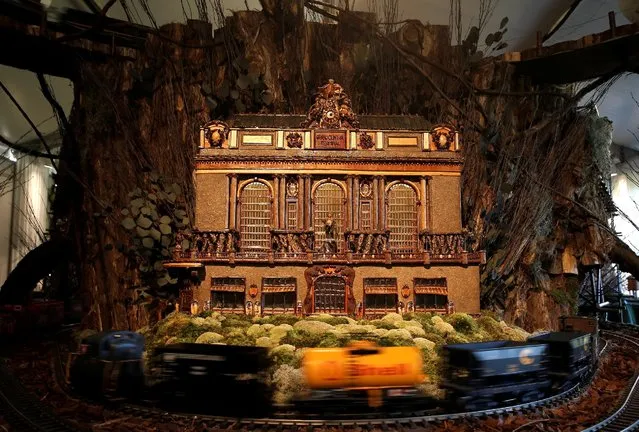
A model train travels past a scaled model of New York's Grand Central Station built entirely with plant parts during a media preview of the 25th annual Holiday Train Show at the New York Botanical Garden in the Bronx borough of New York City, U.S., November 14, 2016. (Photo by Mike Segar/Reuters)
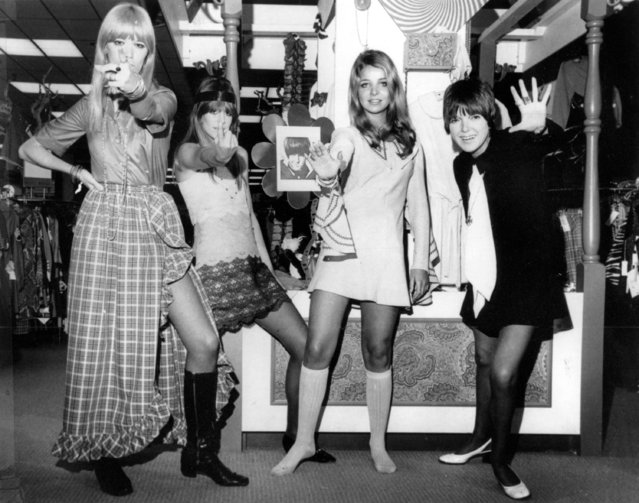
British fashion designer Mary Quant, right, waves as she poses with models wearing her Mod creations in Little Rock, Ark. on October 25, 1968. The models, from left, are, Amanda Tear, Rory Davis and Penny Yates. (Photo by AP Photo)
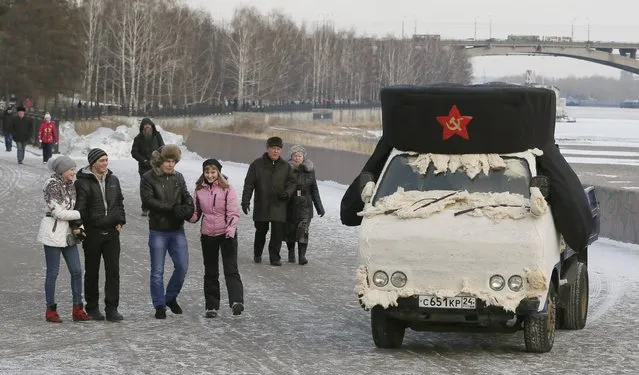
Pedestrians walk past a truck with a giant Soviet Red Army hat seen on it, an installation created by Russian artist Vasily Slonov, during the annual “Winter Virage” motor sports festival dedicated to the Defender of the Fatherland Day on the embankment of the Yenisei River in Russia's Siberian city of Krasnoyarsk, February 23, 2015. (Photo by Ilya Naymushin/Reuters)
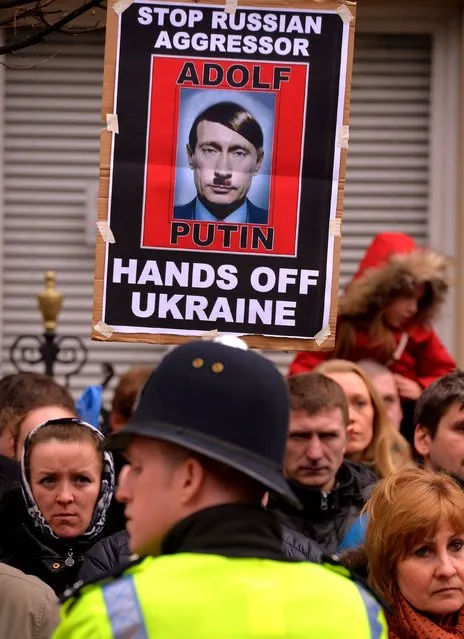
British-based Ukrainians gather outside the Russian Embassy in London to protest against the build-up of troops in the Crimea region, on March 2, 2014. The demonstrators chanted and held banners demanding “Hands off Ukraine”. (Photo by John Stillwell/PA Wire)
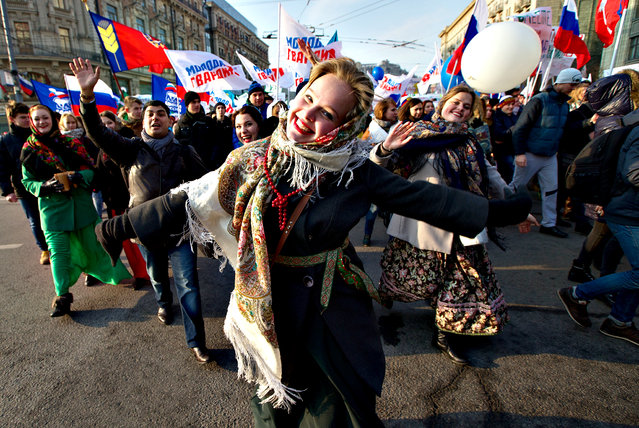
People of pro-government groups, with Russian flags, dance marching through downtown Moscow to mark People's Unity Day, a public holiday, in Russia, on Tuesday, November 4, 2014. Russia marks National Unity Day on November 4 to celebrate the defeat of Polish invaders in 1612. (Photo by Ivan Sekretarev/AP Photo)