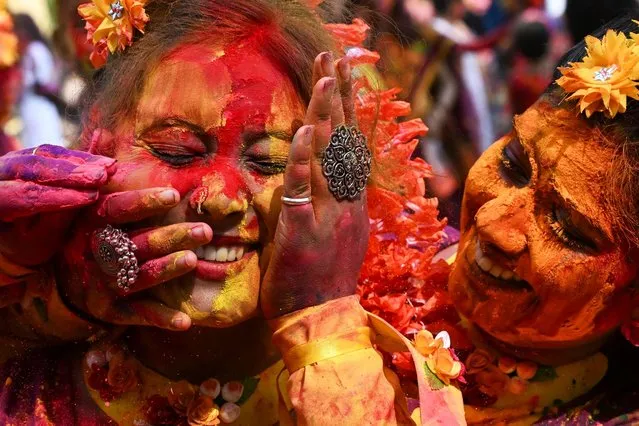
Women smeared with “Gulal” as they celebrate Holi, the Hindu spring festival of colours, in Kolkata on March 25, 2024. (Photo by Dibyangshu Sarkar/AFP Photo)
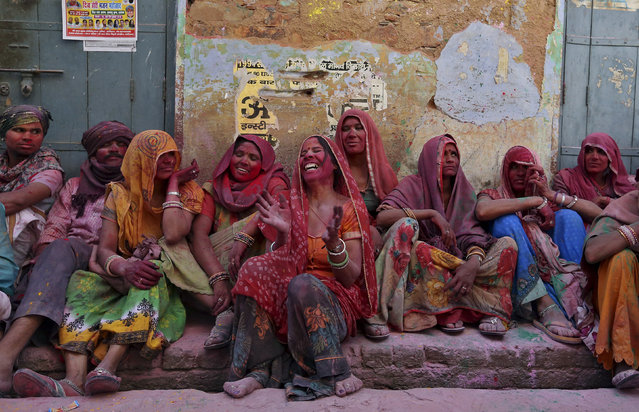
Hindu devotees laugh as they watch the religious festival of Lathmar Holi, where women beat the men with sticks, in the town of Barsana in the Uttar Pradesh region of India, March 17, 2016. During Lathmar Holi the women of Barsana beat the men from Nandgaon, the hometown of Krishna, with wooden sticks in response to their teasing. (Photo by Cathal McNaughton/Reuters)
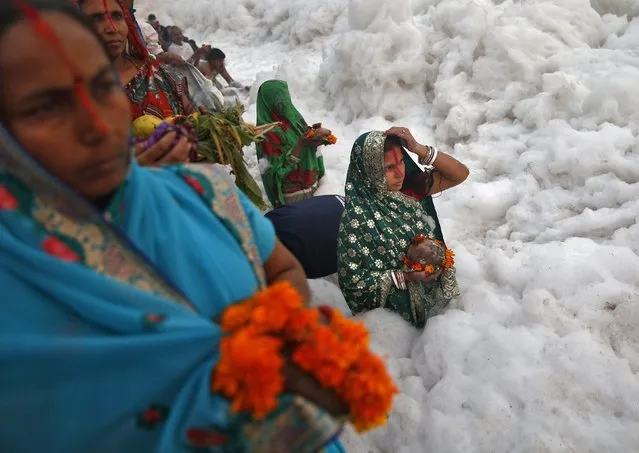
Hindu women worship the Sun god Surya in the polluted waters of the river Yamuna during the Hindu religious festival of Chatt Puja in New Delhi October 30, 2014. Hindu women fast for the whole day for the betterment of their family and the society during the festival. (Photo by Ahmad Masood/Reuters)
Andrea Abarca, (C) leads an aerobics class in Los Guidos de Desamparados July 23, 2015. More than 300 women participated in a physical health program organized by Abarca, which aims to combat obesity and sedentary behavior in poor women living in a slum. The National Nutrition Survey shows that the Costa Rican population has 62.4 percent of adult men who are obese, while among women the percentage was 77.3, according to local media. (Photo by Juan Carlos Ulate/Reuters)
A catholic faithful smeared in burnt oil, takes part in the opening of the ten-day celebration of the Santo Domingo de Guzman festival in Managua, on August 1, 2019. In Central America the black devil, or El Cadejo, is an evil dog-like spirit with glowing red eyes that locals believe eats new born puppies. (Photo by Inti Ocon/AFP Photo)
Underwater photographer Alexander Semenovs has snapped some of the most stunning, fragile life forms anywhere on planet Earth. Shot in deep, dark conditions, the images continue to provide an insight into what lies beneath, with glowing creatures appearing a lot like aliens in the pitch-black water. Semenovs has shot the likes of bioluminescent jellyfish, aggressive-looking worms and many species that leave a lot to the imagination. The 30-year-old from Moscow does the majority of his work in the White Sea, near the Arctic Circle. Here: A Comb jelly – Beroe cucumis. (Photo by Alexander Semenovs/Caters News)
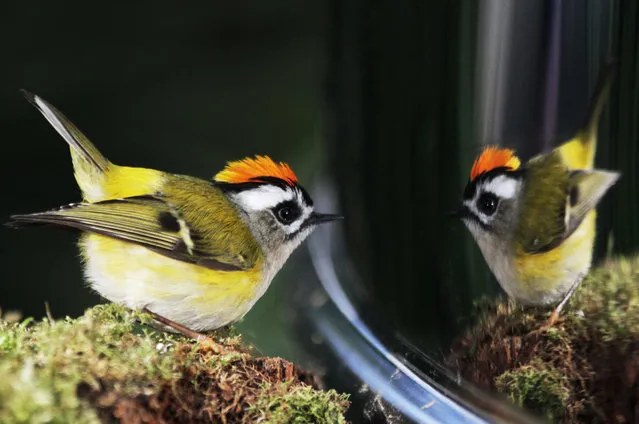
Golden-crowned Kinglets boldly bear their flashy lemon-yellow crest and a black eyebrow stripe. Taking a good look at them might be rather challenging, since they spend most of their time in the dense fir foliage or spruce. However, if you’re patient enough to find them, listen for their shrill, thin song. Though these “little Kings” are only a tad bit larger than a hummingbird, they can survive easily extreme cold by huddling close together. They breed in montane west and the far north and only visit North America during winter.
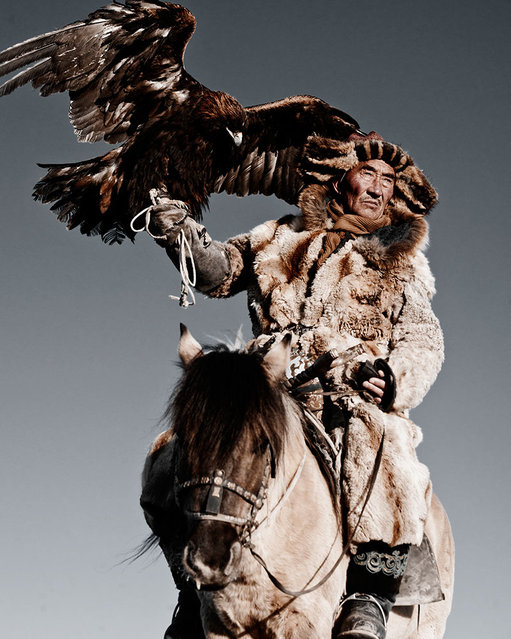
The Kazakhs are the descendants of Turkic, Mongolic and Indo-Iranian tribes and Huns that populated the territory between Siberia and the Black Sea. They are a semi-nomadic people and have roamed the mountains and valleys of western Mongolia with their herds since the 19th century. The ancient art of eagle hunting is one of many traditions and skills that the Kazakhs have, in recent decades, been able to hold on to. They rely on their clan and herds, believing in pre-Islamic cults of the sky, the ancestors, fire and the supernatural forces of good and evil spirits.