Loading...
Done
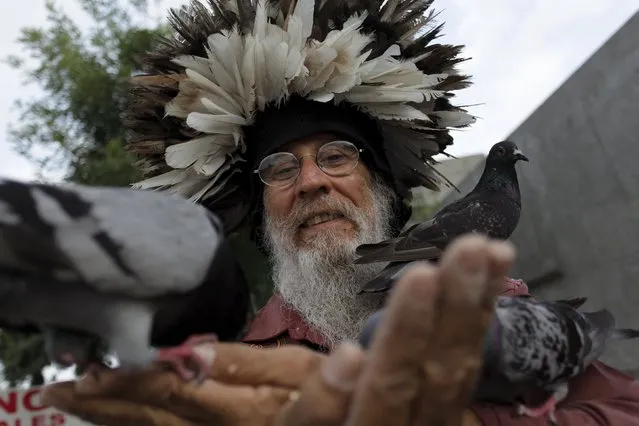
Jesus Moreno, 60, feeds pigeons in downtown Monterrey, Mexico July 7, 2015. For the past 30 years Moreno, who was once homeless, a drug addict, and formerly working as a investigative policeman, has been feeding pigeons twice a day, because to him they represent peace and the only way to communicate to God, local media reported. (Photo by Daniel Becerril/Reuters)

Jesus Moreno, 60, feeds pigeons in downtown Monterrey, Mexico July 7, 2015. For the past 30 years Moreno, who was once homeless, a drug addict, and formerly working as a investigative policeman, has been feeding pigeons twice a day, because to him they represent peace and the only way to communicate to God, local media reported. (Photo by Daniel Becerril/Reuters)
Details
09 Jul 2015 11:59:00
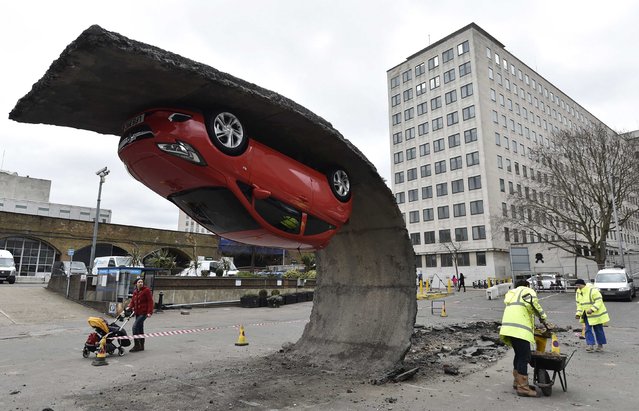
Pedestrians and workers pass an upside down car art installation in a car park on the South Bank in London, February 19, 2015. British artist Alex Chinneck's illusory piece, entitled “Pick yourself up and pull yourself together”, and on display in the working car park for a week, sees a Vauxhall car suspended upside down, appearing to be gripping onto a peeled back length of tarmac. (Photo by Toby Melville/Reuters)

Pedestrians and workers pass an upside down car art installation in a car park on the South Bank in London, February 19, 2015. British artist Alex Chinneck's illusory piece, entitled “Pick yourself up and pull yourself together”, and on display in the working car park for a week, sees a Vauxhall car suspended upside down, appearing to be gripping onto a peeled back length of tarmac. (Photo by Toby Melville/Reuters)
Details
20 Feb 2015 12:39:00
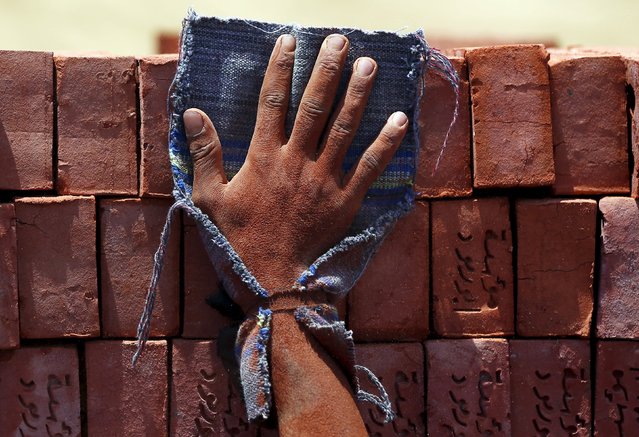
A hand of a labourer pushes bricks at a traditional brick factory in Arab Mesad district of Helwan, northeast of Cairo, May 14, 2015. (Photo by Amr Abdallah Dalsh/Reuters)

A hand of a labourer pushes bricks at a traditional brick factory in Arab Mesad district of Helwan, northeast of Cairo, May 14, 2015. About 45 labourers are employed at the brick factory and most work 10 hours a day. Adult workers earn a daily wage of 70 Egyptian pounds ($9) and child workers earn 40 Egyptian pounds ($5). The labourers, who are usually temporary or seasonally employed in Egypt's brick-making industry, experience unsafe work conditions, according to local media. (Photo by Amr Abdallah Dalsh/Reuters)
Details
19 May 2015 11:37:00
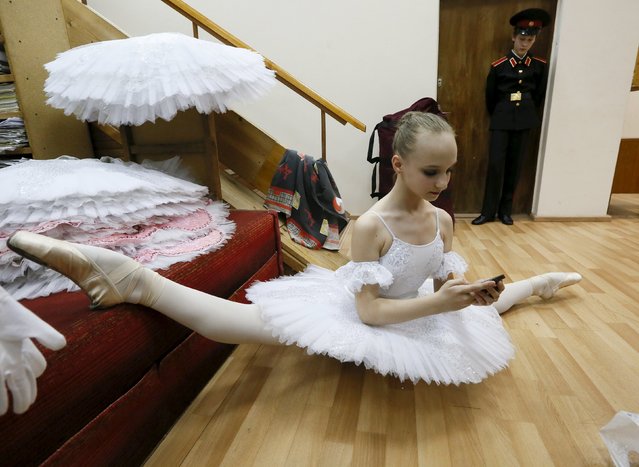
A student of the Krasnoyarsk choreographic college prepares backstage before a dress rehearsal of a performance by graduates of the college at the State Theatre of Opera and Ballet in Russia's Siberian city of Krasnoyarsk, Russia, May 12, 2015. The annual performance showcases the work of students from across Russia who study or have studied at the well-known school. (Photo by Ilya Naymushin/Reuters)

A student of the Krasnoyarsk choreographic college prepares backstage before a dress rehearsal of a performance by graduates of the college at the State Theatre of Opera and Ballet in Russia's Siberian city of Krasnoyarsk, Russia, May 12, 2015. The annual performance showcases the work of students from across Russia who study or have studied at the well-known school. (Photo by Ilya Naymushin/Reuters)
Details
14 May 2015 11:58:00
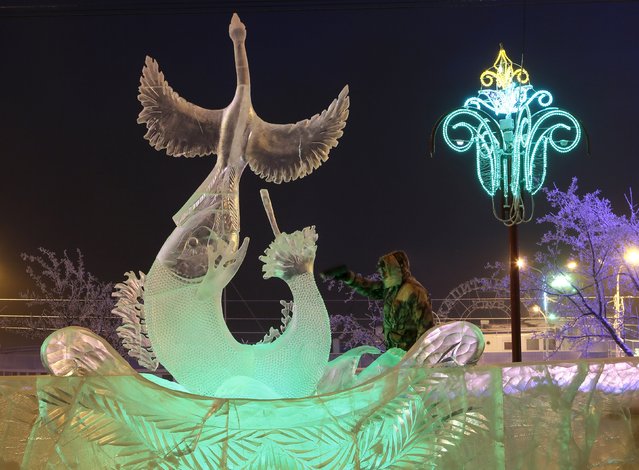
Mikhail Vasilenko, a participant from the Siberian town of Nizhny Tagil, works on an ice sculpture called “The Predator”, on the last day of the annual international festival of snow and ice sculptures “The Magical Ice of Siberia”, with the air temperature at about minus 28 degrees Celsius (minus 18.4 degrees Fahrenheit), in Krasnoyarsk, Russia, January 17, 2016. (Photo by Ilya Naymushin/Reuters)

Mikhail Vasilenko, a participant from the Siberian town of Nizhny Tagil, works on an ice sculpture called “The Predator”, on the last day of the annual international festival of snow and ice sculptures “The Magical Ice of Siberia”, with the air temperature at about minus 28 degrees Celsius (minus 18.4 degrees Fahrenheit), in Krasnoyarsk, Russia, January 17, 2016. (Photo by Ilya Naymushin/Reuters)
Details
19 Jan 2016 08:00:00
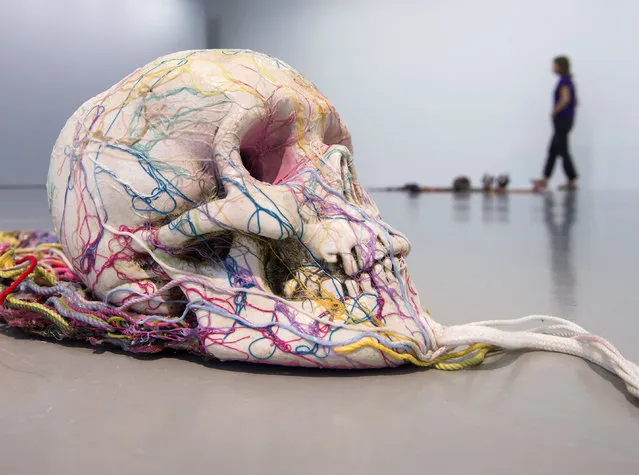
A woman walks behind the installation “Wandering boy is forever attractive” (1985) by Tetsumi Kudo during the press preview at the exhibition “Tetsumi Kudo – Retrospective” in the Fridericianum in Kassel, Germany, Friday, September 23, 2016. The exhibition offers an in-depth, comprehensive view of works by the Japanese artist Kudo. It starts on Sept. 25, 2016 and lasts until Jan. 1, 2017. (Photo by Jens Meyer/AP Photo)

A woman walks behind the installation “Wandering boy is forever attractive” (1985) by Tetsumi Kudo during the press preview at the exhibition “Tetsumi Kudo – Retrospective” in the Fridericianum in Kassel, Germany, Friday, September 23, 2016. The exhibition offers an in-depth, comprehensive view of works by the Japanese artist Kudo. It starts on Sept. 25, 2016 and lasts until Jan. 1, 2017. (Photo by Jens Meyer/AP Photo)
Details
24 Sep 2016 11:18:00
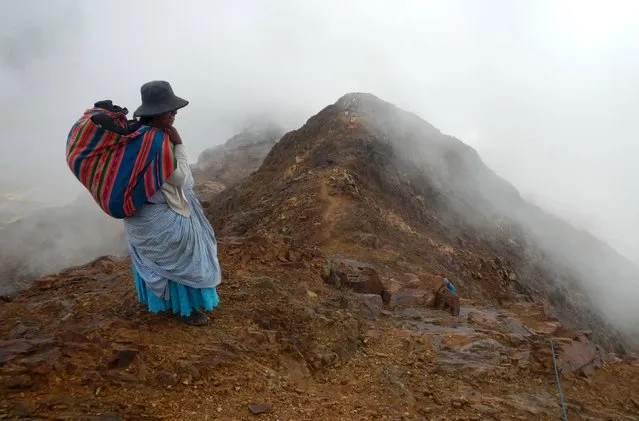
A porter stands at the bottom of the Illimani mountain, on the outskirts of La Paz, Bolivia, April 16, 2016. (Photo by David Mercado/Reuters)

A porter stands at the bottom of the Illimani mountain, on the outskirts of La Paz, Bolivia, April 16, 2016. For years, Lydia Huayllas, 48, has worked as a cook at base camps and mountain-climbing refuges on the steep, glacial slopes of Huayna Potosi, a 19,974-foot (6,088-meter) Andean peak outside of La Paz, Bolivia. But two years ago, she and 10 other Aymara indigenous women, ages 42 to 50, who also worked as porters and cooks for mountaineers, put on crampons – spikes fixed to a boot for climbing – under their wide traditional skirts and started to do their own climbing. (Photo by David Mercado/Reuters)
Details
22 Apr 2016 12:33:00
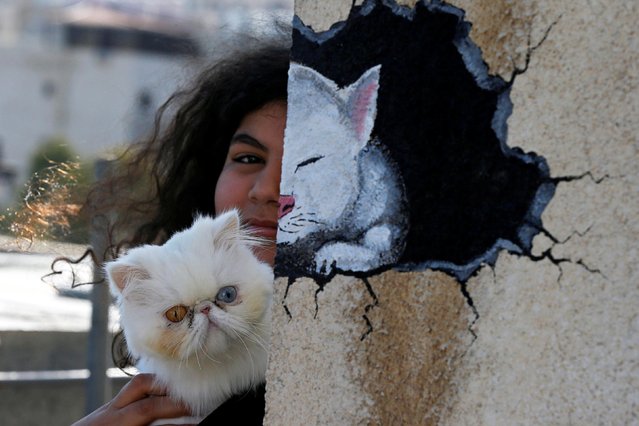
Jude Hajjaj, carries her cat near a picture of her cat painted on the wall by her father Osama Hajjaj, who teams up with his neighbours in creating works of art at their roof during the curfew imposed by the Jordanian government amid concerns over the spread of the coronavirus disease (COVID-19) in Amman, Jordan, May 10, 2020. (Photo by Muhammad Hamed/Reuters)

Jude Hajjaj, carries her cat near a picture of her cat painted on the wall by her father Osama Hajjaj, who teams up with his neighbours in creating works of art at their roof during the curfew imposed by the Jordanian government amid concerns over the spread of the coronavirus disease (COVID-19) in Amman, Jordan, May 10, 2020. (Photo by Muhammad Hamed/Reuters)
Details
23 May 2020 00:03:00