Loading...
Done
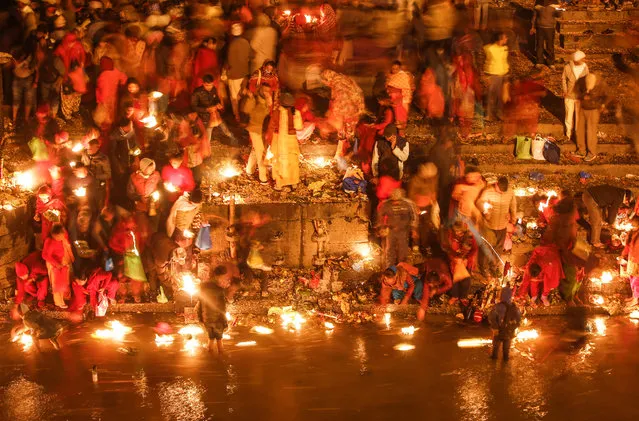
Nepalese Hindu devotees offer oil lamps in the Bagmati River as they observe the festival of Bala Chaturdashi in the early morning hours at the Pashupati Temple in Kathmandu, Nepal, 28 November 2016. Seven kinds of seeds – paddy, barley, sesame, wheat, gram, maize and finger millet – are sown around the temple premises in the name of loved ones departed during the last three years, in the belief that the departed souls will receive salvation. (Photo by Narendra Shrestha)

Nepalese Hindu devotees offer oil lamps in the Bagmati River as they observe the festival of Bala Chaturdashi in the early morning hours at the Pashupati Temple in Kathmandu, Nepal, 28 November 2016. Seven kinds of seeds – paddy, barley, sesame, wheat, gram, maize and finger millet – are sown around the temple premises in the name of loved ones departed during the last three years, in the belief that the departed souls will receive salvation. (Photo by Narendra Shrestha)
Details
05 Dec 2016 11:28:00
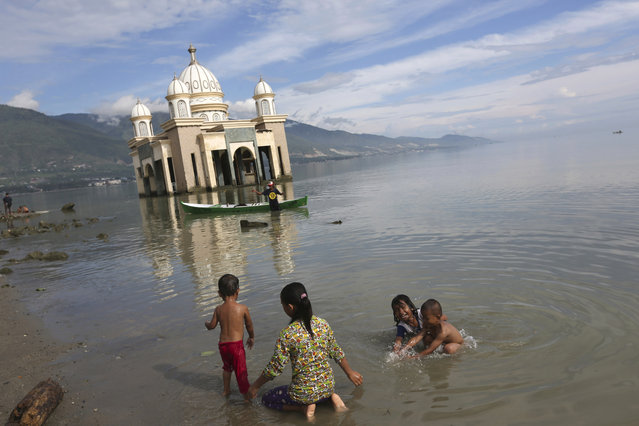
In this Wednesday, April 3, 2019, photo, children play in the water on a beach as a mosque collapsed during the Sept. 28, 2018, earthquake is seen in the background in Palu, Central Sulawesi, Indonesia. The earthquake spawned a large localized tsunami that wiped out coastal areas, while liquefaction caused by the shaking turned entire neighborhoods into rivers of sludge. The disaster killed thousands of people, making it the world’s deadliest seismic event in 2018. (Photo by Tatan Syuflana/AP Photo)

In this Wednesday, April 3, 2019, photo, children play in the water on a beach as a mosque collapsed during the Sept. 28, 2018, earthquake is seen in the background in Palu, Central Sulawesi, Indonesia. The earthquake spawned a large localized tsunami that wiped out coastal areas, while liquefaction caused by the shaking turned entire neighborhoods into rivers of sludge. The disaster killed thousands of people, making it the world’s deadliest seismic event in 2018. (Photo by Tatan Syuflana/AP Photo)
Details
04 May 2019 00:05:00
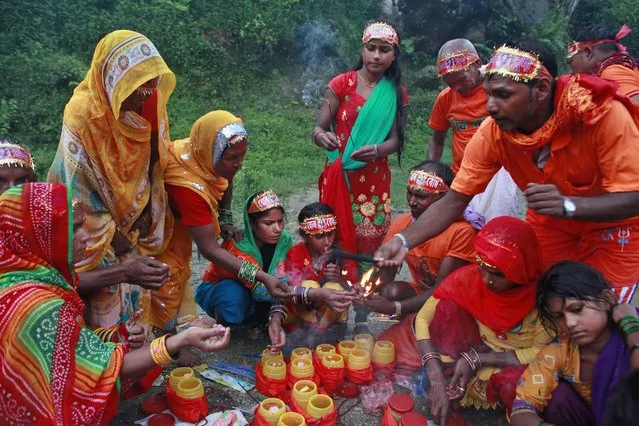
Hindu devotees perform rituals during the Bol Bom pilgrimage, on the outskirts of Kathmandu, Nepal, Monday, August 8, 2016. During this pilgrimage, devotees walk miles barefooted before offering water collected from Bagmati river, at the Pashupatinath temple in Katmandu. Shravan Somwar or Monday of Hindu calendar month of Shravan is considered auspicious for offering prayers to Lord Shiva, the god of destruction. (Photo by Niranjan Shrestha/AP Photo)

Hindu devotees perform rituals during the Bol Bom pilgrimage, on the outskirts of Kathmandu, Nepal, Monday, August 8, 2016. During this pilgrimage, devotees walk miles barefooted before offering water collected from Bagmati river, at the Pashupatinath temple in Katmandu. Shravan Somwar or Monday of Hindu calendar month of Shravan is considered auspicious for offering prayers to Lord Shiva, the god of destruction. (Photo by Niranjan Shrestha/AP Photo)
Details
09 Aug 2016 12:42:00
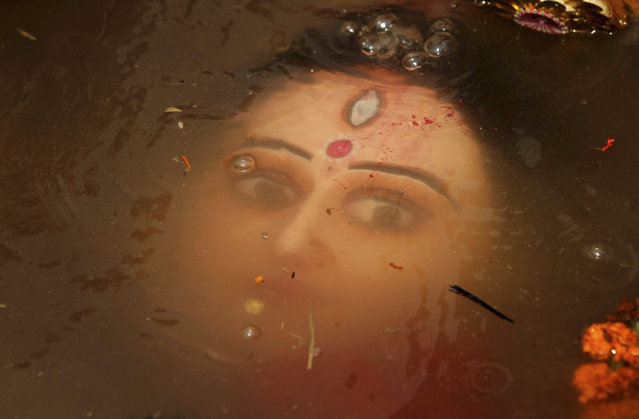
An idol of Hindu goddess Durga floats in water as devotees immerse the same in the River Kuakhai after the Durga Puja festival in Bhubaneswar, India, Saturday, October 24, 2015. The immersion of idols marks the end of the festival that commemorates the slaying of a demon king by lion-riding, 10-armed goddess Durga, marking the triumph of good over evil. (Photo by Biswaranjan Rout/AP Photo)

An idol of Hindu goddess Durga floats in water as devotees immerse the same in the River Kuakhai after the Durga Puja festival in Bhubaneswar, India, Saturday, October 24, 2015. The immersion of idols marks the end of the festival that commemorates the slaying of a demon king by lion-riding, 10-armed goddess Durga, marking the triumph of good over evil. (Photo by Biswaranjan Rout/AP Photo)
Details
26 Oct 2015 08:04:00
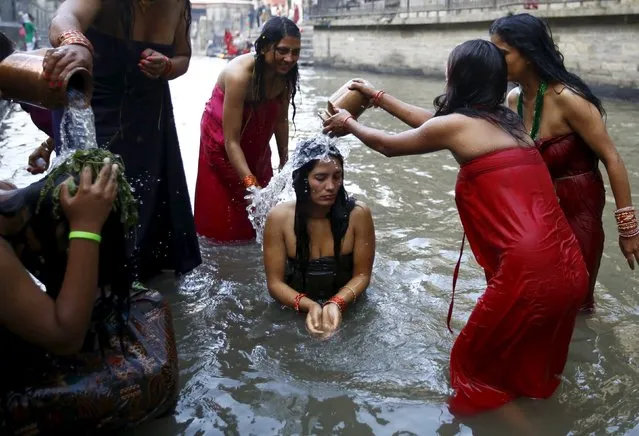
Nepalese women performs ritual as they take a holy bath in the Bagmati River, during the Rishi Panchami festival, in Kathmandu, Nepal September 18, 2015. Rishi Panchami is observed on the last day of Teej when women worship Sapta Rishi (Seven Saints) to ask for forgiveness for sins committed during their menstrual periods throughout the year. (Photo by Navesh Chitrakar/Reuters)

Nepalese women performs ritual as they take a holy bath in the Bagmati River, during the Rishi Panchami festival, in Kathmandu, Nepal September 18, 2015. Rishi Panchami is observed on the last day of Teej when women worship Sapta Rishi (Seven Saints) to ask for forgiveness for sins committed during their menstrual periods throughout the year. The Hindu religion considers menstruation as a representation of impurity and women are prohibited from taking part in religious practices during their monthly menstruations. (Photo by Navesh Chitrakar/Reuters)
Details
21 Sep 2015 12:23:00
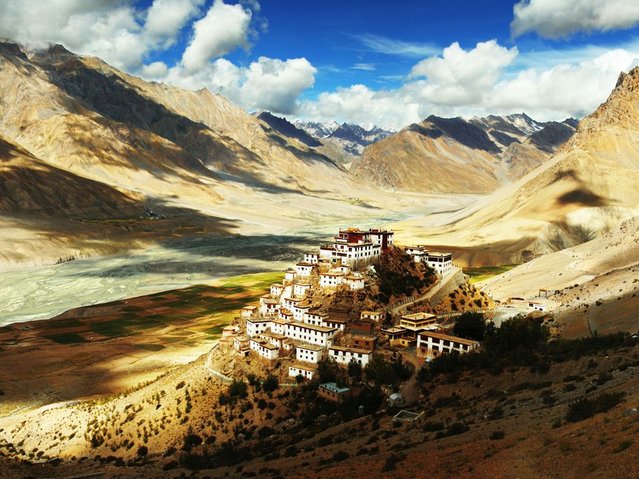
Buddhist Monastery Key Gompa

Key Gompa (also spelled Ki, Kye or Kee) is a Tibetan Buddhist monastery located on top of a hill at an altitude of 4,166 metres (13,668 ft) above sea level, close to the Spiti River, in the Spiti Valley of Himachal Pradesh, Lahaul and Spiti district, India. It is the biggest monastery of Spiti Valley and a religious training centre for Lamas. It reportedly had 100 monks in 1855.
Details
05 Dec 2013 10:48:00
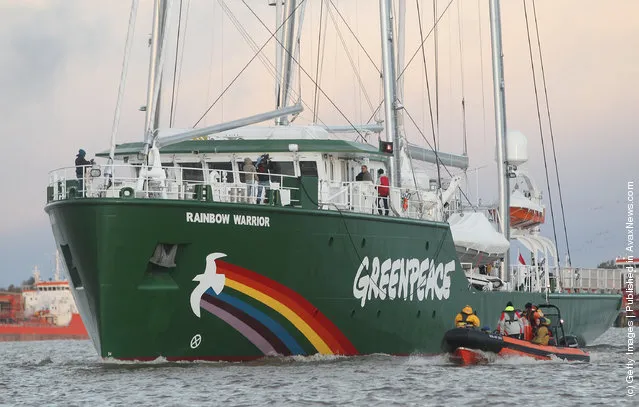
The Rainbow Warrior III, the newest ship of the enivornmental conservation organization Greenpeace

The Rainbow Warrior III, the newest ship of the enivornmental conservation organization Greenpeace, makes its way to port on the Elbe River on October 20, 2011 in Hamburg, Germany. The Rainbow Warrior III, 53 meters long, designed by Greenpeace and built in Poland and Germany, is a EUR 23 million project completed last week. (Photo by Sean Gallup/Getty Images)
Details
21 Oct 2011 09:35:00
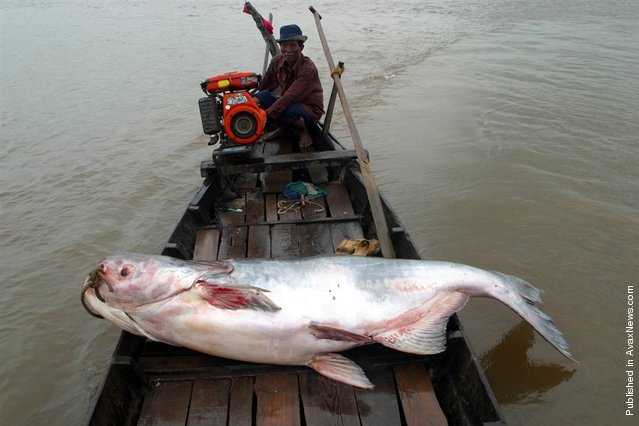
Among the fish populations that could be harmed by the Xayaburi dam in Laos is the critically endangered Mekong giant catfish, considered by the Guinness Book of World Records to be the world’s largest freshwater fish. The fish, which grows to 650 pounds and about 10 feet long, is only found in the Mekong River. It is migratory, moving between downstream habitats in Cambodia upstream to northern Thailand and Laos each year to spawn. Some experts fear the Xayaburi dam could block the migration and drive the giant catfish to extinction

Among the fish populations that could be harmed by the Xayaburi dam in Laos is the critically endangered Mekong giant catfish, considered by the Guinness Book of World Records to be the world’s largest freshwater fish. The fish, which grows to 650 pounds and about 10 feet long, is only found in the Mekong River. It is migratory, moving between downstream habitats in Cambodia upstream to northern Thailand and Laos each year to spawn. Some experts fear the Xayaburi dam could block the migration and drive the giant catfish to extinction. (Photo by Courtesy of Zeb Hogan/University of Nevada, Reno)
Details
20 Apr 2012 13:10:00