Loading...
Done
A young Nepalese girl dressed as a Kumari or living Goddess, smiles for camera as she waits for Kumari puja at Hanuman Dhoka, Basantapur Durbar Square in Katmandu, Nepal, Tuesday, Sept 17, 2013. More than hundred girls under the age of nine gathered for Kumari puja, a tradition of worshiping young pre-pubescent girls as manifestations of the divine female energy. The ritual holds a strong religious significance in Newar community. It is a community affair held primarily to save small girls from diseases and bad luck in the years to come. (AP Photo/Niranjan Shrestha)

The festival marks the end of the monsoon season and beginning of autumn. More than hundred girls under the age of nine gathered for the tradition of worshiping young pre-pubescent girls as manifestations of the divine female energy. The ritual holds a strong religious significance in Newar community. It is a community affair held primarily to save small girls from diseases and bad luck in the years to come. Photo: A young Nepalese girl dressed as a Kumari or living Goddess, smiles for camera as she waits for Kumari puja at Hanuman Dhoka, Basantapur Durbar Square in Katmandu, Nepal, Tuesday, September 17, 2013. (Photo by Niranjan Shrestha/AP Photo)
Details
18 Sep 2013 09:33:00
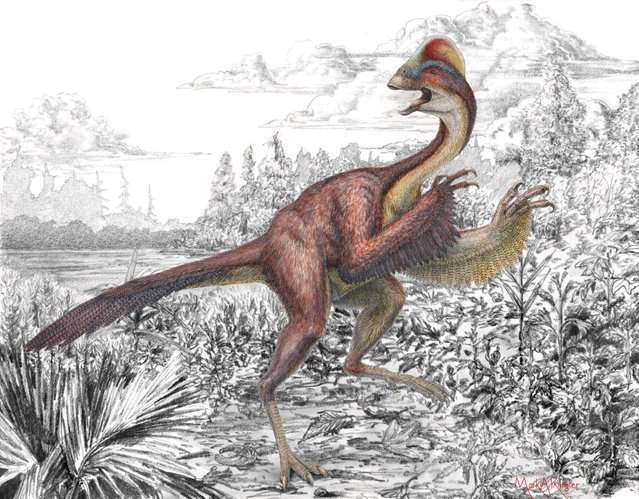
Life reconstruction of the new oviraptorosaurian dinosaur species Anzu wyliei in its 66 million-year-old environment in western North America as seen in an undated handout illustration by Mark A. Klinger, Carnegie Museum of Natural History. Some 18,000 species, great and small, were discovered in 2014, adding to the 2 million already known, scientists said on May 21, 2015 as they released a “Top 10” list that highlights the diversity of life. (Photo by Mark A. Klingler/Reuters/Carnegie Museum of Natural History)

Life reconstruction of the new oviraptorosaurian dinosaur species Anzu wyliei in its 66 million-year-old environment in western North America as seen in an undated handout illustration by Mark A. Klinger, Carnegie Museum of Natural History. Some 18,000 species, great and small, were discovered in 2014, adding to the 2 million already known, scientists said on May 21, 2015 as they released a “Top 10” list that highlights the diversity of life. Anzu wyliei, one of the top 10, dubbed “the chicken from hell”, is extinct. The feathered dinosaur whose partial skeletons were unearthed in the Dakotas was a contemporary of T. rex and Triceratops. (Photo by Mark A. Klingler/Reuters/Carnegie Museum of Natural History)
Details
22 May 2015 12:31:00


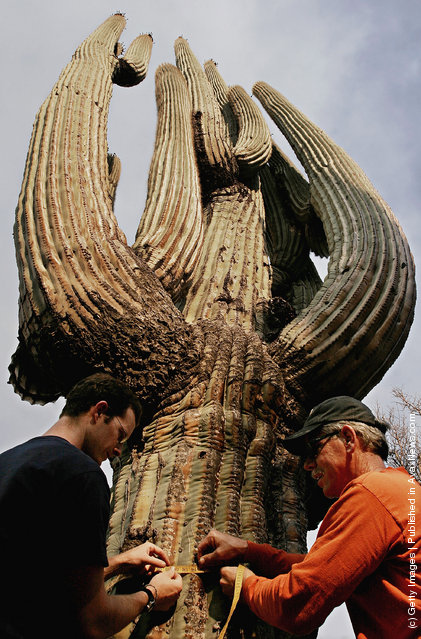
“The saguaro (scientific name Carnegiea gigantea) is a large, tree-sized cactus species in the monotypic genus Carnegiea. It is native to the Sonoran Desert in the U.S. state of Arizona, the Mexican state of Sonora, a small part of Baja California in the San Felipe Desert and an extremely small area of California, U.S. The saguaro blossom is the State Wildflower of Arizona”. – Wikipedia

Photo: Daniel Appel (L), a firefighter with Engine 84 from the Lassen National Forest in California and Mike Hallen, (R), Arizona representative of the National Register of Big Trees, measure the circumference of this Saguaro cactus called the "Grand One," in the Tonto National Forest on July 1, 2005 35 miles north of Phoenix, near Carefree, Arizona. The cactus, estimated to be more than 200 years old, measures a circumference of 7 feet, 10 inches (2.4 meters) and stands 46 feet high (14 meters). The cactus was burned in the Cave Creek Complex fire and may not survive. It was once the largest Saguaro in the world, two others have been found recently that have tied it's measurements. The fire has burned more than 214,000 acres of the Sonoran desert. (Photo by Jeff Topping/Getty Images)
Details
26 Jul 2011 12:27:00
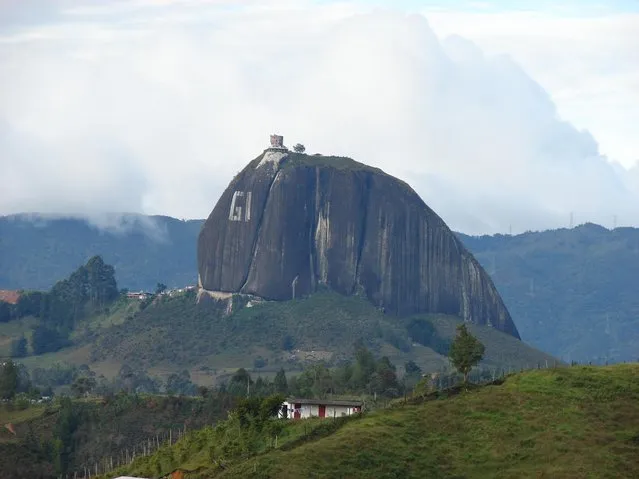
Guatape Rock In Colombia

Guatapé is a town and municipality in Antioquia Department, Colombia. Part of the subregion of Eastern Antioquia. Guatapé is located in the outskirts of Medellín, bordering a reservoir created by the Colombian government for a hydro-electric dam, built in the late 1960s. This quaint town is the gathering place for "Las Vegas", or the small farms of the area. It is also a growing area of recreation for citizens of Medellín, and aims to be a tourist destination for foreign travellers.
Guatapé was founded in 1811, by the Spaniard Don Francisco Giraldo y Jimenez. The name "Guatapé", comes from the Quechua language, related to "stones and water". The area was visited by the conquistadors circa 1551.
Details
25 Dec 2013 09:18:00
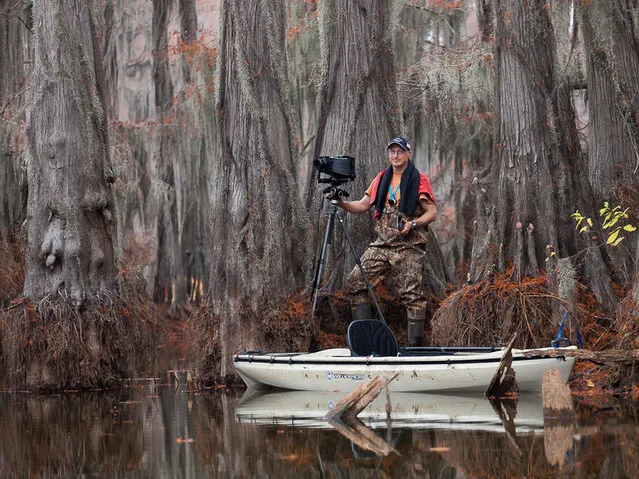
Verena Popp-Hackner And Georg Popp Professional Landscape Photographers

We – Verena Popp-Hackner and Georg Popp - are professional landscape photographers. While we are based in Vienna/Austria, running our own (rights managed) image library and a small but fine photo-gallery. Photographing our tiny country Austria, with all it's culture and nature, canoeing it's rivers or lakes and hiking the Alps is our profession but our photographic “backyard” includes the rest of the planet as well. We use analog large format cameras almost exclusively for our landscape work, shooting on 4x5” sheet film, to provide clients with the maximum of print-sharpness and details and unsurpassed clarity and depth of focus.
Details
15 Jan 2014 14:06:00
Mixed Media Mosaics By Kyu-Hak Lee

At first glance, Korean artist Kyu-Hak Lee's mixed media mosaics come off as fairly straightforward recreations of iconic works of art. But upon closer inspection, there's more depth to Lee's works than expected. Using a specific technique – rolling strips of magazine and newspaper pages around small bits of wood – Lee replicates brushstrokes, patterns, and colors to create a commentary on consumerism and worth.
Details
08 May 2015 10:32:00
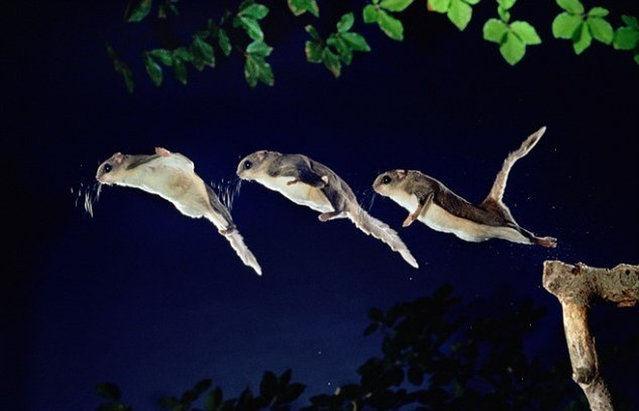
 Flying Squirrel

Flying squirrels are not capable of powered flight like birds or bats; instead, they glide between trees. They are capable of obtaining lift within the course of these flights, with flights recorded to 90 meters (295 ft). The direction and speed of the animal in midair is varied by changing the positions of its two arms and legs, largely controlled by small cartilaginous wrist bones. This changes the tautness of the patagium, a furry parachute-like membrane that stretches from wrist to ankle. It has a fluffy tail that stabilizes in flight. The tail acts as an adjunct airfoil, working as an air brake before landing on a tree trunk.
Details
07 Aug 2012 16:29:00
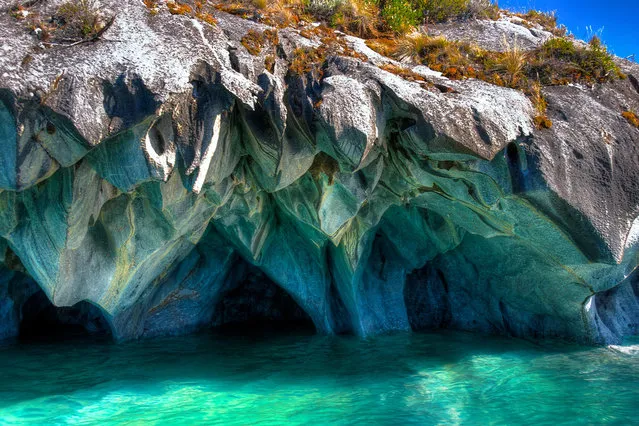
 Marble Caves, Patagonia, Chile

The Marble Caves of Patagonia, Chile, are beautiful vibrant blue caverns, partially submerged in the equally stunning turquoise waters of Carrera Lake. The lake itself is on the border of Argentina and Chile, with the caves located on the Chilean side. The caves are comprised of three main caverns: the Chapel (La Capilla), the Cathedral (El Catedral), and the Cave (La Cueva). Visitors to the caves can explore them in a small boat or kayak, but only when Carrera Lake’s waters are calm and gentle. A rare and invaluable natural wonder, the existence of these caves is currently threatened by plans to build five large dams in the area. If you visit these caves, please treat them with the utmost respect and care.
Details
15 Aug 2012 11:25:00