Loading...
Done
A Colombian soldier hugs his girlfriend during the graduation ceremony of soldiers in Nilo, Colombia, February 17, 2017. The soldiers will be deployed to occupy territories formerly controlled by FARC rebels. (Photo by Jaime Saldarriaga/Reuters)

A Colombian soldier hugs his girlfriend during the graduation ceremony of soldiers in Nilo, Colombia, February 17, 2017. The soldiers will be deployed to occupy territories formerly controlled by FARC rebels. (Photo by Jaime Saldarriaga/Reuters)
Details
18 Feb 2017 10:03:00
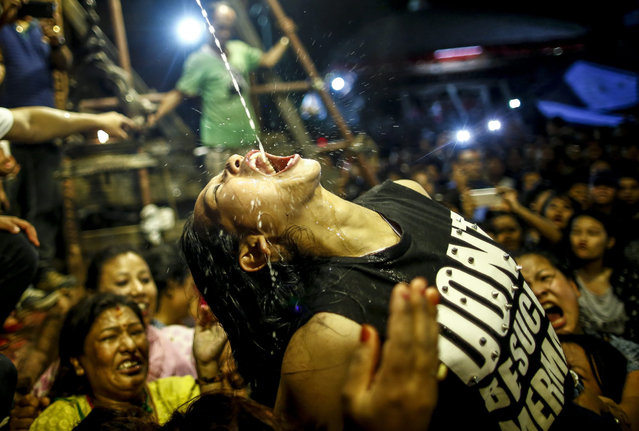
Nepalese women and young girls struggle to drink homemade alcohol poured through a pipe sticking out of the mouth of Swet Bhairab, a god of Power, during the Indra Jatra festival at Basantapur Durbar Square in Kathmandu, Nepal, 17 September 2016. Hundreds of women and young girls gathered to drink alcohol as a blessing from idol of Swet Bhairab which they believes will keep them free from all diseases. The Indra Jatra festival is celebrated to honor Indra, the king of gods and god of rains. The festival also marks the end of the monsoon. (Photo by Narendra Shrestha/EPA)

Nepalese women and young girls struggle to drink homemade alcohol poured through a pipe sticking out of the mouth of Swet Bhairab, a god of Power, during the Indra Jatra festival at Basantapur Durbar Square in Kathmandu, Nepal, 17 September 2016. Hundreds of women and young girls gathered to drink alcohol as a blessing from idol of Swet Bhairab which they believes will keep them free from all diseases. The Indra Jatra festival is celebrated to honor Indra, the king of gods and god of rains. The festival also marks the end of the monsoon. (Photo by Narendra Shrestha/EPA)
Details
18 Sep 2016 08:31:00
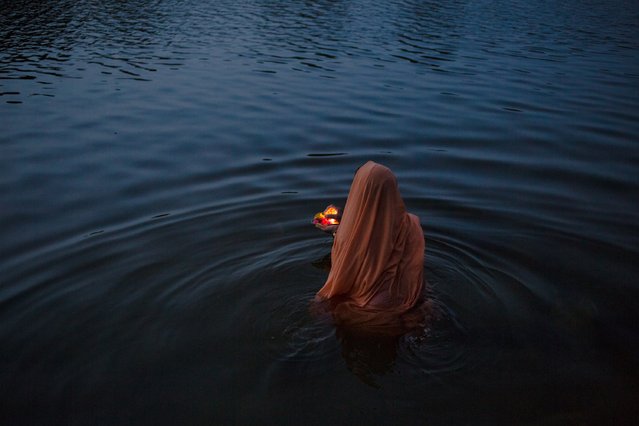
An Indian women offers early-morning prayers or a “puja” at a ghat early in the morning on the banks of the Betawa River in Orchha in the state of Madhya Pradesh on July 5, 2015. (Photo by Rebecca Conway/AFP Photo)

An Indian women offers early-morning prayers or a “puja” at a ghat early in the morning on the banks of the Betawa River in Orchha in the state of Madhya Pradesh on July 5, 2015. (Photo by Rebecca Conway/AFP Photo)
Details
08 Jul 2015 11:56:00


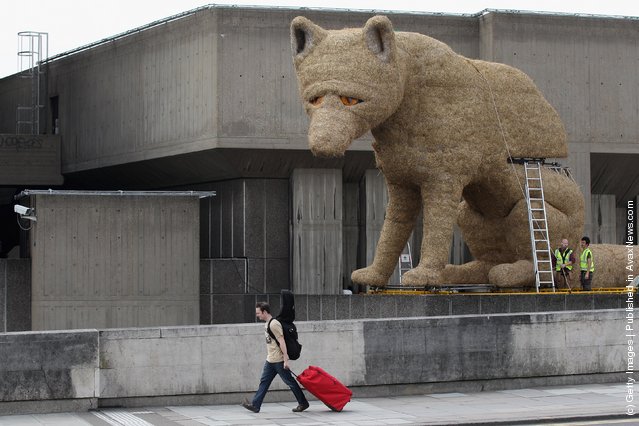
The finishing touches are made to a giant sculpture on the Hayward Gallery entitled “Urban Fox” and made from straw bales on April 18, 2011 in London, England. The sculpture features in the Southbank Centre's 60th anniversary celebration of the 1951 Festival of Britain. The celebration will feature various cultural and creative events and runs from April 22 until September 4, 2011 at London's Southbank Centre. (Photo by Oli Scarff/Getty Images)
Details
22 Apr 2011 09:45:00
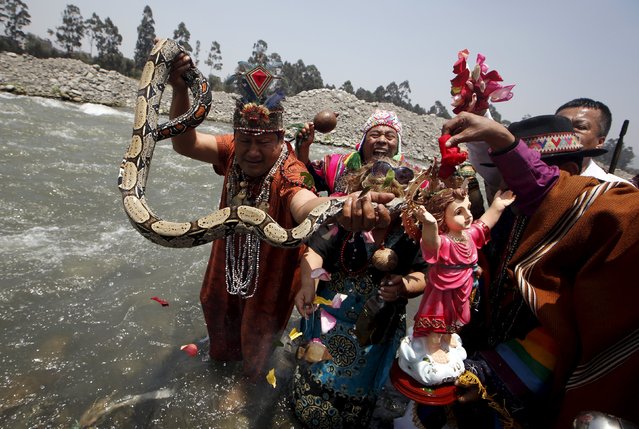
Peruvian shamans holding a figure of a Nino Jesus (Child Jesus) and a snake perform a ritual at the Rimac river to fight the negative effects of the Nino weather phenomena over Nature, in Lima, October 1, 2015. (Photo by Mariana Bazo/Reuters)

Peruvian shamans holding a figure of a Nino Jesus (Child Jesus) and a snake perform a ritual at the Rimac river to fight the negative effects of the Nino weather phenomena over Nature, in Lima, October 1, 2015. (Photo by Mariana Bazo/Reuters)
Details
03 Oct 2015 08:07:00
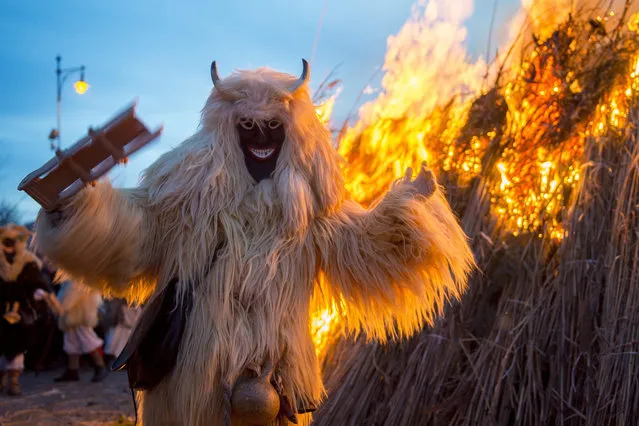
A reveler wearing sheepfur costume is seen in front of a bonfire on which they burn a coffin symbolizing winter during the closing ceremony of the traditional carnival parade in Mohacs, 189 kms south of Budapest, Hungary, 07 February 2016. (Photo by Tamas Soki/EPA)

A reveler wearing sheepfur costume is seen in front of a bonfire on which they burn a coffin symbolizing winter during the closing ceremony of the traditional carnival parade in Mohacs, 189 kms south of Budapest, Hungary, 07 February 2016. The carnival parade of people, the so-called busos, dressed in such costumes and frightening wooden masks, using various noisy wooden rattlers is traditionally held on the seventh weekend before Easter to drive away winter, and is a revival of a legend, which says that ethnic Croats ambushed the Osmanli Turkish troops, who escaped in panic seeing the terrifying figures during the Turkish occupation of Hungary. (Photo by Tamas Soki/EPA)
Details
09 Feb 2016 14:02:00
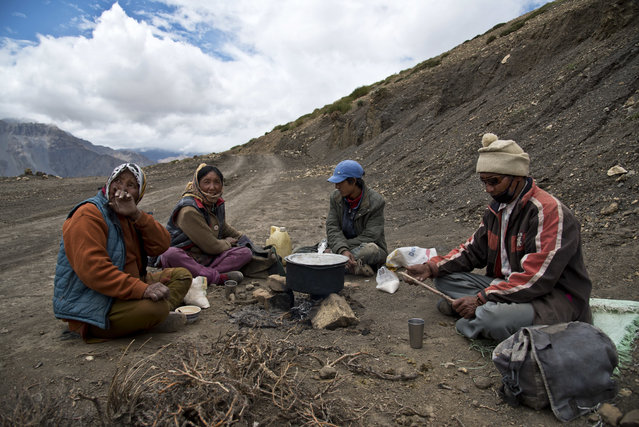
In this August 17, 2016, photo, from left to right, Chhering Chodom, 60, Tashi Yangzom, 50, Lobsang Chhering, 27, and Dorje Tandup, 58, drink milk tea on the side of the road. For centuries, the sleepy valley nestled in the Indian Himalayas remained a hidden Buddhist enclave forbidden to outsiders. Enduring the harsh year-round conditions of the high mountain desert, the people of Spiti Valley lived by a simple communal code – share the Earth's bounty, be hospitable to neighbors, and eschew greed and temptation at all turns. That's all starting to change, for better or worse. Since India began allowing its own citizens as well as outsiders to visit the valley in the early 1990s, tourism and trade have boomed. And the marks of modernization, such as solar panels, asphalt roads and concrete buildings, have begun to appear around some of the villages that dot the remote landscape at altitudes above 4,000 meters (13,000 feet). (Photo by Thomas Cytrynowicz/AP Photo)

In this August 17, 2016, photo, from left to right, Chhering Chodom, 60, Tashi Yangzom, 50, Lobsang Chhering, 27, and Dorje Tandup, 58, drink milk tea on the side of the road. For centuries, the sleepy valley nestled in the Indian Himalayas remained a hidden Buddhist enclave forbidden to outsiders. Enduring the harsh year-round conditions of the high mountain desert, the people of Spiti Valley lived by a simple communal code – share the Earth's bounty, be hospitable to neighbors, and eschew greed and temptation at all turns. That's all starting to change, for better or worse. (Photo by Thomas Cytrynowicz/AP Photo)

Details
15 Sep 2016 09:22:00
A view of one of the dioramas contained inside iron boxes as part of the “S.A.C.R.E.D” installation by Chinese artist Ai Weiwei during a media preview at the cathedral in Cuenca, Spain, July 21, 2016. (Photo by Susana Vera/Reuters)

A view of one of the dioramas contained inside iron boxes as part of the “S.A.C.R.E.D” installation by Chinese artist Ai Weiwei during a media preview at the cathedral in Cuenca, Spain, July 21, 2016. Ai Weiwei has reproduced scenes of his incarceration for a new art installation, a series of almost life-size dioramas – encased in steel boxes – showing his life in jail. (Photo by Susana Vera/Reuters)
Details
26 Jul 2016 10:25:00