Loading...
Done
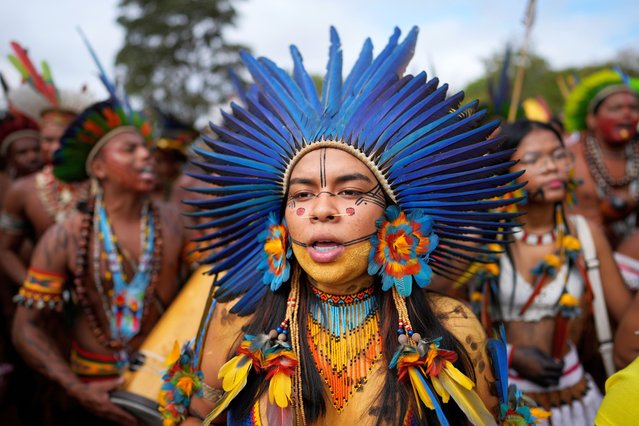
Indigenous people march during the annual Free Earth camp, where they discuss rights, territorial protection and their role in COP30, which will take place for the first time in the Amazon, in Brasilia, Brazil, Tuesday, April 8, 2025. (Photo by Eraldo Peres/AP Photo)

Indigenous people march during the annual Free Earth camp, where they discuss rights, territorial protection and their role in COP30, which will take place for the first time in the Amazon, in Brasilia, Brazil, Tuesday, April 8, 2025. (Photo by Eraldo Peres/AP Photo)
Details
15 Jun 2025 04:21:00
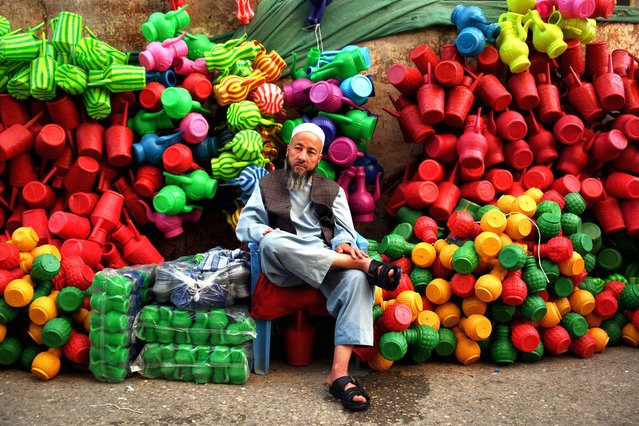
An Afghan vendor waits for customers at his stall selling plastic cans in a market in Mazar-i-Sharif on June 15, 2025. (Photo by Atif Aryan/AFP Photo)

An Afghan vendor waits for customers at his stall selling plastic cans in a market in Mazar-i-Sharif on June 15, 2025. (Photo by Atif Aryan/AFP Photo)
Details
29 Aug 2025 03:06:00


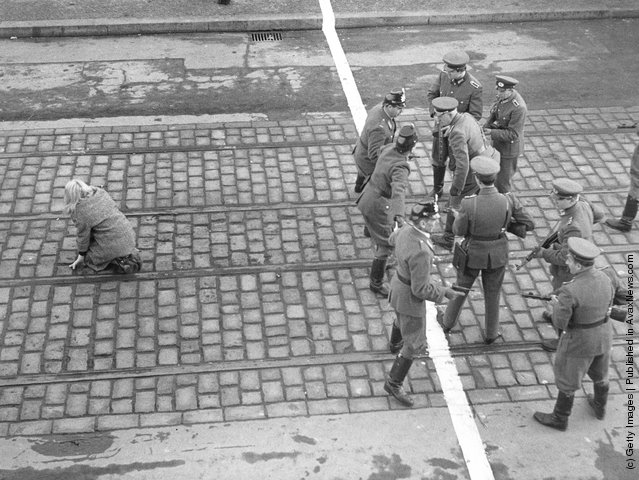
“The Berlin Wall (German: Berliner Mauer) was a barrier constructed by the German Democratic Republic (GDR, East Germany) starting on 13 August 1961, that completely cut off West Berlin from surrounding East Germany and from East Berlin. The barrier included guard towers placed along large concrete walls, which circumscribed a wide area (later known as the “death strip”) that contained anti-vehicle trenches, “fakir beds” and other defenses. The Soviet-dominated Eastern Bloc officially claimed that the wall was erected to protect its population from fascist elements conspiring to prevent the “will of the people” in building a socialist state in East Germany. However, in practice, the Wall served to prevent the massive emigration and defection that marked Germany and the communist Eastern Bloc during the post-World War II period”. – Wikipedia

Photo: West Berlin policemen and East German Volkspolizei face each other across the border in Berlin, circa 1955. (Photo by Three Lions/Hulton Archive/Getty Images)
Details
22 May 2011 10:49:00
Police fire rubber bullets as they help an Atletico Paranaense fan during clashes between Vasco da Gama soccer fans and Atletico Paranaense fans at their Brazilian championship match in Joinville in Santa Catarina, on December 8, 2013. Dozens of fans fought a savage battle on the terraces at the match on Sunday, interrupting play for more than one hour and leaving at least three people reportedly in serious condition. (Photo by Carlos Moraes/Agencia O Dia)

Police fire rubber bullets as they help an Atletico Paranaense fan during clashes between Vasco da Gama soccer fans and Atletico Paranaense fans at their Brazilian championship match in Joinville in Santa Catarina, on December 8, 2013. Dozens of fans fought a savage battle on the terraces at the match on Sunday, interrupting play for more than one hour and leaving at least three people reportedly in serious condition. (Photo by Carlos Moraes/Agência O DIA)
Details
14 Dec 2013 14:11:00
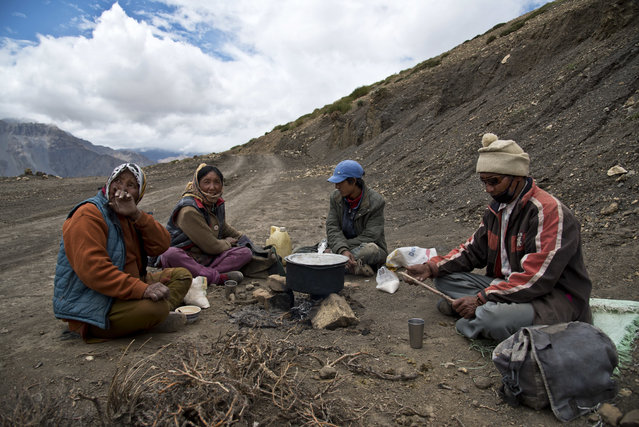
In this August 17, 2016, photo, from left to right, Chhering Chodom, 60, Tashi Yangzom, 50, Lobsang Chhering, 27, and Dorje Tandup, 58, drink milk tea on the side of the road. For centuries, the sleepy valley nestled in the Indian Himalayas remained a hidden Buddhist enclave forbidden to outsiders. Enduring the harsh year-round conditions of the high mountain desert, the people of Spiti Valley lived by a simple communal code – share the Earth's bounty, be hospitable to neighbors, and eschew greed and temptation at all turns. That's all starting to change, for better or worse. Since India began allowing its own citizens as well as outsiders to visit the valley in the early 1990s, tourism and trade have boomed. And the marks of modernization, such as solar panels, asphalt roads and concrete buildings, have begun to appear around some of the villages that dot the remote landscape at altitudes above 4,000 meters (13,000 feet). (Photo by Thomas Cytrynowicz/AP Photo)

In this August 17, 2016, photo, from left to right, Chhering Chodom, 60, Tashi Yangzom, 50, Lobsang Chhering, 27, and Dorje Tandup, 58, drink milk tea on the side of the road. For centuries, the sleepy valley nestled in the Indian Himalayas remained a hidden Buddhist enclave forbidden to outsiders. Enduring the harsh year-round conditions of the high mountain desert, the people of Spiti Valley lived by a simple communal code – share the Earth's bounty, be hospitable to neighbors, and eschew greed and temptation at all turns. That's all starting to change, for better or worse. (Photo by Thomas Cytrynowicz/AP Photo)
Details
15 Sep 2016 09:22:00
A Goodwood official prepares to brave the rain on the opening day of the Glourious Goodwood, racing festivall at Goodwood Racecourse, Chichester, England on July 30, 2019. (Photo by David Hartley/PA Wire Press Association)

A Goodwood official prepares to brave the rain on the opening day of the Glourious Goodwood, racing festivall at Goodwood Racecourse, Chichester, England on July 30, 2019. (Photo by David Hartley/PA Wire Press Association)
Details
01 Aug 2019 00:05:00
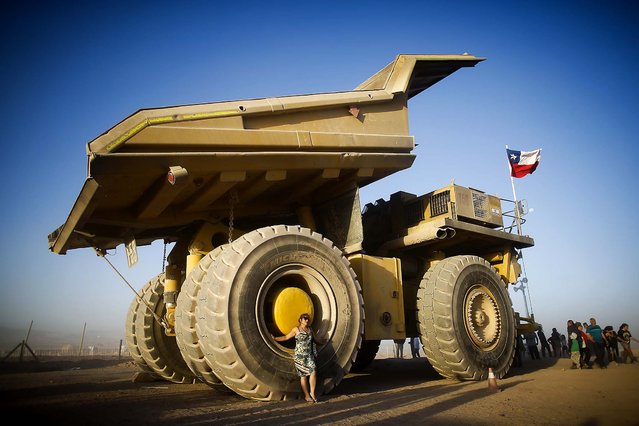
A woman poses next to a giant mining truck at the entrance of the Dakar Rally camp in Calama, Chile. The truck operates in copper mines near the city. (Photo by Victor R. Caivano/Associated Press)

A woman poses next to a giant mining truck at the entrance of the Dakar Rally camp in Calama, Chile. The truck operates in copper mines near the city. (Photo by Victor R. Caivano/Associated Press)
Details
19 Jan 2014 05:28:00
Military policemen take part in an operation at Cidade de Deus favela in Rio de Janeiro, Brazil, on February 01, 2018. (Photo by Mauro Pimentel/AFP Photo)

Military policemen take part in an operation at Cidade de Deus favela in Rio de Janeiro, Brazil, on February 01, 2018. (Photo by Mauro Pimentel/AFP Photo)
Details
02 Feb 2018 08:16:00