Loading...
Done
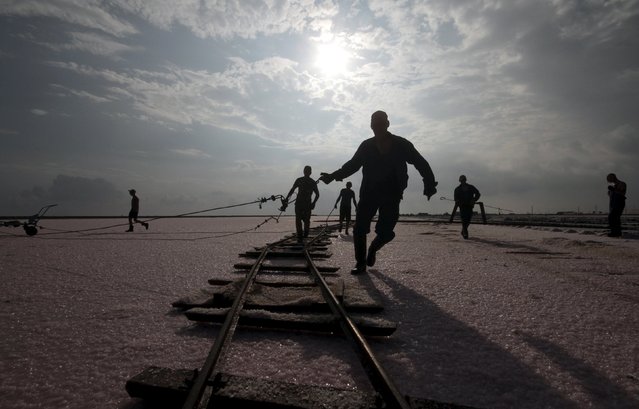
Workers adjust rails at the bed of a drained area of a lake used for the production of salt at the Sasyk-Sivash lake near the city of Yevpatoria, Crimea, September 25, 2015. The area has a long tradition of salt production, prepared from salt flats flooded with water from the Black Sea. (Photo by Pavel Rebrov/Reuters)

Workers adjust rails at the bed of a drained area of a lake used for the production of salt at the Sasyk-Sivash lake near the city of Yevpatoria, Crimea, September 25, 2015. The area has a long tradition of salt production, prepared from salt flats flooded with water from the Black Sea. (Photo by Pavel Rebrov/Reuters)
Details
28 Sep 2015 08:01:00


“The Crimean War (October 1853 – February 1856) was a conflict fought between the Russian Empire and an alliance of the French Empire, the British Empire, the Ottoman Empire, and the Kingdom of Sardinia. The war was part of a long-running contest between the major European powers for influence over territories of the declining Ottoman Empire. Most of the conflict took place on the Crimean Peninsula, but there were smaller campaigns in western Anatolia, Caucasus, the Baltic Sea, the Pacific Ocean and the White Sea”. – Wikipedia

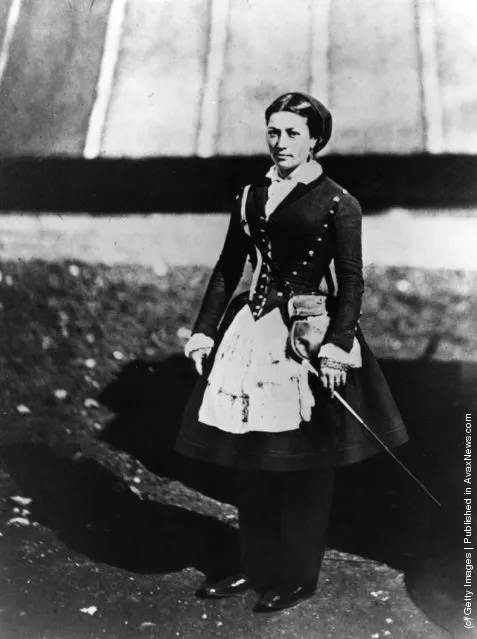
Photo: A vivandiere, a female soldier selling provisions and spirits, with the Allied forces during the Crimean War. (Photo by Hulton Archive/Getty Images)
Details
18 Jul 2011 11:57:00
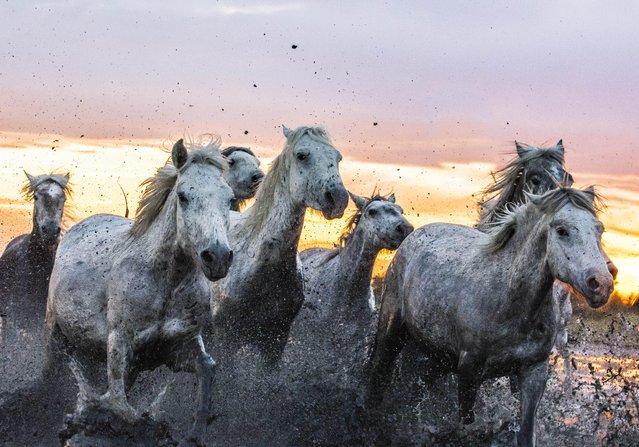
White horses of the Camargue thunder through the shallow salt flats at sunset on December 8, 2022. Known as Horses of the Sea, the breed native to the wetlands in southern France is one of the oldest in the world. (Photo by Nathalie Mountain/Media Drum Images)

White horses of the Camargue thunder through the shallow salt flats at sunset on December 8, 2022. Known as Horses of the Sea, the breed native to the wetlands in southern France is one of the oldest in the world. (Photo by Nathalie Mountain/Media Drum Images)
Details
18 Dec 2022 06:27:00
A U.S. Navy F18 fighter jet takes off from aircraft carrier USS Carl Vinson during a FONOPS (Freedom of Navigation Operation Patrol) in South China Sea, March 3, 2017. (Photo by Erik De Castro/Reuters)

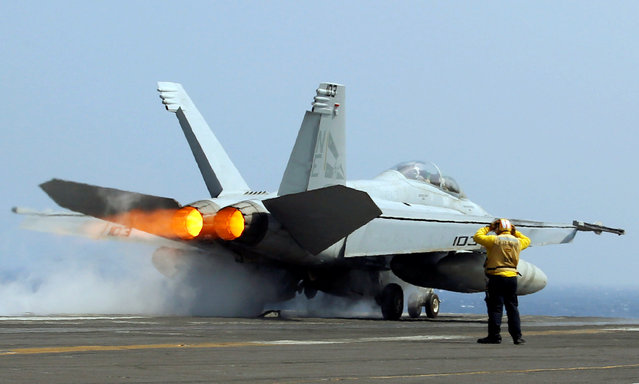
A U.S. Navy F18 fighter jet takes off from aircraft carrier USS Carl Vinson during a FONOPS (Freedom of Navigation Operation Patrol) in South China Sea, March 3, 2017. The U.S. military took journalists Friday to the carrier on routine patrol off the disputed South China Sea, sending a signal to China and American allies of its resolve to ensure freedom of navigation and overflight in one of the world's security hotspots. (Photo by Erik De Castro/Reuters)
Details
06 Mar 2017 00:01:00
Up to 35% of Mongolians still live a nomadic life, depending on their land to survive. But environmental changes, particularly desertification, means this way of life is under threat. Korean photographer Daesung Lee’s Futuristic Archaeology images show billboard-size backdrops of lush steppe contrasting with actual scenery as former nomads enact scenes of hunting, herding and Mongolian wrestling. (Photo by Daesung Lee)

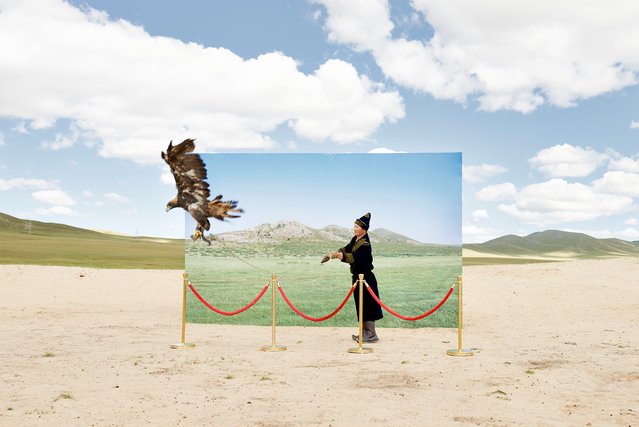
Up to 35% of Mongolians still live a nomadic life, depending on their land to survive. But environmental changes, particularly desertification, means this way of life is under threat. Korean photographer Daesung Lee’s Futuristic Archaeology images show billboard-size backdrops of lush steppe contrasting with actual scenery as former nomads enact scenes of hunting, herding and Mongolian wrestling. (Photo by Daesung Lee)
Details
24 Nov 2016 08:01:00
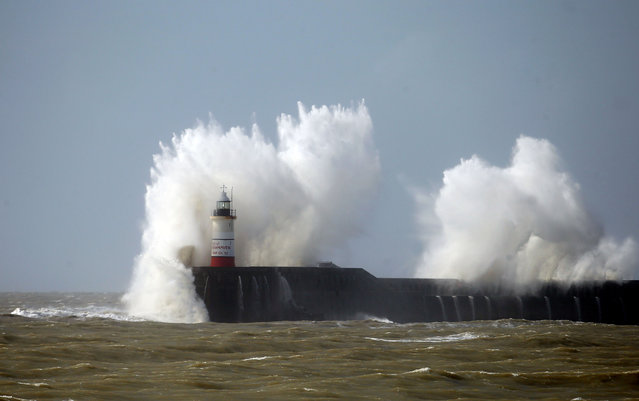
Waves crash against the lighthouse at Newhaven, England, Monday March 28, 2016. Some flights at London's Gatwick and Heathrow airports have been diverted due to high winds battering much of Britain and western France. The high winds from a storm caused 87 cancellations and 43 diversions at Gatwick and Heathrow because flights had trouble landing safely. (Photo by Steve Parsons/PA Wire via AP Photo)

Waves crash against the lighthouse at Newhaven, England, Monday March 28, 2016. Some flights at London's Gatwick and Heathrow airports have been diverted due to high winds battering much of Britain and western France. The high winds from a storm caused 87 cancellations and 43 diversions at Gatwick and Heathrow because flights had trouble landing safely. (Photo by Steve Parsons/PA Wire via AP Photo)
Details
30 Mar 2016 11:24:00
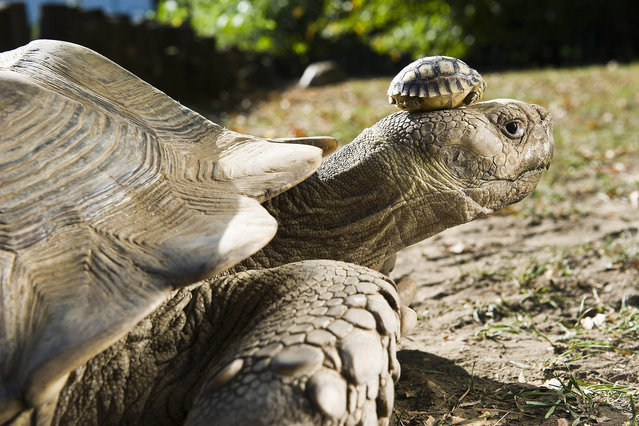
A four-day old African spurred tortoise, Geochelone sulcata, one of eight babies, was place on the head of its mother in their enclosure in Nyiregyhaza Animal Park in Nyiregyhaza, 226 km east of Budapest, Hungary, 27 September 2011. This was the first time that offspring of an African spurred tortoise were born in this zoo. The eight babies hatched after 115 days, they are 5.5 cms long and weigh 25 grams. Spurred tortoise is the largest species of land tortoises in Africa, the weight of an adult animal may reach 80 kgs. (Photo by Attila Balazs/EPA)

A four-day old African spurred tortoise, Geochelone sulcata, one of eight babies, was place on the head of its mother in their enclosure in Nyiregyhaza Animal Park in Nyiregyhaza, 226 km east of Budapest, Hungary, 27 September 2011. This was the first time that offspring of an African spurred tortoise were born in this zoo. The eight babies hatched after 115 days, they are 5.5 cms long and weigh 25 grams. Spurred tortoise is the largest species of land tortoises in Africa, the weight of an adult animal may reach 80 kgs. (Photo by Attila Balazs/EPA)
Details
07 May 2016 12:58:00
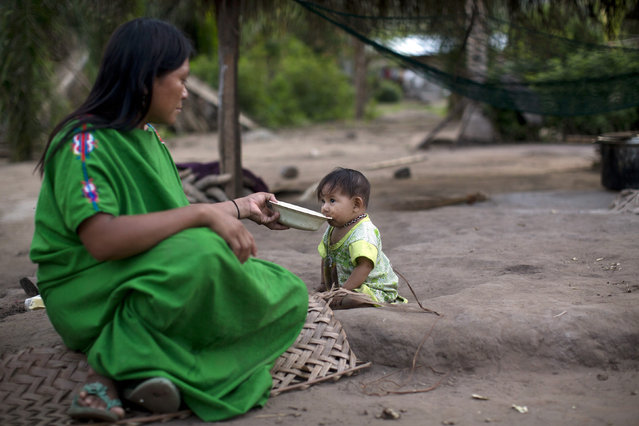
In this November 19, 2015 photo, Ester Melendez feeds banana porridge to her nine-month-old daughter Dina, in Pichiquia, an Ashaninka indigenous community in Peru's Junin region. Incursions and assaults by loggers, miners, colonists and leftist guerrillas have reduced the lands of the Ashaninka people in the Peruvian Amazon, leaving many of the 97,000 members of the group malnourished, despite efforts by the government and independent organizations to help. (Photo by Rodrigo Abd/AP Photo)

In this November 19, 2015 photo, Ester Melendez feeds banana porridge to her nine-month-old daughter Dina, in Pichiquia, an Ashaninka indigenous community in Peru's Junin region. Incursions and assaults by loggers, miners, colonists and leftist guerrillas have reduced the lands of the Ashaninka people in the Peruvian Amazon, leaving many of the 97,000 members of the group malnourished, despite efforts by the government and independent organizations to help. (Photo by Rodrigo Abd/AP Photo)
Details
10 Dec 2015 08:00:00