Loading...
Done
One of two black-and-white ruffed lemur pups born at Blair Drummond Safari and Adventure Park, near Stirling, UK on Friday, May 24, 2024.The critically endangered lemur pups, both female were born on April 14 and have been named Nova, meaning “new” and Evie meaning “life”. (Photo by Andrew Milligan/PA Images via Getty Images)

One of two black-and-white ruffed lemur pups born at Blair Drummond Safari and Adventure Park, near Stirling, UK on Friday, May 24, 2024.The critically endangered lemur pups, both female were born on April 14 and have been named Nova, meaning “new” and Evie meaning “life”. (Photo by Andrew Milligan/PA Images via Getty Images)
Details
04 Oct 2025 04:29:00
Two rare Peninsular pronghorns

“The Baja California Pronghorn or Peninsular Pronghorn (Antilocapra americana peninsularis) is a critically endangered pronghorn, endemic to Mexico. The wild population is estimated at 200”. – Wikipedia

Photo: Two rare Peninsular pronghorns, male twins was born at the Los Angeles Zoo on April 24, 2009 in Los Angeles, California. Only 250 antelope-like Peninsular pronghorns are believed to exist in the wild. (Photo by David McNew/Getty Images)
Details
07 Nov 2011 11:18:00
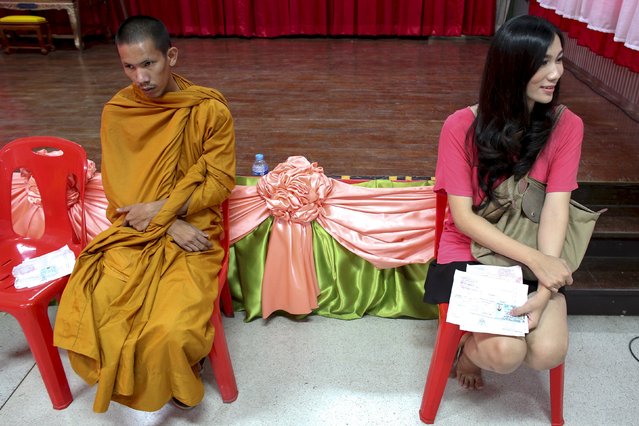
Nopparat (R), a 24-year-old transgender, and a Buddhist monk (L) wait to speak to officers during an army draft held at a school in Bang Na in Bangkok April 3, 2015. Thai men over 21 must serve in the army. Those who volunteer serve six months, but others choose the annual lottery, which goes on for 10 days in recruitment centres around Thailand. Only those not considered physically capable of service, the mentally ill and those who have significantly altered their physical appearance, such as transgenders, are exempt. Picture taken April 3, 2015. (Photo by Athit Perawongmetha/Reuters)

Nopparat (R), a 24-year-old transgender, and a Buddhist monk (L) wait to speak to officers during an army draft held at a school in Bang Na in Bangkok April 3, 2015. Thai men over 21 must serve in the army. Those who volunteer serve six months, but others choose the annual lottery, which goes on for 10 days in recruitment centres around Thailand. Only those not considered physically capable of service, the mentally ill and those who have significantly altered their physical appearance, such as transgenders, are exempt. Picture taken April 3, 2015. (Photo by Athit Perawongmetha/Reuters)
Details
06 Apr 2015 09:54:00
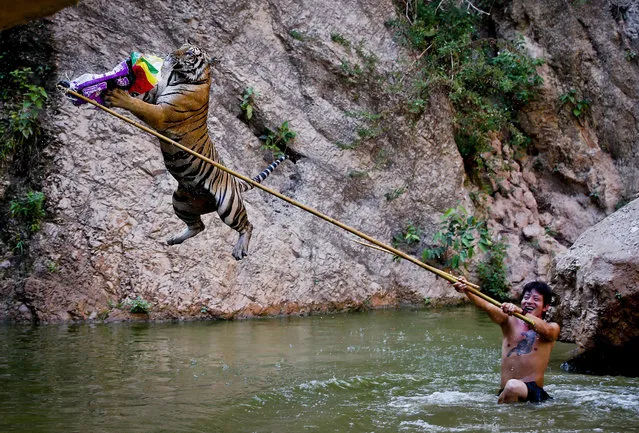
A picture made available 26 April 2016 shows a tiger playing in the water with a trainer nicknamed “Super Tiger Man” at the Tiger Temple in Kanchanaburi province, Thailand, 24 April 2016. The site known in Thai as “Wat Pa Luangta Maha Bua Yannasampanno” has been the focus of a dispute with the Department of National Parks, Wildlife and Plant Conservation (DNP) after the DNP asked in 2015 that the temple hands over its 147 tigers since it was not licensed to keep them. The temple has requested for a zoo license according to its managing director. (Photo by Diego Azubel/EPA)

A picture made available 26 April 2016 shows a tiger playing in the water with a trainer nicknamed “Super Tiger Man” at the Tiger Temple in Kanchanaburi province, Thailand, 24 April 2016. The site known in Thai as “Wat Pa Luangta Maha Bua Yannasampanno” has been the focus of a dispute with the Department of National Parks, Wildlife and Plant Conservation (DNP) after the DNP asked in 2015 that the temple hands over its 147 tigers since it was not licensed to keep them. The temple has requested for a zoo license according to its managing director. (Photo by Diego Azubel/EPA)
Details
01 Jun 2016 12:44:00
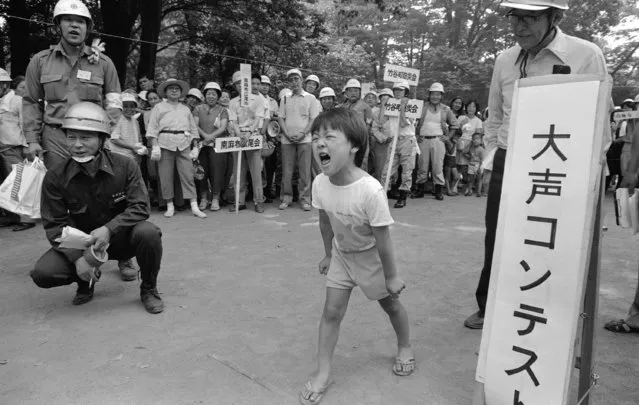
A little boy shouts “Earthquake!” during a shouting contest, part of the annual evacuation drill on the National Disaster Prevention Day on September 1, 1986. The contest was aimed at teaching youngsters the importance of telling neighbors quickly and loudly of a disaster when it hits. The drill is annually conducted through out the country on the day marking the anniversary of the Great Kanto Earthquake that hit the Japanese capital and its vicinity on September 1, 1923, killing more than 104,000 people. (Photo by Sadayuki Mikami/AP Photo)

A little boy shouts “Earthquake!” during a shouting contest, part of the annual evacuation drill on the National Disaster Prevention Day on September 1, 1986. The contest was aimed at teaching youngsters the importance of telling neighbors quickly and loudly of a disaster when it hits. The drill is annually conducted through out the country on the day marking the anniversary of the Great Kanto Earthquake that hit the Japanese capital and its vicinity on September 1, 1923, killing more than 104,000 people. (Photo by Sadayuki Mikami/AP Photo)
Details
02 Sep 2015 11:58:00
Revellers celebrate during the “Bloco da Lama”, a mud carnival, in Paraty, Brazil, on February 10, 2018. (Photo by Mauro Pimentel/AFP Photo)

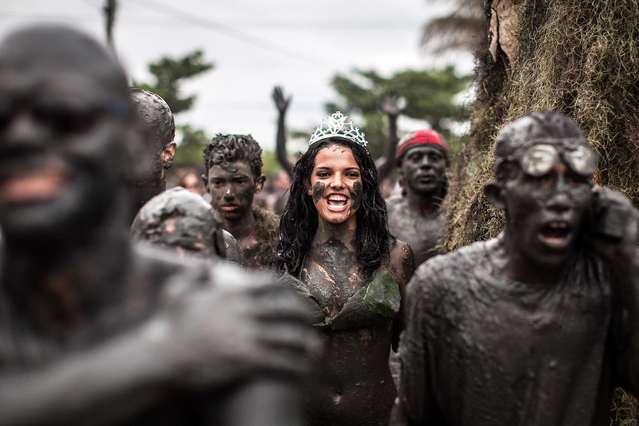
Revellers celebrate during the “Bloco da Lama”, a mud carnival, in Paraty, Brazil, on February 10, 2018. “Bloco da Lama” started in 1986 by teenagers playing with mud and became a traditional event at the historical city of Paraty. (Photo by Mauro Pimentel/AFP Photo)
Details
13 Feb 2018 05:58:00
Nikolay Skidan, a hunter, carries the skin of a wolf in the village of Khrapkovo, Belarus February 1, 2017. (Photo by Vasily Fedosenko/Reuters)

Nikolay Skidan, a hunter, carries the skin of a wolf in the village of Khrapkovo, Belarus February 1, 2017. Wolf fur grows thickest in winter, so Belarussian hunter Vladimir Krivenchik only sets his traps once snow is on the ground. He and his wife live on the edge of the Chernobyl exclusion zone – 2,600 square km of land on the Belarus-Ukraine border that was contaminated by a nuclear disaster in 1986. (Photo by Vasily Fedosenko/Reuters)
Details
16 Feb 2017 00:04:00
Revelers participate in the traditional Bloco da Lama (Mud block) carnival in Parati, Rio de Janeiro State, Brazil, on February 9, 2013. The event, which was begun by two men in a playful manner in 1986, has now become a traditional carnival in which participants disguised as primitives with rags, lianas or skulls and bones, dive in the mud. (Photo by Victor Moriyama/AFP Photo)

Revelers participate in the traditional Bloco da Lama (Mud block) carnival in Parati, Rio de Janeiro State, Brazil, on February 9, 2013. The event, which was begun by two men in a playful manner in 1986, has now become a traditional carnival in which participants disguised as primitives with rags, lianas or skulls and bones, dive in the mud. (Photo by Victor Moriyama/AFP Photo)
Details
12 Feb 2013 14:10:00