Loading...
Done
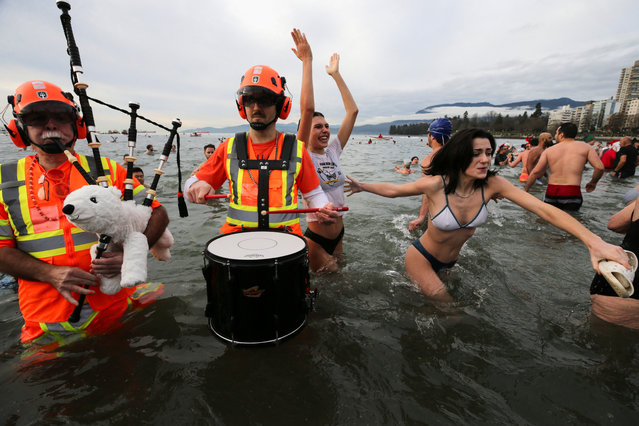
Musicians play as bathers run into the chilly waters of English Bay while celebrating New Year's Day with the Polar Bear Swim in Vancouver, British Columbia, Canada on January 1, 2024. (Photo by Chris Helgren/Reuters)

Musicians play as bathers run into the chilly waters of English Bay while celebrating New Year's Day with the Polar Bear Swim in Vancouver, British Columbia, Canada on January 1, 2024. (Photo by Chris Helgren/Reuters)
Details
19 Apr 2025 00:18:00
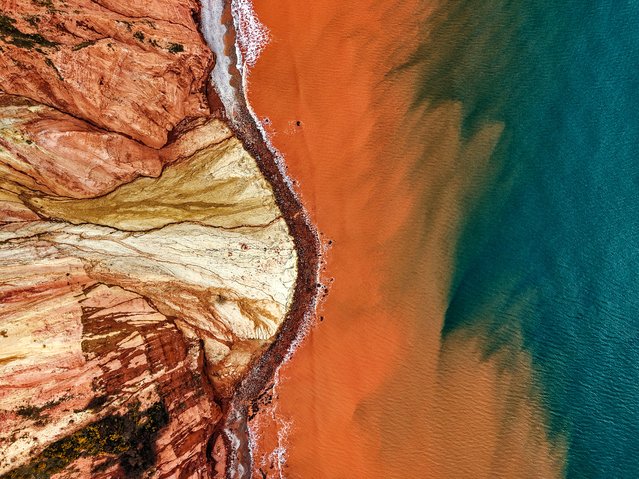
The clear blue water off Sidmouth in Devon, UK in March 2025 turned an orangey-red hue as tonnes of 200 million-year-old sandstone was mixed in by the tide. The 500ft cliff suffered a massive fall in October last year, and took a large section of Otter sandstone and Mercia mudstone with it. (Phoot by Dean Penn/RedZepplin/Bournemouth News)

The clear blue water off Sidmouth in Devon, UK in March 2025 turned an orangey-red hue as tonnes of 200 million-year-old sandstone was mixed in by the tide. The 500ft cliff suffered a massive fall in October last year, and took a large section of Otter sandstone and Mercia mudstone with it. (Phoot by Dean Penn/RedZepplin/Bournemouth News)
Details
29 Apr 2025 02:30:00
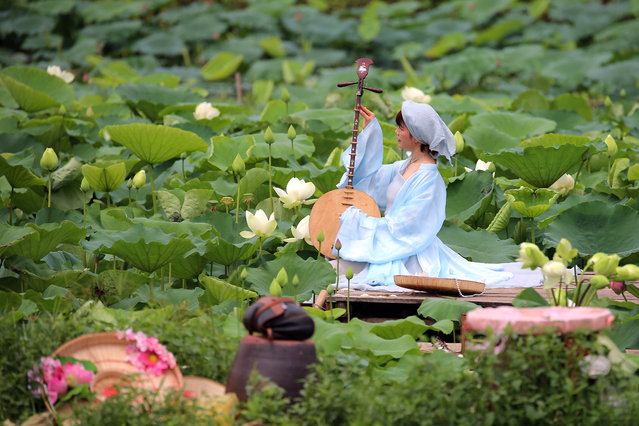
A woman poses for a photo next to lotus flowers in West lake in Hanoi, Vietnam, 09 June 2025.. Lotus flowers bloom from late May to August in Vietnam and are commonly found growing in the muddy waters of lakes and ponds across the country. (Photo by Luong Thai Linh/EPA)

A woman poses for a photo next to lotus flowers in West lake in Hanoi, Vietnam, 09 June 2025.. Lotus flowers bloom from late May to August in Vietnam and are commonly found growing in the muddy waters of lakes and ponds across the country. (Photo by Luong Thai Linh/EPA)
Details
16 Aug 2025 03:28:00
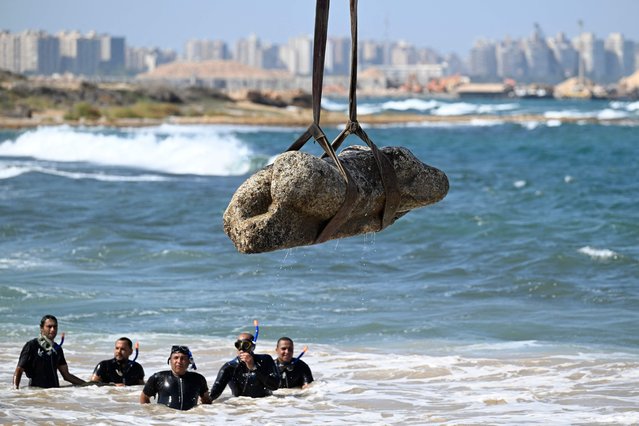
Divers watch as a crane pulls a piece of stone from the waters at Abu Qir bay in Alexandria on August 21, 2025, as part of an event organized by the Ministry of Tourism and Antiquities to recover sunken antiquities. (Photo by Khaled Desouki/AFP Photo)

Divers watch as a crane pulls a piece of stone from the waters at Abu Qir bay in Alexandria on August 21, 2025, as part of an event organized by the Ministry of Tourism and Antiquities to recover sunken antiquities. (Photo by Khaled Desouki/AFP Photo)
Details
11 Oct 2025 05:22:00
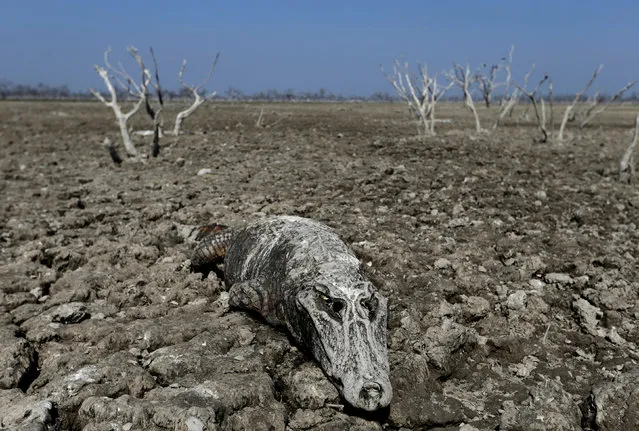
The carcass of a yacare caiman lies in the dried-up river bed of the Pilcomayo river in Boqueron, Paraguay, August 14, 2016. In Paraguay, alongside the Pilcomayo River, black vultures flew over a shrinking pond where a group of crocodilian reptiles known as yacare caimans sought refuge. Water from the river, which divides Paraguay and Argentina in the area of the Gran Chaco, was scarce. This is not an uncommon sight in the region of General Diaz, about 700 kilometres (435 miles) northwest of the country's capital Asuncion, where the Pilcomayo's waters form lakes and streams that give life to capybaras, birds and caimans. “The river's situation is critical. No water is forecast to enter the basin until December, as happens every year”, said Alcides Gonzalez, a resident of the area. (Photo by Jorge Adorno/Reuters)

The carcass of a yacare caiman lies in the dried-up river bed of the Pilcomayo river in Boqueron, Paraguay, August 14, 2016. In Paraguay, alongside the Pilcomayo River, black vultures flew over a shrinking pond where a group of crocodilian reptiles known as yacare caimans sought refuge. Water from the river, which divides Paraguay and Argentina in the area of the Gran Chaco, was scarce. This is not an uncommon sight in the region of General Diaz, about 700 kilometres (435 miles) northwest of the country's capital Asuncion, where the Pilcomayo's waters form lakes and streams that give life to capybaras, birds and caimans. (Photo by Jorge Adorno/Reuters)

Details
03 Nov 2016 12:40:00
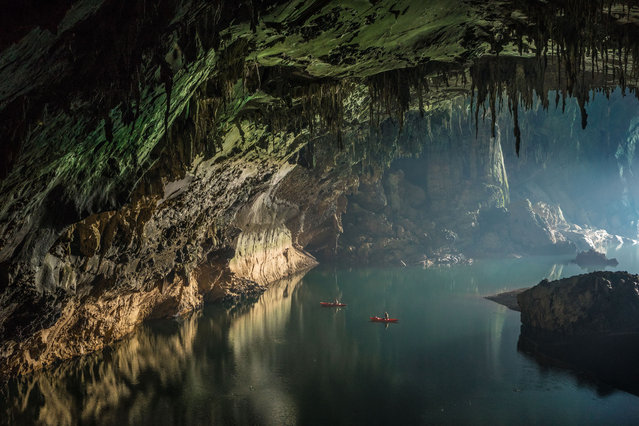
Floating on clear deep water and reflections near the cave entrance. Visitors can either bring their own kayaks or rent boats from the local community to paddle deep inside the cave and marvel at its wonders on March 2015 at Tham Khoun Ex, Laos. Tham Khoun Xe, commonly known as the Xe Bang Fai River Cave, in Laos, has over 15km of passages filled with awe-inspiring views and wide expanses of water. (Photo by John Spies/Barcroft Media/ABACAPress)

Floating on clear deep water and reflections near the cave entrance. Visitors can either bring their own kayaks or rent boats from the local community to paddle deep inside the cave and marvel at its wonders on March 2015 at Tham Khoun Ex, Laos. Tham Khoun Xe, commonly known as the Xe Bang Fai River Cave, in Laos, has over 15km of passages filled with awe-inspiring views and wide expanses of water. Photographer, John Spies, 59, captured scenes from the entrances of the huge underground river passages, intricate cave formations and views from a passage high above the water. The cave is formed by the Xe Bang Fai river, a major tributary of the Mekong and in the dry season can be traversed using inflatable kayaks. (Photo by John Spies/Barcroft Media/ABACAPress)
Details
11 Apr 2015 09:56:00
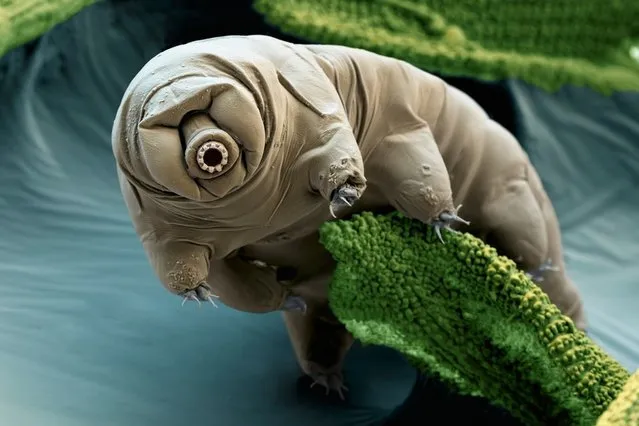
Tardigrades (commonly known as waterbears or moss piglets). (Photo by SPL/East News)

“Tardigrades (commonly known as waterbears or moss piglets) are small, water-dwelling, segmented animals with eight legs. Tardigrades were first discovered in 1773 by Johann August Ephraim Goeze, who called them kleiner Wasserbär, meaning “little water bear” in German. The name Tardigrada means “slow walker” and was given by Lazzaro Spallanzani in 1777. The name water bear comes from the way they walk, reminiscent of a bear's gait. The biggest adults may reach a body length of 1.5 millimetres (0.059 in), the smallest below 0.1 mm. Freshly hatched tardigrades may be smaller than 0.05 mm”. – Wikipedia. Photo: Tardigrades. (Photo by SPL/East News)
Details
26 Sep 2012 09:55:00
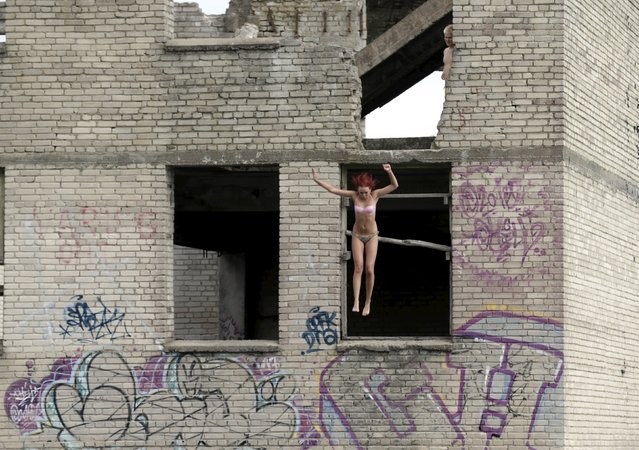
A woman jumps into water from the roof of Murru prison, an abandoned Soviet prison, in Rummu quarry, Estonia, during hot weather July 4, 2015. (Photo by Ints Kalnins/Reuters)

A woman jumps into water from the roof of Murru prison, an abandoned Soviet prison, in Rummu quarry, Estonia, during hot weather July 4, 2015. During the Soviet time, Rummu quarry was used as a mining site for Vasalemma marble and most of the workforce came from among the detainees of Murru prison. When the prison closed after 1991, pumps that once kept the quarry and the prison dry were shut down, causing water to fill the quarry. It has become an unofficial and unguarded swimming and diving spot, attracting locals and tourists. (Photo by Ints Kalnins/Reuters)
Details
05 Jul 2015 09:52:00