Loading...
Done
Aluminum Wire Sculptures By Seung Mo Park

Korean artist Seung Mo Park continues to amaze with his astonishingly crafted figurative sculptures made with tightly wrapped layers of aluminum wire based on fiberglass forms. The works shown here are part of the Brooklyn-based artist’s Human series where he recreates the delicate wrinkles and folds of clothing as well as the sinuous musculature of the human body in metallic layers remeniscent of tree rings. He’s also sculpted bicycles, musical insturments and other forms as part of his Object series.
Details
17 Jan 2014 12:02:00


A North Korean soldier looks through a window at Australian Prime Minister Julia Gillard (L) and her partner Tim Mathieson (C) while they visit the United Nations Command Military Armistice Commission (UNCMAC) meeting room at the border village of Panmunjom, between South and North Korea, on April 24, 2011 South Korea. Gillard will visit Japan, the Republic of Korea and China during a bilateral tour of North Asia from April 20-27. (Photo by Jeon Heon-Kyun-pool/Getty Images)
Details
26 Apr 2011 06:48:00
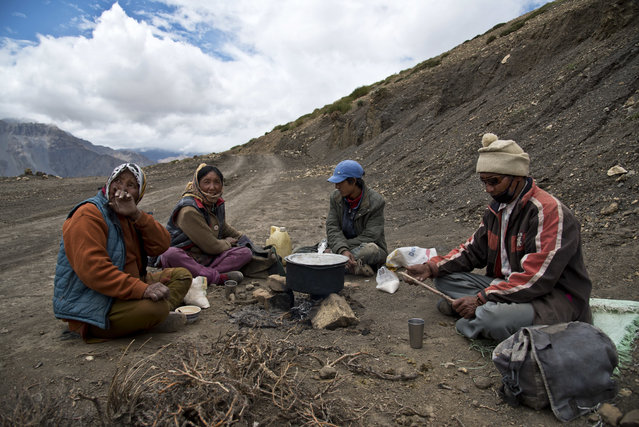
In this August 17, 2016, photo, from left to right, Chhering Chodom, 60, Tashi Yangzom, 50, Lobsang Chhering, 27, and Dorje Tandup, 58, drink milk tea on the side of the road. For centuries, the sleepy valley nestled in the Indian Himalayas remained a hidden Buddhist enclave forbidden to outsiders. Enduring the harsh year-round conditions of the high mountain desert, the people of Spiti Valley lived by a simple communal code – share the Earth's bounty, be hospitable to neighbors, and eschew greed and temptation at all turns. That's all starting to change, for better or worse. Since India began allowing its own citizens as well as outsiders to visit the valley in the early 1990s, tourism and trade have boomed. And the marks of modernization, such as solar panels, asphalt roads and concrete buildings, have begun to appear around some of the villages that dot the remote landscape at altitudes above 4,000 meters (13,000 feet). (Photo by Thomas Cytrynowicz/AP Photo)

In this August 17, 2016, photo, from left to right, Chhering Chodom, 60, Tashi Yangzom, 50, Lobsang Chhering, 27, and Dorje Tandup, 58, drink milk tea on the side of the road. For centuries, the sleepy valley nestled in the Indian Himalayas remained a hidden Buddhist enclave forbidden to outsiders. Enduring the harsh year-round conditions of the high mountain desert, the people of Spiti Valley lived by a simple communal code – share the Earth's bounty, be hospitable to neighbors, and eschew greed and temptation at all turns. That's all starting to change, for better or worse. (Photo by Thomas Cytrynowicz/AP Photo)
Details
15 Sep 2016 09:22:00
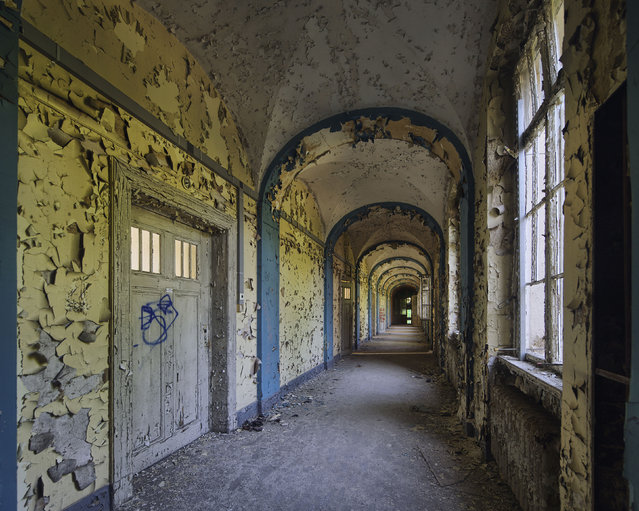
Lung sanatorium. (Photo by Daniel Barter/Caters News)

Even the powerhouse of Europe has its fair share of abandoned properties and empty shop fronts as seen in these pictures of decaying buildings in Germany. Photographer Daniel Barter, 30, from London traveled Berlin and the surrounding countryside to capture buildings in need of work on film. Far from being resplendent in vintage glory, the deserted music venues and crumbling hospitals are a shadow of their former selves. German eagle motifs flake off ceilings and concert halls designed for hundreds have not seen a show for years. Photo: Lung sanatorium. (Photo by Daniel Barter/Caters News)
Details
04 Aug 2014 13:12:00
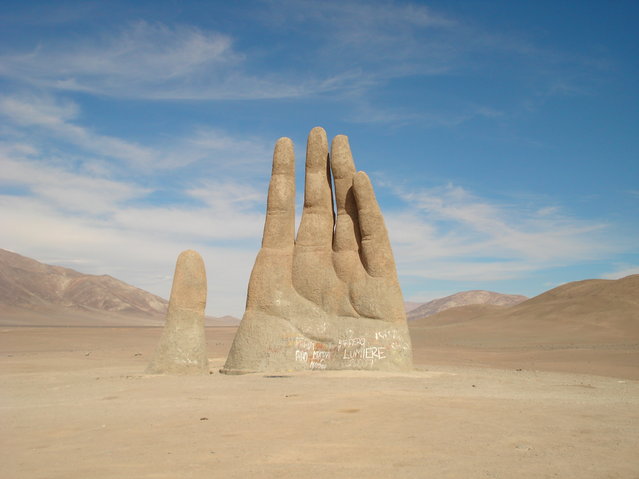
The Giant Hand of Atacama

The Mano de Desierto is a large-scale sculpture of a hand located in the Atacama Desert in Chile, 75 km to the south of the city of Antofagasta, on the Panamerican Highway. The nearest point of reference is the “Ciudad Empresarial La Negra” (La Negra Business City). The sculpture was constructed by the Chilean sculptor Mario Irarrázabal at an altitude of 1,100 meters above sea level. Irarrázabal used the human figure to express emotions like injustice, loneliness, sorrow and torture. Its exaggerated size is said to emphasize human vulnerability and helplessness. The work has a base of iron and cement, and stands 11 metres (36 ft) tall. Funded by Corporación Pro Antofagasta, a local booster organization, the sculpture was inaugurated on March 28, 1992.
Details
21 Dec 2013 10:18:00
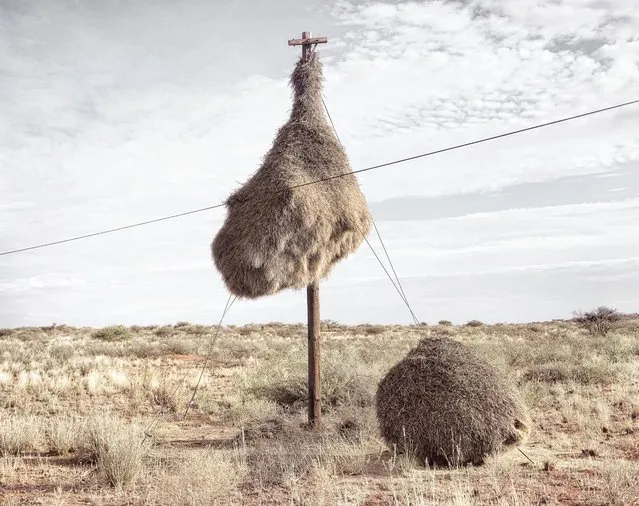
Assimilation By Dillon Marsh

Captured by South African photographer Dillon Marsh, these fantastic photographs depict the many designs employed by sociable weavers to build sturdy nests that are safe from intruders such as cobras and tree snakes. They are also nice cool during the day, and stay warm during cold desert nights. A University of Stellenbosch graduate, Marsh is currently interested in landscape photographer who seeks out anomalies that can be arranged in a photographic series. Assimilation depicts scores of intricate weaver’s nests atop utility poles in Southern Africa. Colonies of sociable weavers have been known to stay attached to one particular nest for up to 100 years, according to The San Diego Zoo.
Details
15 Feb 2014 14:47:00
Key Monastery illuminated on a mountain in the Spiti Valley, Himachal Pradesh, northern India with an amazing nights sky illuminated beyond. (Photo by Grey Chow/Caters News Agency)

The Tibetan night sky was captured in these beautiful images showing the stunning buildings and statues in the Himalayan mountains. Grey Chow, 33, traveled for two hours to get to the Spiti Valley to capture the starry backdrop along the isolated, deserted roads. The senior project engineer was able to take amazingly clear images thanks to the limited amount of pollution at the 4,500-foot (1371m) altitude. (Photo by Grey Chow/Caters News Agency)
Details
06 Aug 2018 00:05:00
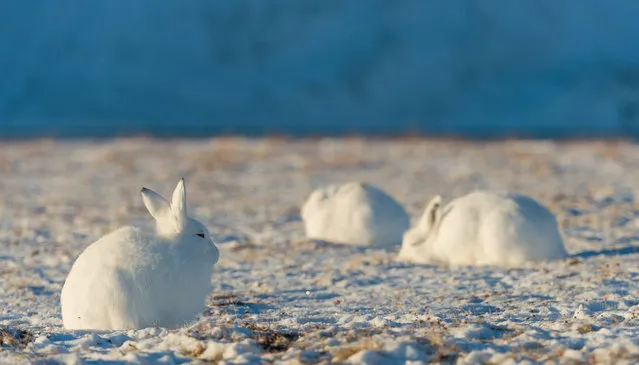
Arctic Hare

The arctic hare, or polar rabbit, is a species of hare which is adapted largely to polar and mountainous habitats. The arctic hare survives with a thick coat of fur and usually digs holes in the ground or under snow to keep warm and sleep. Arctic hares look like rabbits but have shorter ears, are taller when standing, and, unlike rabbits, can thrive in cold climates. They can travel together with many other hares, sometimes huddling with dozens or more, but are usually found alone, taking, in some cases, more than one partner. The arctic hare can run up to 60 kilometres per hour (40 mph). Its predators include the arctic wolf, arctic fox, and ermine.
Details
17 Mar 2014 13:56:00