Loading...
Done


“The Southern Tamandua, Collared Anteater or Lesser Anteater (Tamandua tetradactyla) is a species of anteater from South America. It is a solitary animal, found in many habitats from mature to highly disturbed secondary forests and arid savannas. It feeds on ants, termites and bees. It has very strong foreclaws that can be used to break insect nests or to defend itself”. – Wikipedia

Photo: A three-month-old baby Southern Tamandua “Konbu” lies on its mother Tae's back at Sunshine International Aquarium on July 7, 2009 in Tokyo, Japan. Baby Southern Tamandua feels safe and comfortable holding onto something and normally stays on the mother's back until around 3 months old. (Photo by Junko Kimura/Getty Images)
Details
19 May 2011 10:31:00
A protester clashes with riot police officers during a protest against the Asia-Pacific Economic Cooperation (APEC) Summit 2022, near the Democracy Monument in Bangkok, Thailand on November 18, 2022. (Photo by Tanat Chayaphattharitthee/Reuters)

A protester clashes with riot police officers during a protest against the Asia-Pacific Economic Cooperation (APEC) Summit 2022, near the Democracy Monument in Bangkok, Thailand on November 18, 2022. (Photo by Tanat Chayaphattharitthee/Reuters)
Details
03 Jan 2024 19:52:00
British-American actress Anya Taylor-Joy sticks out her tongue as she poses during a photocall for the film “Furiosa: A Mad Max Saga” at the 77th edition of the Cannes Film Festival in Cannes, southern France, on May 16, 2024. (Photo by Christophe Simon/AFP Photo)

British-American actress Anya Taylor-Joy sticks out her tongue as she poses during a photocall for the film “Furiosa: A Mad Max Saga” at the 77th edition of the Cannes Film Festival in Cannes, southern France, on May 16, 2024. (Photo by Christophe Simon/AFP Photo)
Details
17 Sep 2025 03:25:00
Mahouts return home with their elephants carrying grass to feed them on the eve of the rhino census in Kaziranga National Park in Assam state, India, 24 March 2015. Kaziranga will be closed to visitors for the next two days for a census of the rhinos commencing 25 March, in a previous census in 2013 in the park the population of the Indian rhinos was 2329. (Photo by EPA/Stringer)

Mahouts return home with their elephants carrying grass to feed them on the eve of the rhino census in Kaziranga National Park in Assam state, India, 24 March 2015. Kaziranga will be closed to visitors for the next two days for a census of the rhinos commencing 25 March, in a previous census in 2013 in the park the population of the Indian rhinos was 2329. (Photo by EPA/Stringer)
Details
28 Mar 2015 11:46:00
Children try to push an injured and weak dolphin back into the water after it washed ashore during bad weather and high tide on a beach in Cilacap, Central Java, Indonesia August 12, 2016 in this photo taken by Antara Foto. (Photo by Idhad Zakaria/Reuters/Antara Foto)

Children try to push an injured and weak dolphin back into the water after it washed ashore during bad weather and high tide on a beach in Cilacap, Central Java, Indonesia August 12, 2016 in this photo taken by Antara Foto. (Photo by Idhad Zakaria/Reuters/Antara Foto)
Details
26 Aug 2016 11:13:00


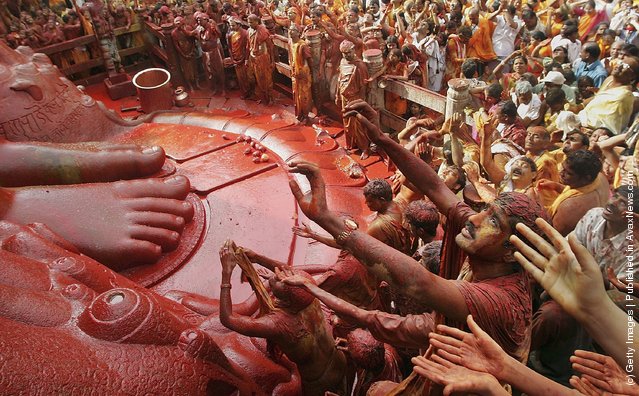
“The Mahamasthakabhisheka (or Mahamasthak Abhishek) is an important Jain festival held once every twelve years in the town of Shravanabelagola in Karnataka state, India. The festival is held in veneration of an immense 18 meter high statue of the Bhagwan (or Saint) Gomateshwara Bahubali. The anointing last took place in February 2006, and the next ceremony will occur in 2018”. – Wikipedia

Photo: A Jain Sadhu (2nd L) and devotees gather and pray at the feet of the monolithic statue of Jain sage Gomateswara during preparations for the Mahamastak Abhisheka ceremony February 7, 2006 in Shravanabelagola, India. The Mahamastak Abhisheka ceremony is held just once every twelve years where the statue will be bathed with milk, yogurt, saffron, gold coins and other religious items. The statue is said to be the world's largest monolith. The ceremony officially runs February 8-19. (Photo by Mario Tama/Getty Images)
Details
21 Jun 2011 12:27:00
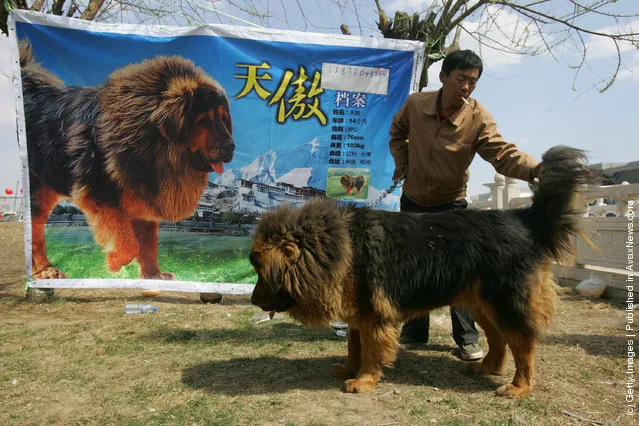
Tibetan Mastiff

“The Tibetan Mastiff also known as Do-khyi (variously translated as “home guard”, “door guard”, “dog which may be tied”, “dog which may be kept”), reflects its use as a guardian of herds, flocks, tents, villages, monasteries, and palaces, much as the old English ban-dog (also meaning tied dog) was a dog tied outside the home as a guardian. However, in nomad camps and in villages, the Do-khyi is traditionally allowed to run loose at night and woe be unto the stranger who walks abroad after dark”. – Wikipedia

Photo: A man displays a Tibetan Mastiff he raised during the Tibetan Mastiff exposition on April 7, 2007 in Langfang of Hebei Province, China. (Photo by China Photos/Getty Images)

Details
05 Oct 2011 14:27:00
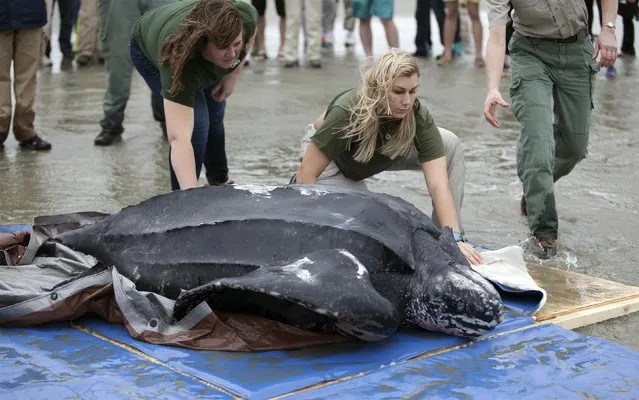
Biologists Jenna Cormany (L) and Lauryn Wright of the South Carolina Department of Natural Resources help to release a leatherback turtle in Isle of Palms, South Carolina March 12, 2015. (Photo by Randall Hill/Reuters)

Biologists Jenna Cormany (L) and Lauryn Wright of the South Carolina Department of Natural Resources help to release a leatherback turtle in Isle of Palms, South Carolina March 12, 2015. The 475-pound turtle was the first living leatherback turtle to be recovered in South Carolina and one of only a handful ever treated at rehabilitation facilities in the United States. It was found March 7 on the beach on Yawkey-South Island Reserve, a 3.5-mile-long (5.6-km-long) barrier island and wildlife preserve near Georgetown, South Carolina. (Photo by Randall Hill/Reuters)
Details
14 Mar 2015 13:32:00