Loading...
Done
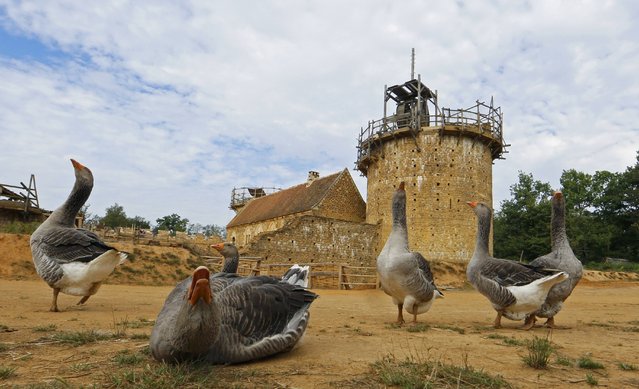
A view of the construction site of the Chateau de Guedelon near Treigny in the Burgundy region of France, September 13, 2016. Blacksmiths, stonemasons and quarry men are hard at work in a Burgundy forest building a 13th-century-style castle using the most basic tools and materials, replicating the methods used hundreds of years ago to better understand them. Forgoing all modern technology, workers use hammers to break stones and forge iron, operate wooden wheels to hoist their materials up to where they are needed, and rely on a quarry for stone, clay and sand as they build up a castle from scratch. Construction on Guedelon Castle in central France began in 1997 after an archaeological survey revealed a medieval fortress hidden inside the walls of nearby Chateau de Saint-Fargeau. Those behind the project hope to answer questions about medieval construction and provide lessons on sustainable building. (Photo by Jacky Naegelen/Reuters)

A view of the construction site of the Chateau de Guedelon near Treigny in the Burgundy region of France, September 13, 2016. Blacksmiths, stonemasons and quarry men are hard at work in a Burgundy forest building a 13th-century-style castle using the most basic tools and materials, replicating the methods used hundreds of years ago to better understand them. (Photo by Jacky Naegelen/Reuters)
Details
15 Sep 2016 09:43:00
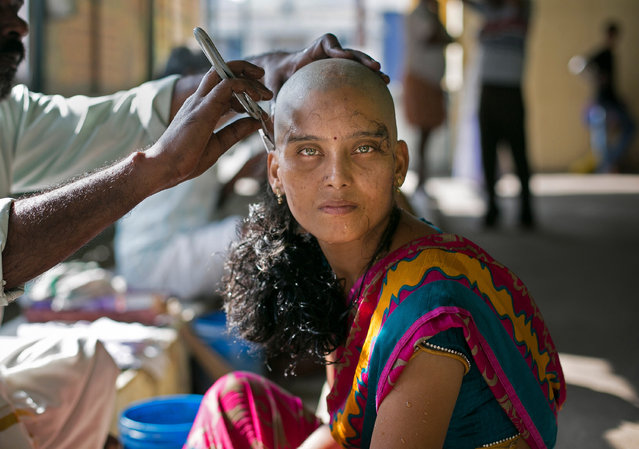
28 year old Rupa has her hair shaven to donate to the Gods at the Thiruthani Murugan Temple November 10, 2016 in Thiruttani, India. Rupa donated her hair with the wish that her daughter's illness is cured. The process of shaving ones hair and donating it to the Gods is known as tonsuring. It is common for Hindu believers to tonsure their hair at a temple as a young child, and also to celebrate a wish coming true, such as the birth of a baby or the curing of an illness. The “temple hair”, as it's known, is then auctioned off to a processing plant and then sold as pricey wigs and weaves in the US, Europe and Africa. (Photo by Allison Joyce/Getty Images)

28 year old Rupa has her hair shaven to donate to the Gods at the Thiruthani Murugan Temple November 10, 2016 in Thiruttani, India. Rupa donated her hair with the wish that her daughter's illness is cured. The process of shaving ones hair and donating it to the Gods is known as tonsuring. It is common for Hindu believers to tonsure their hair at a temple as a young child, and also to celebrate a wish coming true, such as the birth of a baby or the curing of an illness. The “temple hair”, as it's known, is then auctioned off to a processing plant and then sold as pricey wigs and weaves in the US, Europe and Africa. (Photo by Allison Joyce/Getty Images)
Details
21 Nov 2016 10:30:00
A Manipuri woman sells smoked and dry fish in Ima market - the world's largest all women market - in Imphal city, Manipur state, 06 January 2016. The 150-year-old Ima Keithel or 'Mothers's market' complex, which is run exclusively by women and was damaged in the 04 January 2016 earthquake, is returning back to normal. Nine deaths have been reported from in and around Imphal due to falling debris. (Photo by EPA/Stringer)

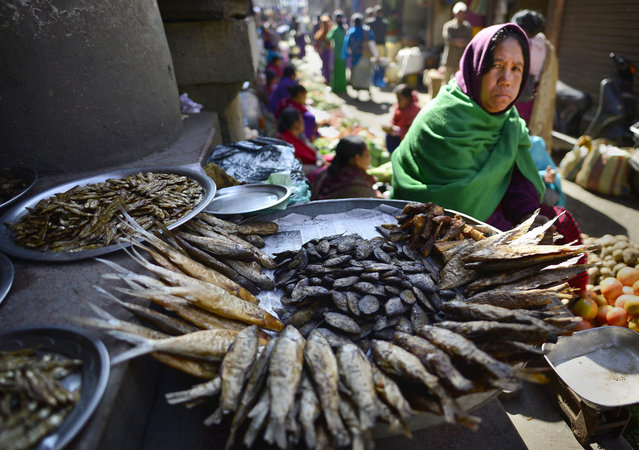
A Manipuri woman sells smoked and dry fish in Ima market - the world's largest all women market – in Imphal city, Manipur state, 06 January 2016. The 150-year-old Ima Keithel or “Mothers's market” complex, which is run exclusively by women and was damaged in the 04 January 2016 earthquake, is returning back to normal. Nine deaths have been reported from in and around Imphal due to falling debris. Imphal has a population of some 270,000 and people were jolted from their sleep and ran out of their homes in panic when the earth shook 04 January, reports say. (Photo by EPA/Stringer)
Details
08 Jan 2016 08:04:00
A child blowing confetti from her hands during a Carnival parade in Cyprus' coastal city of Limassol, Sunday, March 13, 2016. Limassol's long-established parade is Cyprus' biggest and most famous, drawing revelers from across the east Mediterranean island. This year's parade drew huge crowds as people sought lighthearted reprieve from the bailed-out country's recession. The parade marks the start of the 40-day fasting period of Lent in the run-up to the Orthodox Christian Easter. (Photo by Petros Karadjias/AP Photo)

A child blowing confetti from her hands during a Carnival parade in Cyprus' coastal city of Limassol, Sunday, March 13, 2016. Limassol's long-established parade is Cyprus' biggest and most famous, drawing revelers from across the east Mediterranean island. This year's parade drew huge crowds as people sought lighthearted reprieve from the bailed-out country's recession. The parade marks the start of the 40-day fasting period of Lent in the run-up to the Orthodox Christian Easter. (Photo by Petros Karadjias/AP Photo)
Details
14 Mar 2016 10:21:00
People sit near a fully loaded in Madama near the border with Lybia on January 1, 2015. French Defence Minister Jean-Yves Le Drian paid a surprise visit to northern Niger on January 1, to visit a base being built to combat the growing flow of weapons and jihadists from neighbouring Libya. Le Drian travelled from Chad to Madama, a desert outpost about 100 kilometres from Libya, where he saw in the New Year with troops at a French base. (Photo by Dominique Faget/AFP Photo)

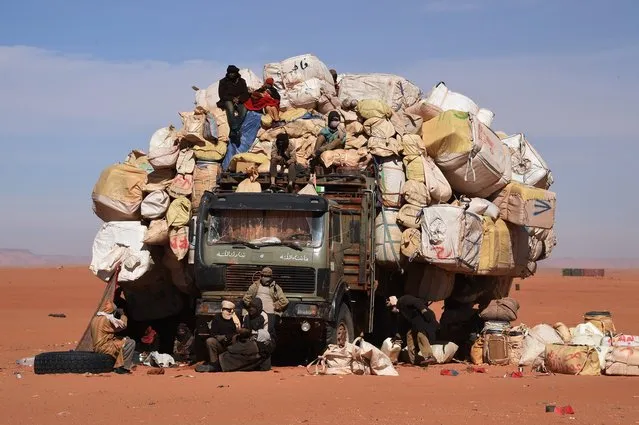
People sit near a fully loaded in Madama near the border with Lybia on January 1, 2015. French Defence Minister Jean-Yves Le Drian paid a surprise visit to northern Niger on January 1, to visit a base being built to combat the growing flow of weapons and jihadists from neighbouring Libya. Le Drian travelled from Chad to Madama, a desert outpost about 100 kilometres from Libya, where he saw in the New Year with troops at a French base. Madama is situated on the route used by jihadists and arms smugglers in southern Libya to reach northern Mali and Niger. (Photo by Dominique Faget/AFP Photo)
Details
03 Jan 2015 13:27:00
A young boy scoops water from a hand-dug well in the dry riverbed near Matinyani, in the semi-arid Kitui County in southeastern Kenya, 22 March 2015, the World Water Day. Residents of Kitui County and other arid and semi-arid areas of the country have been hard-hit by extremely poor rainfall this year while the government said in previous month that some 1.6 million people countrywide are facing acute starvation due to the drought and will need relief food over the next six months. (Photo by Dai Kurokawa/EPA)

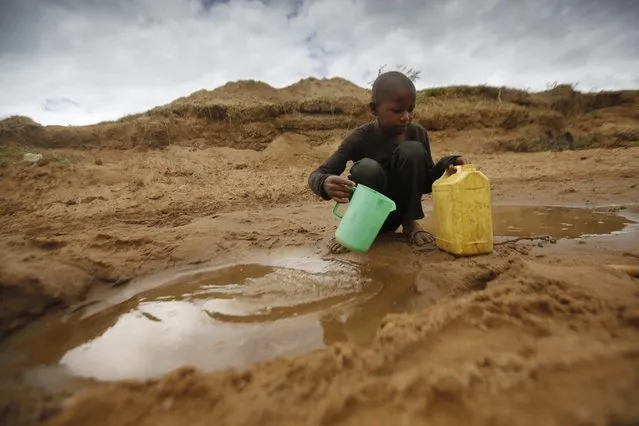
A young boy scoops water from a hand-dug well in the dry riverbed near Matinyani, in the semi-arid Kitui County in southeastern Kenya, 22 March 2015, the World Water Day. Residents of Kitui County and other arid and semi-arid areas of the country have been hard-hit by extremely poor rainfall this year while the government said in previous month that some 1.6 million people countrywide are facing acute starvation due to the drought and will need relief food over the next six months. Residents of Matinyani say they haven't seen a drop of rain in nearly four months. Thousands of Kenyans in rural areas walk tens of kilometers just to fetch water to drink and to be used in their homes. According to an estimate by UNESCO (United Nations Educational, Scientific and Cultural Organization), 17 million people lack access to safe water in Kenya, where the drought is a perennial problem. (Photo by Dai Kurokawa/EPA)
Details
23 Mar 2015 11:01:00
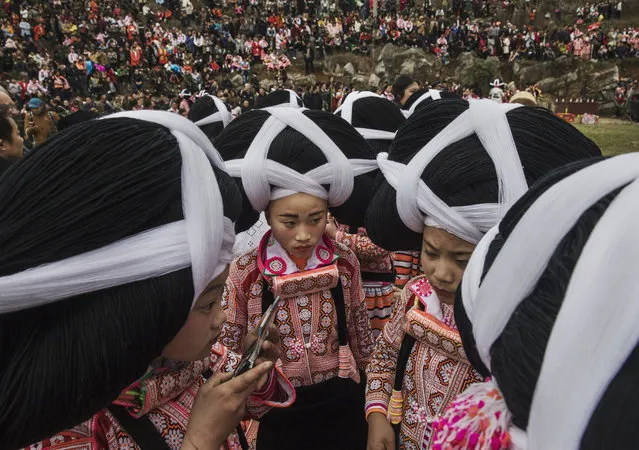
Girls of the Long Horn Miao ethnic minority group wear headdresses as they prepare gather for Tiaohua or Flower Festival as part of the Lunar New Year on February 6, 2017 in Longga village, Guizhou province, southern China. The Long Horn Miao are recognized for their declining practice of wrapping a blend of linen, wool, and the hair of their ancestors around animal horns or a wooden clip to make headdresses. Many young women say they now wear the headdresses only for special occasions and festivals, as the ornaments, which are attached by the horns to their real hair, have proved impractical for modern daily life in a fast changing world. China officially recognizes 56 different ethnic minorities, and statistics show over 7 million Chinese identifying themselves as Miao. But the small Long Horn Miao community counts only around 5000 people living in 12 villages, whose age-old traditions, language, and culture are fading. It is increasingly difficult in a modernizing China, as young people are drawn from remote rural villages to opportunities in bigger cities amongst wide-scale urbanization. Farming and labour remain the mainstays of life for the Long Horn Miao, leaving the area relatively poor in comparison with many parts of China. The government has invested significant amounts into local infrastructure and the tourism industry to try to bolster the local economy. (Photo by Kevin Frayer/Getty Images)

Girls of the Long Horn Miao ethnic minority group wear headdresses as they prepare gather for Tiaohua or Flower Festival as part of the Lunar New Year on February 6, 2017 in Longga village, Guizhou province, southern China. (Photo by Kevin Frayer/Getty Images)
Details
13 Feb 2017 00:01:00
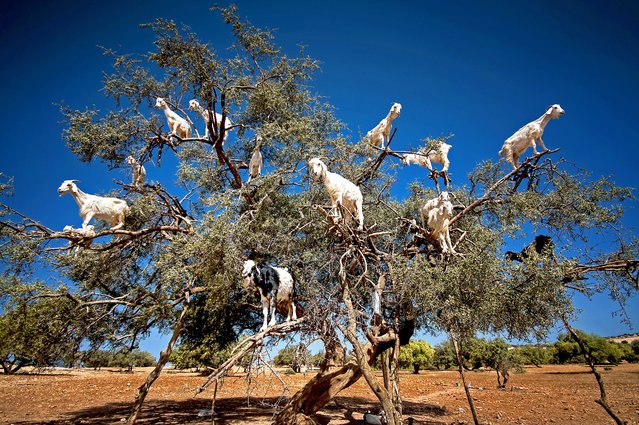
These goats threw caution to the wind and scaled this Argan tree right to the very top, even balancing on the most unsturdy of branches. It looks like a bit of a baa-lancing act, but the goats hooves are perfectly adapted to climbing the trees, where they graze on the Argan fruit. Amateur photographer Burak Senbak, 51, took these photos whilst travelling through Morocco in July 2016. Burak is originally from Turkey and works as a mechanical engineer, but has pursued his passion for photography for 10 years. Intrigued by the sight of goats in a tree, Burak couldnt resist the opportunity to take some photos, and said the goats proved a perfect subject. (Photo by Burak Senbak/Caters News)

These goats threw caution to the wind and scaled this Argan tree right to the very top, even balancing on the most unsturdy of branches. It looks like a bit of a baa-lancing act, but the goats hooves are perfectly adapted to climbing the trees, where they graze on the Argan fruit. Amateur photographer Burak Senbak, 51, took these photos whilst travelling through Morocco in July 2016. Burak is originally from Turkey and works as a mechanical engineer, but has pursued his passion for photography for 10 years. Intrigued by the sight of goats in a tree, Burak couldnt resist the opportunity to take some photos, and said the goats proved a perfect subject. (Photo by Burak Senbak/Caters News)
Details
27 Aug 2017 07:00:00