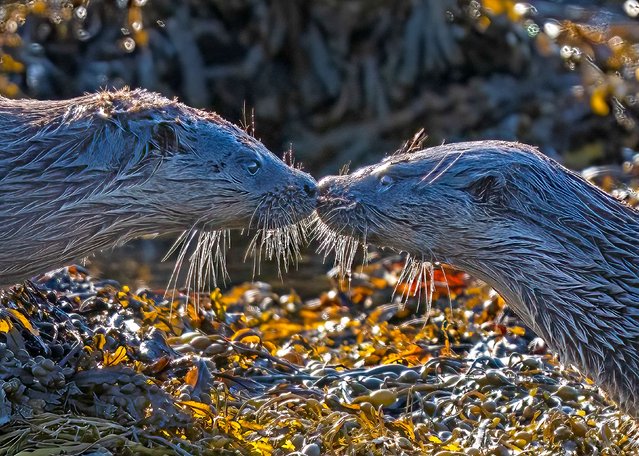
A pair of otters share a soft kiss over seaweed on the Isle of Mull, Scotland in the first decade of October 2025. (Photo by David Akers/Solent News & Photo Agency)
An Oktoberfest visitor swings her dirndl, at the start of Oktoberfest, on Munich's Theresienwiese, in Germany, Saturday, September 20, 2025. (Photo by Karl-Josef Hildenbrand/dpa via AP Photo)
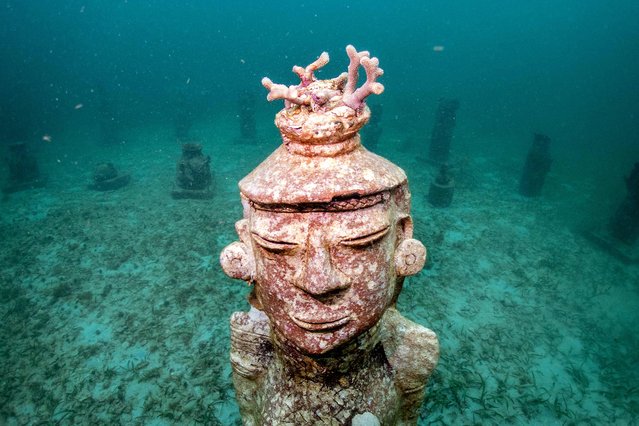
Coral grows in a sculpture at the MUSZIF underwater museum in Isla Fuerte, Bolivar department, Colombia, on May 22, 2024. In the Colombian Caribbean an underwater museum protects coral reefs threatened by tourism and climate change. (Photo by Luis Acosta/AFP Photo)
Switzerland's Zoe Verge-Depre, right, sets up a shot for Esmee Boebner in a beach volleyball match against Canada at the 2024 Summer Olympics, Wednesday, July 31, 2024, in Paris, France. (Photo by Robert F. Bukat/AP Photoy)
Colombia's Tatiana Renteria Renteria (red) wrestles Japan's Yuka Kagami (blue) in their women's freestyle 76kg wrestling semi-final match at the Champ-de-Mars Arena during the Paris 2024 Olympic Games, in Paris on August 10, 2024. (Photo by Punit Paranjpe/AFP Photo)
Getting her tongue pierced was “exciting and scary” says a teen who succumbed to pressure from her best friend in Austin, Texas, February 22, 2008. This image is featured in National Geographic's exhibition “Women of Vision: National Geographic Photographers on Assignment”, on view at the Palm Beach Photographic Centre, Jan. 22 - Mar. 22, 2015. (Photo by Kitra Cahana/National Geographic)
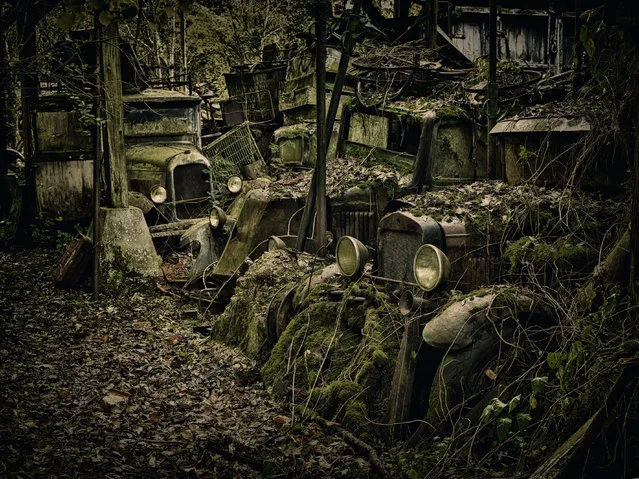
Leaves and forest foliage claim abandoned motors at makeshift car graveyards. German photographer Dieter Klein travels the world to find vintage automobiles left to rust in leafy forests and fields. Here: Seemingly camouflaged cars are stacked on top of each other causing them to blend in with the landscape, in 2013, France. (Photo by Dieter Klein/Barcroft Media)
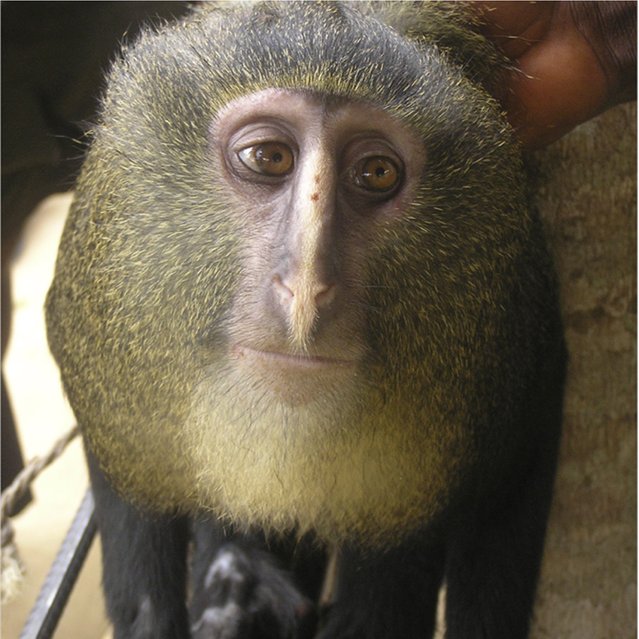
A new species of monkey found in the Democratic Republic of the Congo and identified as Lesula (Cercopithecus lomamiensis) is seen in this undated photograph from an article published September 12, 2012 in the science journal PLOS One. The monkey was first seen in 2007 by researchers John and Terese Hart of the Peabody Museum of Natural History at Yale Research Project. The finding of C. lomamiensis represents only the second new species of African monkey to be discovered in the past 28 years, according to the research article. (Photo by Hart J. A., Detwiler K. M., Gilbert C. C./Reuters)