Loading...
Done
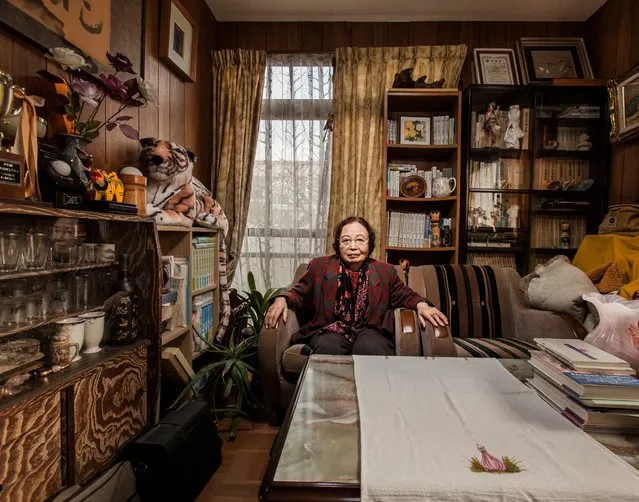
Takeoka Chisaka, Hiroshima, Japan. “One morning in August 1945, I was walking home from the night shift at a factory in Hiroshima. As I reached my door, there was a huge explosion. When I came to, my head was bleeding and I had been blasted 30m away”. (Photo and caption by Sasha Maslov)

Takeoka Chisaka, Hiroshima, Japan. “One morning in August 1945, I was walking home from the night shift at a factory in Hiroshima. As I reached my door, there was a huge explosion. When I came to, my head was bleeding and I had been blasted 30m away. The atomic bomb had detonated. When I found my mother, her eyes were badly burned. A doctor said they had to come out, but he didn’t have the proper tools so used a knife instead. It was hellish. I became a peace-worker after the war. In the 1960s, at a meeting at the UN, I met one of the people who created the atomic bomb. He apologised”. (Photo and caption by Sasha Maslov)
Details
11 May 2015 11:56:00
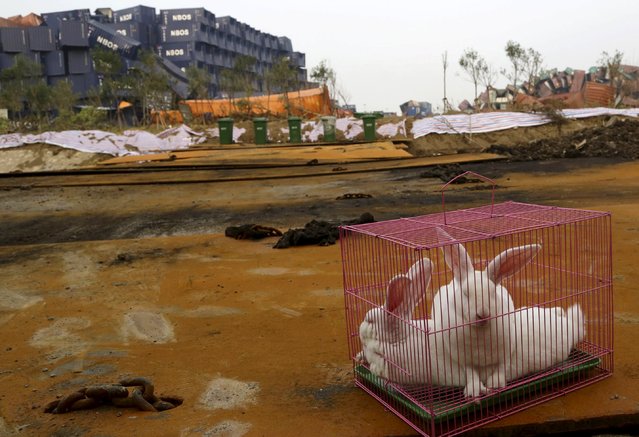
Rabbits are seen in a cage, which is placed by authority as a test of the living conditions near the site of last week's blasts at Binhai new district in Tianjin, China, August 19, 2015. (Photo by Reuters/Stringer)

Rabbits are seen in a cage, which is placed by authority as a test of the living conditions near the site of last week's blasts at Binhai new district in Tianjin, China, August 19, 2015. According to local media, the animals were alive after being placed near the blasts site for two hours. Four new fires have broken out at the site where two huge blasts last week killed 116 people, Chinese state media reported Friday soon after officials said safety hazards were found at almost 70 percent of firms handling dangerous chemicals in Beijing. (Photo by Reuters/Stringer)
Details
22 Aug 2015 12:16:00
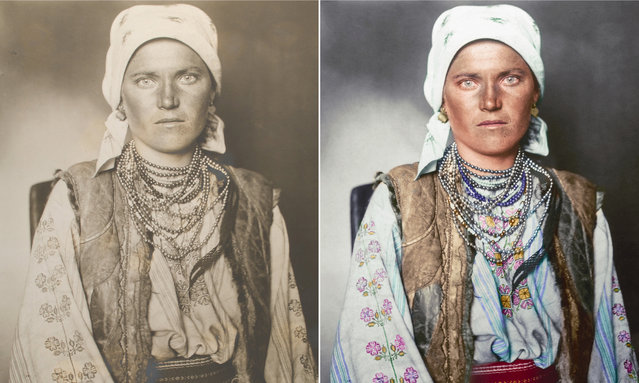
A Ruthenian woman circa 1906 from the region historically inhabiting the kingdom of the Rus, incorporating parts of modern-day Slavic speaking countries. Her outfit consists of a shirt and underskirt made from linen embroidered with traditional floral-based patterns. (Photo by Augustus Francis Sherman/New York Public Library/The Guardian)

Many of the 12 million people who entered the US through New York’s Ellis Island wore traditional dress from their homelands. Here: A Ruthenian woman circa 1906 from the region historically inhabiting the kingdom of the Rus, incorporating parts of modern-day Slavic speaking countries. Her outfit consists of a shirt and underskirt made from linen embroidered with traditional floral-based patterns. (Photo by Augustus Francis Sherman/New York Public Library/The Guardian)
Details
03 Oct 2016 09:15:00
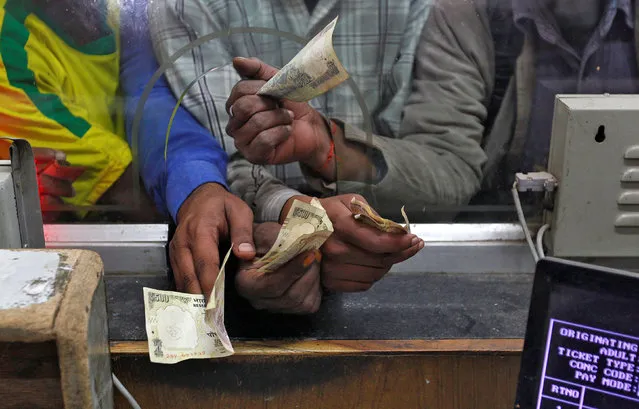
Passengers hold 500 (bottom) rupee banknotes to buy train tickets at a railway booking counter in Allahabad, India, November 9, 2016. (Photo by Jitendra Prakash/Reuters)

Passengers hold 500 (bottom) rupee banknotes to buy train tickets at a railway booking counter in Allahabad, India, November 9, 2016. People are queuing up outside banks across India to exchange 500 and 1,000 rupee notes after they were withdrawn as part of anti-corruption measures. Indians will be able to exchange their old notes, which stopped being legal tender at midnight on Tuesday, for new ones at banks until 30 December. The surprise move is part of a government crackdown on corruption and illegal cash holdings. Banks were shut on Wednesday to allow them enough time to stock new notes. There are also limits on cash withdrawals from ATMs. The BBC's Yogita Limaye in Mumbai says there have been chaotic scenes outside many banks. (Photo by Danish Siddiqui/Reuters)
Details
10 Nov 2016 12:10:00
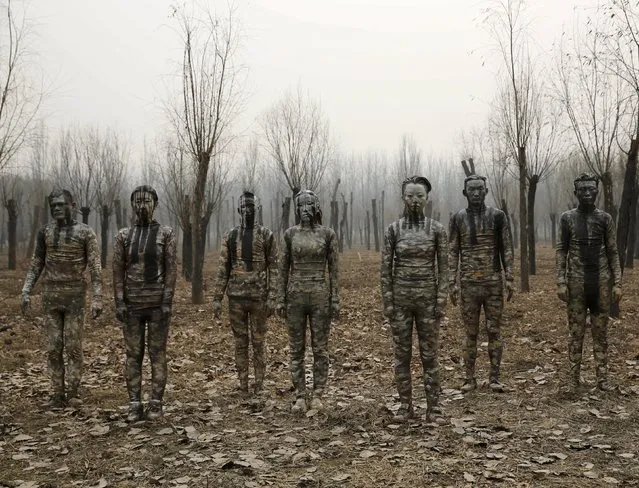
Models painted in camouflage colours to blend in with the background pose for Chinese artist Liu Bolin's artwork “Dongji”, or Winter Solstice, on the second day after China's capital Beijing issued its second ever “red alert” for air pollution, in Beijing, China, December 20, 2015. (Photo by Kim Kyung-Hoon/Reuters)

Models painted in camouflage colours to blend in with the background pose for Chinese artist Liu Bolin's artwork “Dongji”, or Winter Solstice, on the second day after China's capital Beijing issued its second ever “red alert” for air pollution, in Beijing, China, December 20, 2015. In this artwork, Liu wants to express his concerns about China and its people, including air pollution problem, Liu told Reuters. (Photo by Kim Kyung-Hoon/Reuters)
Details
22 Dec 2015 08:01:00
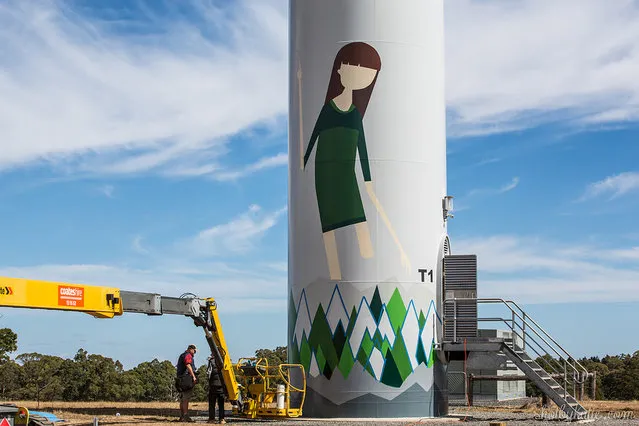
Art By Hepburn Wind

Sleep under the Stars, hosted by Hepburn Wind, has given us an opportunity to enrich our daily life with art. Thanks to this festival, a regular wind turbine was turned into a marvelous peace of art. The artwork is especially noticeable, since its theme greatly contrasts with the background behind the wind turbine. Moreover, the idea of drawing a woman-giantess walking over the mountain tops on a large conical object is quite extraordinary. Nevertheless, the grey and green colors of the picture were very well chosen for this particular image. You can only imagine the obstacles that the artists had to face when making a picture on such a large object. However, nowadays, people never cease to amaze with their ingenuity, leaving us gaping in awe at their creations.
Details
08 Jan 2015 14:41:00
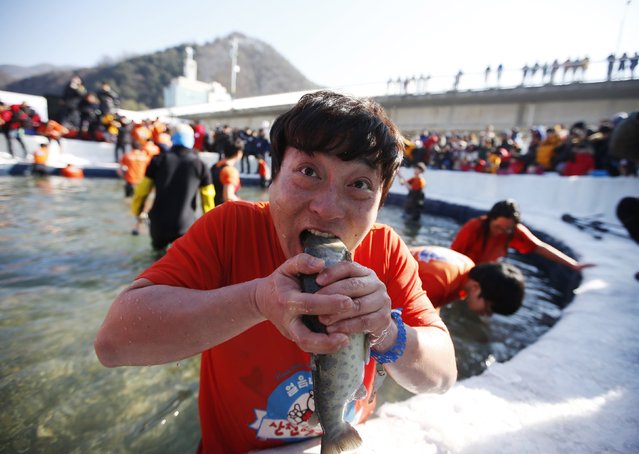
A man reacts after catching a trout with his hands during an event promoting the Ice Festival on a frozen river in Hwacheon, about 20 km (12 miles) south of the demilitarized zone separating the two Koreas, January 10, 2015. (Photo by Kim Hong-Ji/Reuters)

A man reacts after catching a trout with his hands during an event promoting the Ice Festival on a frozen river in Hwacheon, about 20 km (12 miles) south of the demilitarized zone separating the two Koreas, January 10, 2015. The annual ice festival, which is one of the most famous and biggest festivals in South Korea, expects to see more than 1,000,000 people attend. The festival lasts for three weeks from January 10 this year. (Photo by Kim Hong-Ji/Reuters)
Details
11 Jan 2015 13:54:00
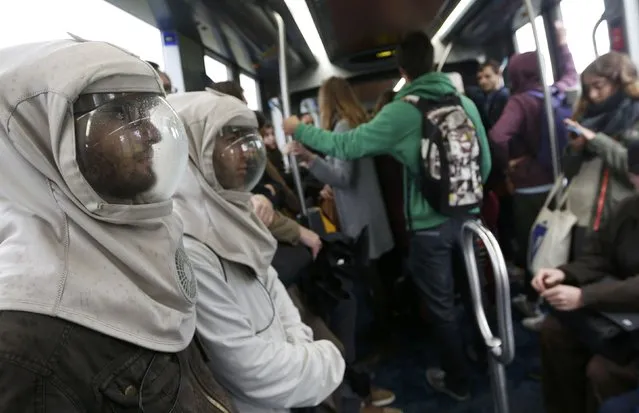
French twins Thomas and Vincent (L) Seris take the tram in Bordeaux, November 12, 2014. Born with Xeroderma Pigmentosum (XP), the twins cannot be exposed to the sun and its ultraviolet (UV) light, which could provoke precocious cancers due to an autosomal recessive genetic disorder of DNA repair. (Photo by Regis Duvignau/Reuters)

French twins Thomas and Vincent (L) Seris take the tram in Bordeaux, November 12, 2014. Born with Xeroderma Pigmentosum (XP), the twins cannot be exposed to the sun and its ultraviolet (UV) light, which could provoke precocious cancers due to an autosomal recessive genetic disorder of DNA repair. Colloquially referred to as Children of the Night (Les Enfants de la Lune) the Seris twins are among 70 to 80 people in France who suffer from the genetic defect. The French association “Les Enfants de la Lune” reports that there are between five and ten thousand such cases in the world. Thomas and Vincent have been testing a new protective mask for the last year which is transparent and ventilated and developed by several hospitals in France. (Photo by Regis Duvignau/Reuters)
Details
01 Feb 2015 10:27:00