Loading...
Done
Tridacna Gigas, or Giant Clams

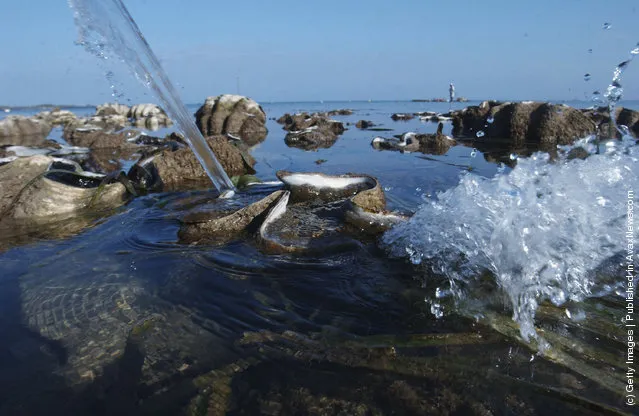
“The giant clam, Tridacna gigas (known as pā’ua in Cook Islands Māori), is the largest living bivalve mollusc. T. gigas is one of the most endangered clam species. It was mentioned as early as 1825 in scientific reports. One of a number of large clam species native to the shallow coral reefs of the South Pacific and Indian oceans, they can weigh more than 200 kilograms (440 lb) measure as much as 120 cm (47 in) across, and have an average lifespan in the wild of 100 years or more”. – Wikipedia

Photo: Tridacna Gigas, or Giant Clams spew water as a traditional fisherman passes by a small sanctuary on January 23, 2004 near Bolinao in the Northern Philippines. The clams, prime builders for coral reefs and providing shelter for spawning fish and other marine life, are exposed by low tides in the sanctuary. Overfishing and pollution throughout the country are not only threatening food security, but are also starting to choke one of the few working clam sanctuaries in the world. (Photo by David Greedy/Getty Images)
Details
01 Oct 2011 13:10:00
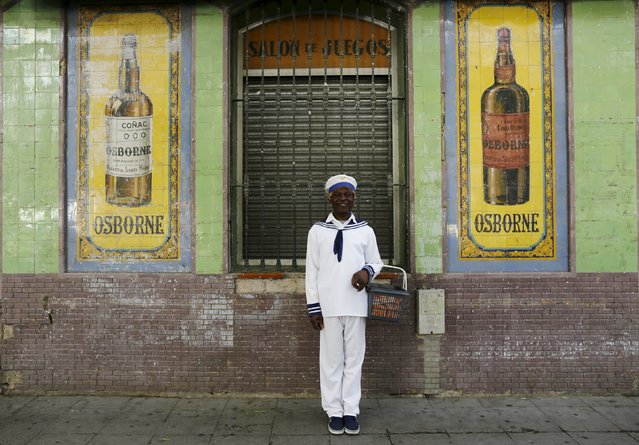
Howard Jackson, a Liberian migrant, poses for a portrait in the Andalusian capital of Seville, southern Spain March 7, 2016. (Photo by Marcelo del Pozo/Reuters)

Howard Jackson, a Liberian migrant, poses for a portrait in the Andalusian capital of Seville, southern Spain March 7, 2016. Jackson escaped civil war and spent three years crossing Africa before reaching Spain. Dressed up in one of his more than 200 costumes, from Peter Pan to Little Red Riding Hood, he is a well-known figure at an intersection entering the Spanish city of Seville where he has sold tissues to motorists for over a decade. Jackson is studying law and wants to become a judge. (Photo by Marcelo del Pozo/Reuters)
Details
24 Mar 2016 12:14:00
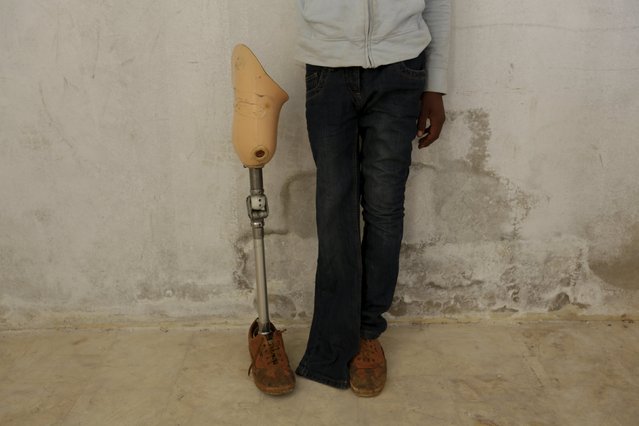
A young man with an amputated leg poses for a photograph standing by his broken artificial limb in the rebel-controlled area of Maaret al-Numan town in Idlib province, Syria March 20, 2016. (Photo by Khalil Ashawi/Reuters)

A young man with an amputated leg poses for a photograph standing by his broken artificial limb in the rebel-controlled area of Maaret al-Numan town in Idlib province, Syria March 20, 2016. Two university students forced to interrupt their studies have learnt to make and fit hundreds of new limbs in the past four years in opposition-held areas of Syria. A mobile clinic operating from a truck has gone some way to improve access to treatment. While most patients are between 15 and 45, the clinic also helps children and the elderly with replacement limbs. (Photo by Khalil Ashawi/Reuters)
Details
16 Apr 2016 12:03:00
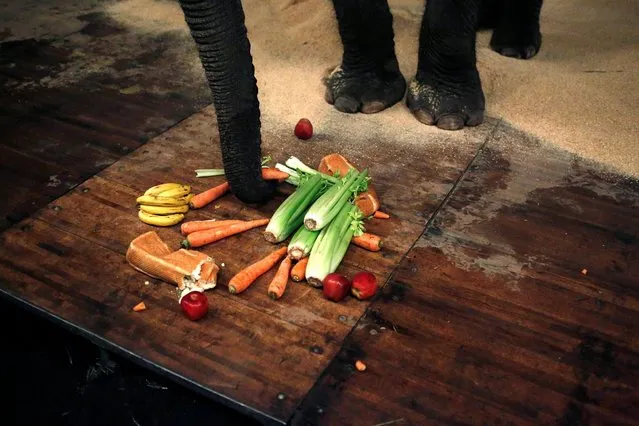
An elephant eats a snack after performing at Ringling Bros and Barnum & Bailey Circus' “Circus Extreme” show at the Mohegan Sun Arena at Casey Plaza in Wilkes-Barre, Pennsylvania, U.S., April 29, 2016. (Photo by Andrew Kelly/Reuters)

An elephant eats a snack after performing at Ringling Bros and Barnum & Bailey Circus' “Circus Extreme” show at the Mohegan Sun Arena at Casey Plaza in Wilkes-Barre, Pennsylvania, U.S., April 29, 2016. Elephants take a final bow at Ringling Bros and Barnum & Bailey Circus on Sunday, ending a 145-year spectacle that delighted fans but enraged animal activists, who say the highly publicized retirement is not enough. (Photo by Andrew Kelly/Reuters)
Details
01 May 2016 11:24:00
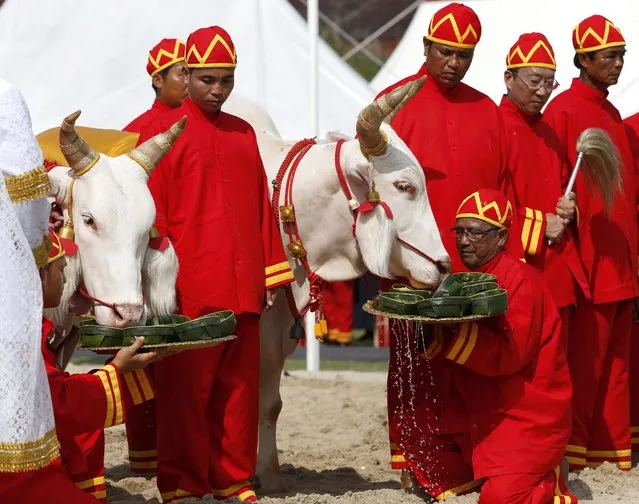
Royal sacred white oxen are offered food to consult the oracles during the Royal Ploughing Ceremony at the Royal Ground, Sanam Luang near the Grand Palace in Bangkok, Thailand, 09 May 2016. The ancient Brahmin rite is of great importance to the country's farmers. Thousands of farmers converge in Bangkok for the annual event, which is believed to assure a successful planting season and an abundance of crops. (Photo by Rungroj Yongrit/EPA)

Royal sacred white oxen are offered food to consult the oracles during the Royal Ploughing Ceremony at the Royal Ground, Sanam Luang near the Grand Palace in Bangkok, Thailand, 09 May 2016. The ancient Brahmin rite is of great importance to the country's farmers. Thousands of farmers converge in Bangkok for the annual event, which is believed to assure a successful planting season and an abundance of crops. This year the sacred oxen ate paddy, sesame seeds, water and liquor which according to traditional soothsayers predicts that the country will have abundant food, sufficient water for agriculture as well as communication and foreign trade will improve leading to the prosperous economy. (Photo by Rungroj Yongrit/EPA)
Details
10 May 2016 13:11:00
A picture of Moon Ji-sung, a high school student who died in the Sewol ferry disaster, hangs in her room in Ansan April 7, 2015. Her dream was to be a flight attendant. (Photo by Kim Hong-Ji/Reuters)

A picture of Moon Ji-sung, a high school student who died in the Sewol ferry disaster, hangs in her room in Ansan April 7, 2015. Her dream was to be a flight attendant. Nearly a year after the Sewol ferry sank on April 16, 2014, with the death of 250 students, some families keep their children’s bedrooms intact to remember and honour their loved ones. More than 300 people, most of them students and teachers from Danwon High School, are dead, or missing and presumed dead, after the Sewol ferry sank on a routine trip from the port of Incheon, near Seoul, to the holiday island of Jeju. (Photo by Kim Hong-Ji/Reuters)
Details
14 Apr 2015 11:18:00
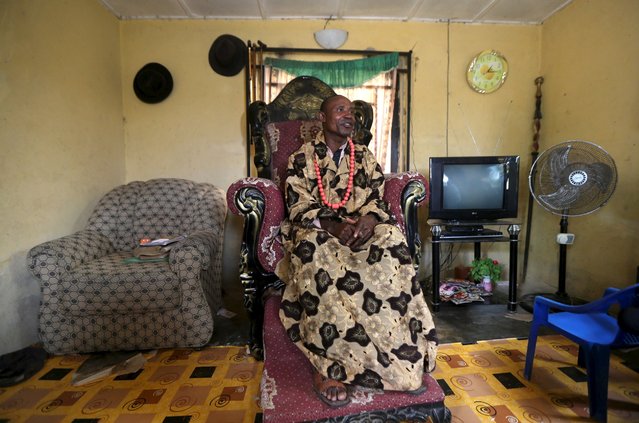
Deputy community chief of Yeneka village Douglas Oguta poses for a portrait in his home on the outskirts of the Bayelsa state capital, Yenagoa, in Nigeria's delta region October 8, 2015. (Photo by Akintunde Akinleye/Reuters)

Deputy community chief of Yeneka village Douglas Oguta poses for a portrait in his home on the outskirts of the Bayelsa state capital, Yenagoa, in Nigeria's delta region October 8, 2015. Tensions are building in the swampland of the Niger Delta as an amnesty that aimed to bring stability to Nigeria's volatile southern region is due to expire at the end of the year. While the region's towns and cities are mostly calm, local residents say kidnappings and armed robberies are on the increase in the mangrove swamps, where most oil wells are located. (Photo by Akintunde Akinleye/Reuters)
Details
17 Oct 2015 08:01:00
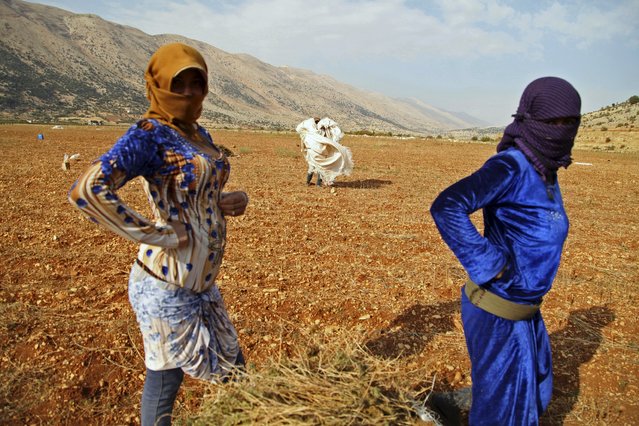
Aisha, 15, (L) (who asked to withhold her last name), a Syrian refugee from Raqqa, waits with a fellow refugee while harvesting cannabis in the Bekaa valley, Lebanon October 19, 2015. Syrian refugees work to harvest and process spiky-leafed cannabis plants in neighbouring Lebanon’s Bekaa Valley. (Photo by Alia Haju/Reuters)

Aisha, 15, (L) (who asked to withhold her last name), a Syrian refugee from Raqqa, waits with a fellow refugee while harvesting cannabis in the Bekaa valley, Lebanon October 19, 2015. Syrian refugees work to harvest and process spiky-leafed cannabis plants in neighbouring Lebanon’s Bekaa Valley. Often farmers of cotton and wheat back home in Raqqa province – now the de facto capital of Islamic State – the conflict in Syria drove them to seek safety in a region where Syrian migrant workers used to spend a few months a year before returning home. (Photo by Alia Haju/Reuters)
Details
24 Dec 2015 08:03:00